✓ Key Takeaways
Before buying a kneeling chair, understand these five essential points:
- ✓ What it helps: May support better spinal alignment by opening hip angle to 110-120 degrees and encouraging natural lumbar curve. Many users report reduced lower back discomfort with consistent use.
- ✓ What it can’t fix: Won’t cure chronic conditions, doesn’t work for everyone, requires 2-3 weeks adaptation, and isn’t meant for all-day use without breaks.
- ✓ The adaptation challenge: 30-40% of new users experience shin discomfort initially. Proper weight distribution (60-70% on seat, 30-40% on shins) is critical.
- ✓ Who should skip it: People with knee injuries, circulation issues in lower legs, those who need frequent standing transitions, or anyone with severe mobility limitations.
- ✓ The success factor: Works best when rotated with other positions—experts recommend using kneeling chairs for 1-2 hour blocks, not 8-hour stretches.
Listen to This Article
Prefer listening? Play this article as audio while you work, commute, or relax. Perfect for multitasking!
📑 Table of Contents
- → What Kneeling Chairs Actually Do (The Simple Version)
- → The Real Pros: Benefits Backed by Research
- → The Honest Cons: Limitations Nobody Mentions
- → Common Mistakes That Make Problems Worse
- → Decision Checklist: Is It Right For You?
- → Who Benefits Most From Kneeling Chairs
- → Who Should Avoid Kneeling Chairs
- → Frequently Asked Questions
- → References
What Kneeling Chairs Actually Do (The Simple Version)
A kneeling chair isn’t really about kneeling. It’s about changing the angle at which you sit.
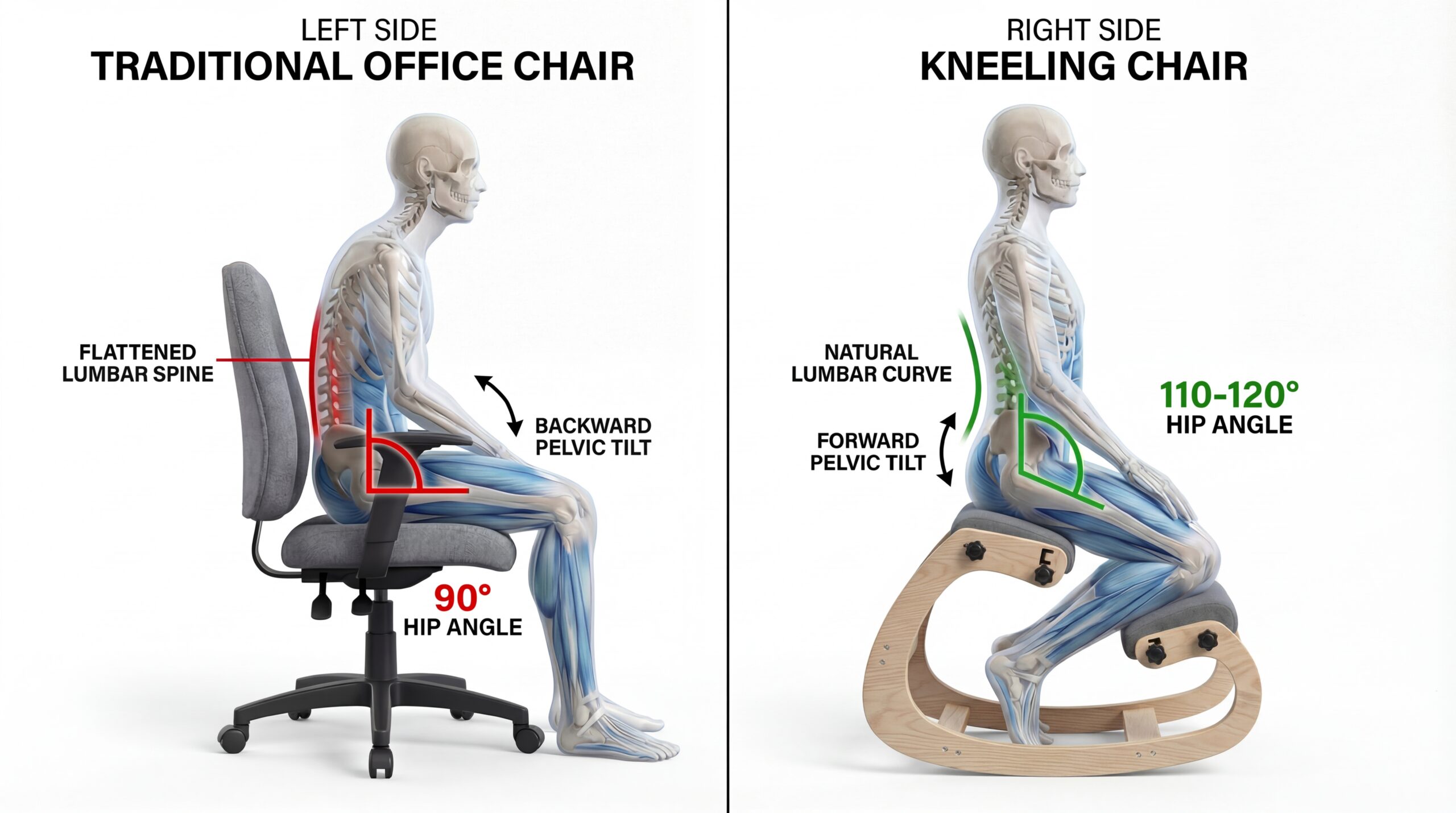
Traditional 90° seating vs kneeling chair’s open 110-120° hip angle
- Traditional chair: Hips at 90 degrees, pelvis tilts backward, lumbar spine flattens
- Kneeling chair: Hips at 110-120 degrees, pelvis tilts forward, lumbar spine maintains natural curve
The forward-tilted seat shifts your weight between your buttocks (60-70%) and your shins (30-40%). With no backrest to lean against, your core muscles engage gently to maintain posture.
That’s the entire mechanical difference. Everything else—the benefits, the drawbacks—flows from this position change.
The Real Pros: Benefits Backed by Research
Pro #1: May Help Maintain Better Spinal Alignment
A 2008 study in Research Into Spinal Deformities found that kneeling chairs set at +20 degree inclination maintained standing lumbar curvature to a greater extent than standard computer chairs.
What this means: Your lower back keeps more of its natural inward curve instead of flattening out during sitting. Some people report this reduces lower back discomfort over time.
Reality check: This doesn’t mean your back pain will disappear. It means the chair creates conditions that may support better alignment if used correctly.
Pro #2: Encourages Active Core Engagement
Without a backrest, your abdominal and back muscles stay gently active (about 5-10% of maximum contraction) to maintain balance. Over weeks, this can build postural endurance.
What users report: After 3-4 weeks of gradual use, many people notice their core feels stronger and they slouch less even in regular chairs.
Reality check: This is gentle conditioning, not a workout. Don’t expect six-pack abs from sitting.
Pro #3: Breaks the Slouching Habit
The open hip angle makes it biomechanically difficult to slump forward in that classic “computer hunch” position.
What this helps: For people who naturally slouch in traditional chairs despite trying to sit up straight, kneeling chairs can make good posture feel more natural.
Reality check: You can still have poor posture in a kneeling chair if you lean too far forward or don’t position it correctly.
Pro #4: Reduces Pressure on Lower Back
By distributing weight across two surfaces instead of one, concentrated pressure on your sit bones and lower spine decreases.
What some users experience: Less numbness or discomfort in the buttocks during long work sessions, reduced pressure sensation in lower back.
Reality check: If you already have disc issues or sciatica, consult a healthcare provider before trying any new seating.
Pro #5: Cost-Effective Compared to High-End Ergonomic Chairs
Quality kneeling chairs typically range from $150-400, while premium ergonomic office chairs cost $800-2,000+.
Budget advantage: You can try active sitting without major financial investment.
The Honest Cons: Limitations Nobody Mentions
Con #1: Shin and Knee Pressure Is Real
The most common complaint: About 30-40% of users report initial shin discomfort or pressure on kneecaps.
Why it happens: Poor weight distribution (too much pressure on shins instead of seat), inadequate padding, or wrong seat height.
Can it be fixed? Often yes, through proper adjustment. But some people’s bodies simply don’t adapt well to shin pressure. If you experience persistent pain, read our troubleshooting guide.
Con #2: Not Designed for All-Day Use
Experts recommend using kneeling chairs for 1-2 hour blocks, not 8 consecutive hours.
Why the limit? Static load on any specific muscle group causes fatigue. Your body needs positional variety.
What this means: A kneeling chair should be part of a rotation strategy, not your only seating option.
Con #3: Limited Range of Motion
Getting in and out of a kneeling chair takes slightly longer than a traditional chair. The position also makes it harder to reach far to the side or swivel quickly.
Who this affects most: People who need to stand frequently (teachers, parents working from home) or those whose work requires constant movement around their desk.
Con #4: Adaptation Period Can Be Uncomfortable
The first 1-2 weeks often involve mild muscle soreness in core and shins as your body adjusts.
What’s normal: Slight muscle awareness, needing breaks after 20-30 minutes initially.
What’s not normal: Sharp pain, numbness, or worsening discomfort after week 2.
Con #5: Doesn’t Work Well With Low Desks
Because you sit slightly higher in a kneeling position, low or non-adjustable desks can create awkward arm angles.
The fix: Most people need standard desk height (28-30 inches) or adjustable desks. Low desks under 27 inches may require modification.
Con #6: Not Suitable for Everyone
People with knee problems, circulation issues, or certain mobility limitations may find kneeling chairs uncomfortable or impractical regardless of adjustment.
Detailed Comparison Table
| Factor | Pros | Cons |
|---|---|---|
| Lower back support | May help maintain natural lumbar curve; some users report reduced discomfort | Not a cure for existing back conditions; doesn’t work for everyone |
| Core strength | Gentle engagement builds postural endurance over 3-4 weeks | Mild soreness during adaptation; not a replacement for exercise |
| Posture habits | Makes slouching difficult; encourages upright position | Can still have poor posture with incorrect setup |
| Comfort | Reduces pressure concentration after adaptation | Initial shin discomfort common (30-40% of users); not for all-day use |
| Cost | $150-400 vs $800-2000 for premium office chairs | May need additional seating for position rotation |
| Mobility | Encourages position changes and movement | Slower to enter/exit; limited lateral reach |
| Adaptation | Most people adapt within 2-3 weeks | Requires gradual introduction; not immediate comfort |
| Desk compatibility | Works with standard 28-30 inch desks | May not work with low or fixed-height desks under 27 inches |
Common Mistakes That Make Problems Worse
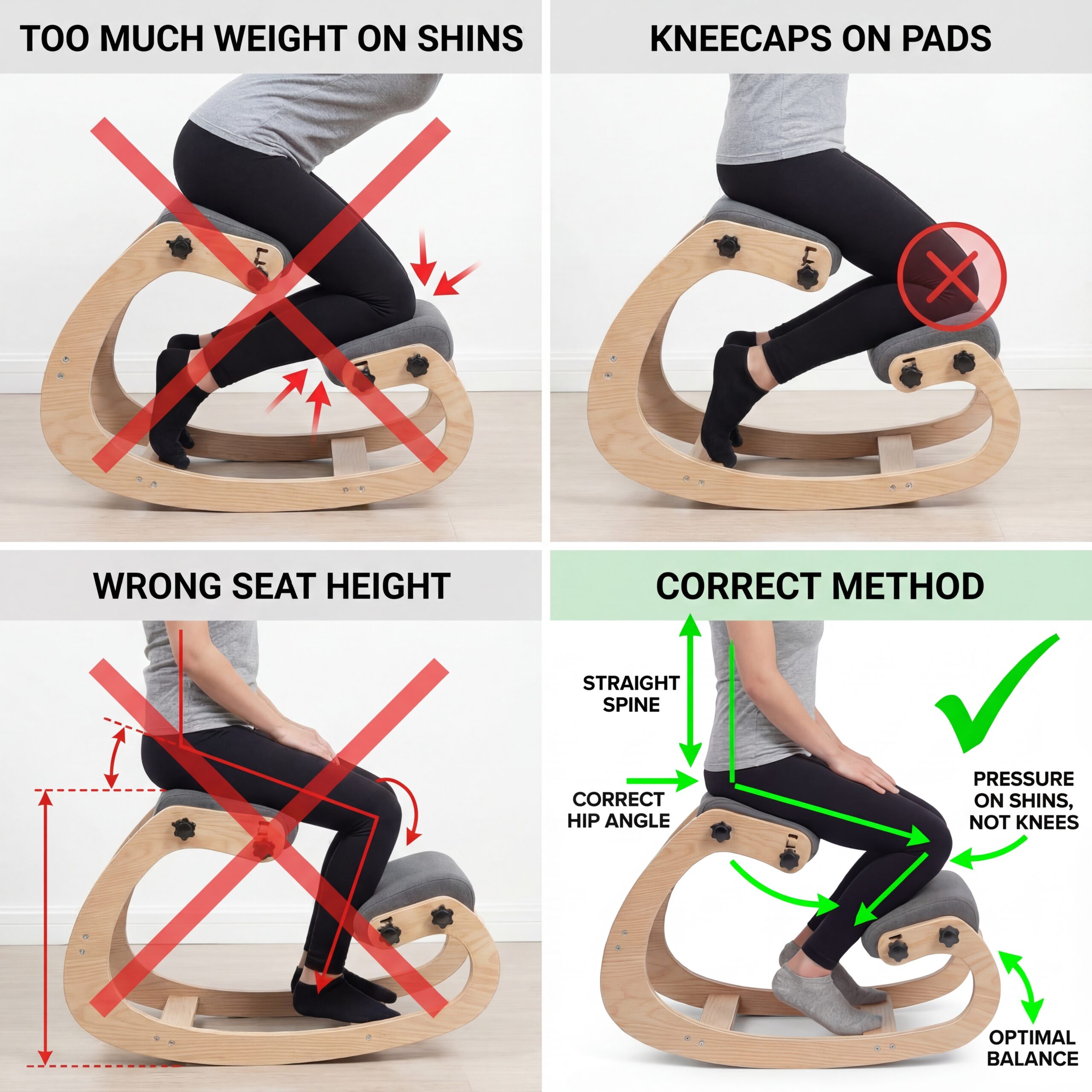
Visual guide to common mistakes and their fixes
Mistake #1: Too Much Weight on Shins
Fix: Adjust seat height higher so 60-70% of weight stays on seat, only 30-40% on shins.
Mistake #2: Using It All Day From Day One
Fix: Start with 20-30 minute sessions. Gradually increase over 2-3 weeks.
Mistake #3: Wrong Seat Height
Fix: Your thighs should slope gently downward. If shins hurt, raise the seat.
Mistake #4: Kneecaps on Shin Pads
Fix: Position shin pads under your shins, not pressing on kneecaps directly.
Mistake #5: Giving Up During Adaptation
Fix: Mild muscle awareness is normal for 1-2 weeks. Sharp pain is not—adjust immediately.
Mistake #6: No Position Rotation
Fix: Use as part of sitting strategy (1-2 hour blocks), not exclusively.
Decision Checklist: Is It Right For You?
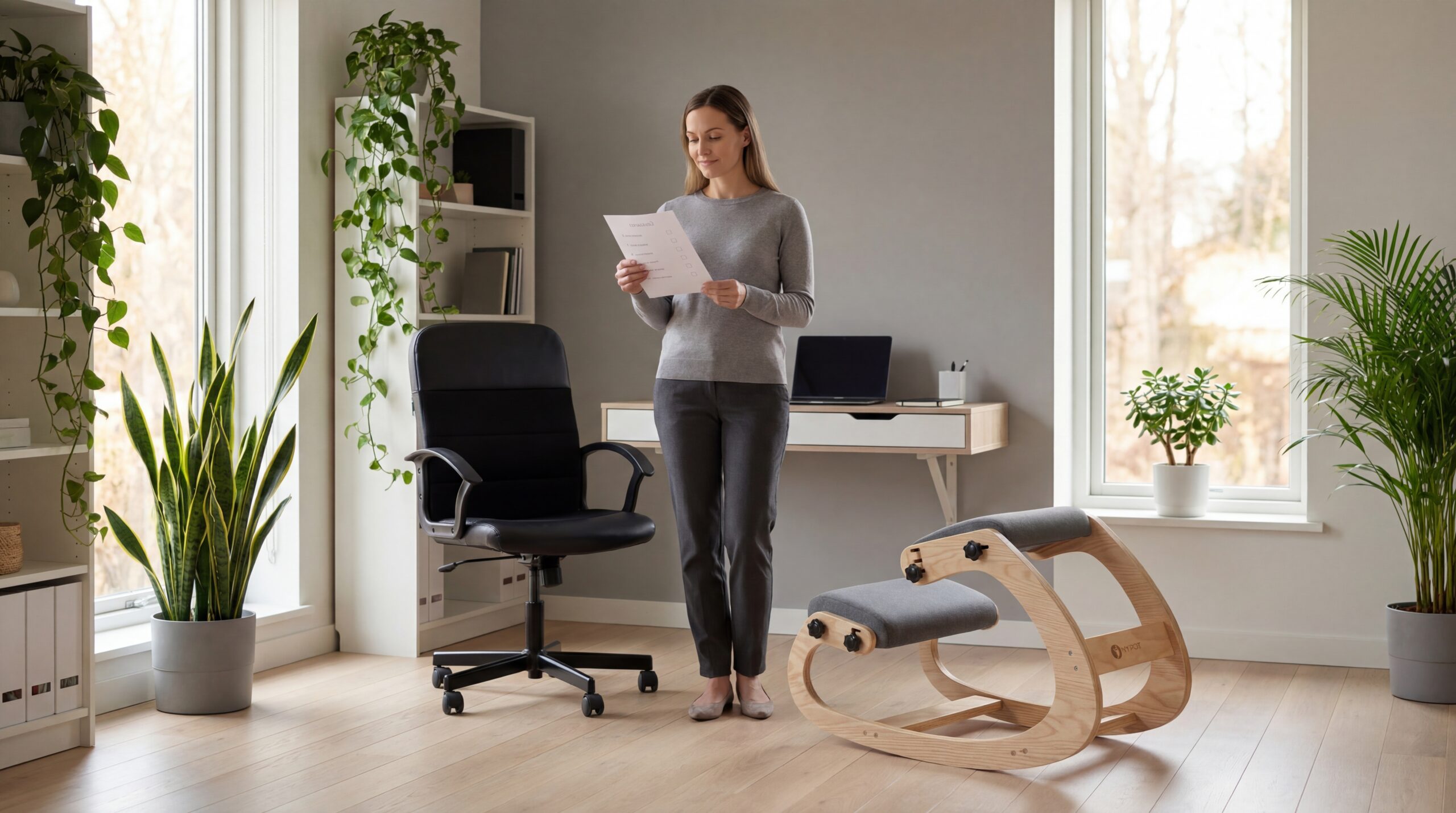
Answer these questions honestly to assess whether a kneeling chair might work for you:
📋 Your Personal Assessment
Click on each statement that applies to you. Your result will update automatically:
Click the questions above to see your personalized recommendation
Scoring guide:
6-8 YES: A kneeling chair might work well for you.
3-5 YES: Consider trying one with a good return policy.
0-2 YES: Traditional ergonomic seating may be a better fit.
Who Benefits Most From Kneeling Chairs
Ideal Candidates:
People who naturally slouch in traditional chairs despite trying to maintain good posture. The biomechanics work with you instead of requiring constant vigilance.
Those with flexible schedules who can rotate between sitting positions throughout the day (kneeling chair for 1-2 hours, traditional chair or standing for others).
Users seeking active sitting who want to build core strength passively while working and prefer dynamic seating over static support.
Remote workers with home office flexibility who can experiment with alternative seating without workplace restrictions.
People without knee issues who have healthy knees and no history of knee injuries or chronic knee pain.
Those willing to adapt gradually who can commit to 2-3 weeks of gradual introduction rather than expecting immediate comfort.
Who Should Avoid Kneeling Chairs
Skip or Be Very Cautious If You:
Have knee injuries or conditions: Any history of knee problems (meniscus tears, arthritis, patellar issues) makes shin pressure risky. Consult a healthcare provider first.
Experience circulation issues: Conditions affecting blood flow to lower legs, varicose veins, or history of deep vein thrombosis. The position may restrict circulation further.
Need frequent standing transitions: Teachers, parents of young children, or anyone whose work requires standing every few minutes. The slower entry/exit becomes frustrating.
Have limited mobility: Difficulty with floor-to-standing transitions or balance issues. The kneeling position requires more core stability.
Must sit for 4+ hours continuously: Jobs that don’t allow regular breaks or position changes. Kneeling chairs aren’t designed for marathon sitting.
Work at very low desks: Fixed desks under 27 inches create awkward arm angles that can cause shoulder and neck strain.
🪑 ErgoLife Foundation’s Chair Recommendation
If this assessment suggests a kneeling chair might work for you, we recommend chairs with adjustable seat height, quality memory foam padding on shin rests, and sturdy construction. Look for models in the $200-400 range for best quality-to-value ratio.
For workspace optimization tips beyond seating, read our complete workspace guide.
As a nonprofit, product links support our educational mission at no extra cost to you.
Frequently Asked Questions
How long should I use a kneeling chair each day?
Start with 20-30 minutes and gradually increase over 2-3 weeks. Most experts recommend 1-2 hour blocks maximum, rotating with other positions throughout the day. Extended use beyond 2-3 hours without breaks can cause fatigue and discomfort.
Will a kneeling chair fix my back pain?
Maybe, but not guaranteed. Kneeling chairs can help people whose back discomfort stems from slouching or poor lumbar support. They won’t cure structural issues, disc problems, or chronic conditions. Consult a healthcare provider for persistent pain.
Are kneeling chairs bad for your knees?
They can be if used incorrectly or with pre-existing conditions. With proper setup (60-70% weight on seat), healthy knees typically adapt fine. People with knee injuries, arthritis, or chronic knee pain should consult a doctor before trying one.
How long does it take to get used to a kneeling chair?
Most people adapt within 2-3 weeks. The first week often involves mild muscle soreness as your core adjusts. If sharp pain, numbness, or worsening discomfort continues past week 2, the chair may not be right for you.
Can I use a kneeling chair with a standing desk?
Yes, they work well together. Use the kneeling chair for focused work (1-2 hours), then stand for lighter tasks. This combination provides the position variety that prevents fatigue from any single posture.
What if my shins hurt on a kneeling chair?
First, check weight distribution—raise seat height so more weight is on your seat. Ensure shin pads aren’t pressing on kneecaps. Add padding if needed. If pain persists after proper adjustment for 1-2 weeks, kneeling chairs may not suit your body.
Do I need a special desk for a kneeling chair?
Most kneeling chairs work with standard desks (28-30 inches high). Low desks under 27 inches may create awkward arm angles. Adjustable desks provide the most flexibility for finding your ideal setup.
Should I get rid of my regular chair when I buy a kneeling chair?
No. Keep your traditional chair for longer sessions, relaxed sitting, and tasks that don’t suit the kneeling position. The best approach is rotating between multiple seating options throughout your day.
Disclaimer
This content provides general ergonomics education and should not replace medical advice. If you have existing back, knee, or circulation conditions, consult a healthcare provider before trying new seating. Stop using any chair that causes persistent pain, numbness, or worsening symptoms.
💚 About ErgoLife Foundation
ErgoLife Foundation is a nonprofit dedicated to evidence-based ergonomics education. Our mission is helping people make informed decisions about their workspace—whether that involves kneeling chairs, standing desks, traditional seating, or a combination of solutions.
We don’t believe any single product is right for everyone. Our goal is providing honest, research-backed information so you can find what works for your body and work style.
Product links may be affiliate links that support our educational programs at no extra cost to you.
References
- Bettany-Saltikov J, Warren J. (2008). “Ergonomically designed kneeling chairs are they worth it?” Research Into Spinal Deformities, IOS Press.
- Canadian Centre for Occupational Health and Safety (CCOHS). “Working in a Sitting Position: Alternative Chairs – Kneeling Chairs.” Occupational Health Resource.
- Furniture at Work UK. (2024). “A Guide to Kneeling Chairs: Pros, Cons and How to Use Them.” Ergonomics Resource Center.
- BTOD.com. (2025). “Are Kneeling Chairs Good For You?” Office Ergonomics Review.
- Sleekform Furniture. (2023). “What Does a Kneeling Chair Do: Will a Kneeling Chair Make Me Sore?” Ergonomic Seating Guide.
Have questions about kneeling chairs or ergonomic seating? Contact our education team — we’re happy to help you find the right solution for your workspace.