
The short version
- ADHD chair needs are different from neurotypical needs. Standard “ergonomic” chairs assume one posture. ADHD brains need many.
- Your sitting style determines your ideal chair. There are four main ADHD sitting patterns, and each maps to a different chair design.
- Wide-seat chairs work for the most ADHD adults because they support cross-legged, tucked, and cycling positions.
- Spend on the seat, not the brand. A $200-400 chair with the right dimensions beats a $1,200 chair that locks you into one position.
- Test for two weeks before deciding. ADHD brains need time to settle into a new seating pattern.
The Short Version
- There is no single best chair for ADHD – it depends on your dominant sitting style.
- Movement-permissive chairs outperform traditional ergonomic chairs for ADHD focus.
- Cross-legged sitters need a wide, flat seat – not a standard contoured one.
- Try before you commit – a 30-day trial matters more than any review.
In this guide
If you have ADHD and have ever searched for “best office chair,” you already know the problem. Every recommendation assumes you sit the same way all day. You do not.
Most “best ergonomic chair” lists recommend expensive task chairs designed for a single posture: feet flat, back straight, arms on armrests. That is the exact opposite of what ADHD bodies need.
This guide takes a different approach. Instead of ranking chairs by brand reputation, we match chair designs to the specific sitting patterns ADHD adults actually use.
Why ADHD chair needs are different
Section 1 of 9
Image Coming Soon
Editorial photo related to this section
ADHD brains need physical movement to maintain focus, and your chair is either helping or blocking that movement. Research shows that hyperactive movement in ADHD directly correlates with better cognitive performance (Sarver et al., 2015). When you fidget, shift, or cross your legs, your body is delivering dopamine to an underactive prefrontal cortex.
A standard ergonomic chair assumes you want to sit still. It is designed around a single “ideal” posture with features that lock you in:
- Narrow seat pans (15-17 inches) that prevent leg crossing
- Fixed armrests that trap your legs facing forward
- Lumbar support that only works in one recline angle
- Headrests designed for a specific spine position
For ADHD adults, these features are not ergonomic. They are restrictive. The chair you need is one that gives your body permission to move rather than punishing it for doing so.
Understanding why your ADHD brain craves cross-legged sitting explains the neuroscience behind this need.
The four ADHD sitting styles
Section 2 of 9
Image Coming Soon
Editorial photo for this section
Most ADHD adults fall into one of four dominant sitting patterns. You probably use more than one, but one tends to dominate. Identifying yours is the key to choosing the right chair.
The Cycler
You rotate through 5+ positions per hour. Cross-legged, one foot tucked, both feet down, legs stretched, one knee up – and back to cross-legged. You need a chair with a wide, flat seat that supports every position equally.
The Nester
You tuck into one compact position and stay there. Cross-legged or both knees pulled up is your default. You need a wide seat with a flat or slightly curved pan and breathable fabric that does not overheat during long nesting sessions.
The Rocker
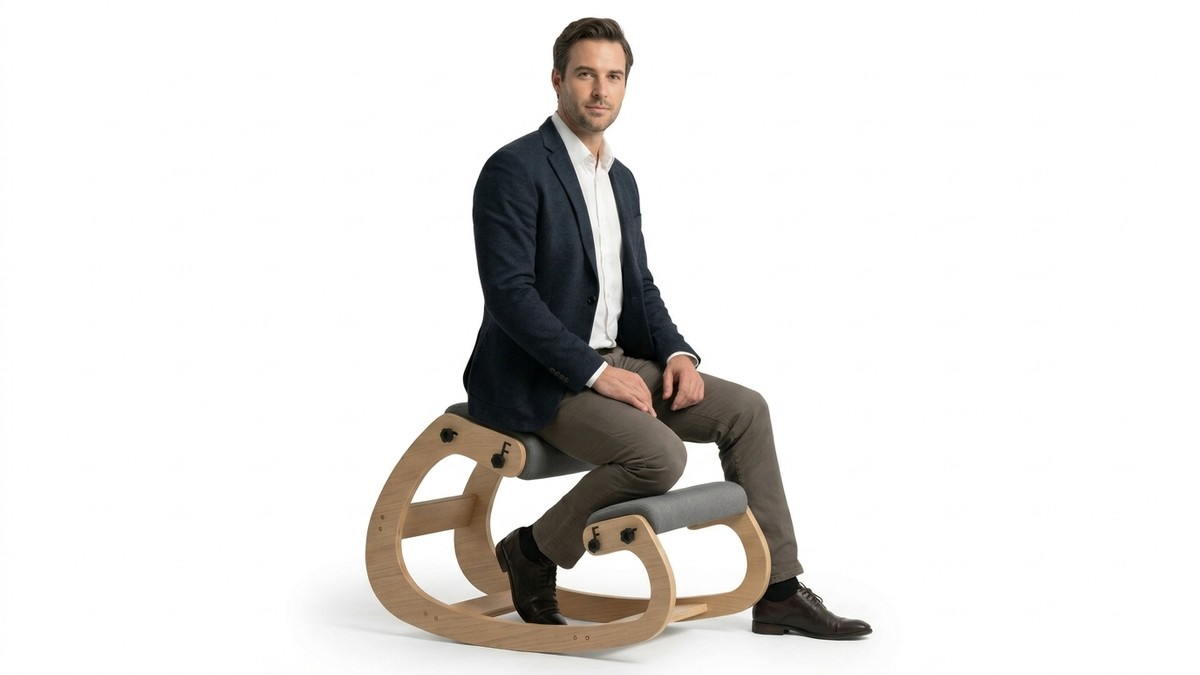
You lean forward, lean back, bounce, and sway. Your chair is always in motion even when your legs are not. You need a chair with a responsive tilt mechanism, or a kneeling chair that channels rocking into productive posture.
The Percher
You sit on the edge of your seat, leaning forward into your work. Standard chairs feel too deep and too reclined. You need a forward-tilt option or a kneeling design that makes the front edge the default position.
Not sure which style describes you?
Pay attention to your sitting for one full work day. Set a timer for every 15 minutes and note your position when it goes off. After 8 entries, you will see your dominant pattern clearly.
Not sure which ADHD sitting style describes you? Our Chair Finder Quiz identifies your dominant pattern and matches it to the right chair in 60 seconds.
Chair comparison table: ADHD edition
Section 3 of 9
Here is how common chair types stack up for ADHD-specific needs. This is not about overall quality or brand. It is about which design enables the movement patterns ADHD brains require.
| Chair type | Cycler | Nester | Rocker | Percher | Price range |
|---|---|---|---|---|---|
| Wide-seat (criss-cross) | Excellent | Excellent | Good | Good | $200-400 |
| Kneeling chair | Fair | Poor | Excellent | Excellent | $150-350 |
| Wobble stool | Fair | Poor | Good | Good | $100-250 |
| Balance ball chair | Poor | Poor | Good | Fair | $50-150 |
| Standard ergonomic | Poor | Poor | Fair | Poor | $300-1,500 |
| Gaming chair | Poor | Poor | Poor | Poor | $200-600 |
Which ADHD sitter are you? Your chair match
Section 4 of 9
Image Coming Soon
Editorial photo for this section
Match your dominant pattern to the chair that supports it.
- Cycler or Nester? You need a wide-seat chair. A 20+ inch seat pan with no armrests gives your legs the freedom to move through every position in your rotation.
- Rocker? A kneeling chair channels your forward-and-back movement into productive posture. The rocking motion becomes core engagement instead of fidgeting.
- Percher? A kneeling chair or forward-tilt seat puts you at the angle you naturally choose. No more fighting the backrest.
- Combination of all four? Start with a wide-seat chair (handles the most patterns) and add a kneeling chair as a rotation option.
Match your ADHD sitting style to the right NYPOT chair
NYPOT Criss-Cross Chair
Best for: Cyclers and Nesters. 22-inch seat, position variety, cross-legged support. Accommodates all four sitting styles.
NYPOT Kneeling Chair
Best for: Rockers and Perchers. Forward tilt, core engagement, focused anchoring. Channels movement into posture.
Our recommendation: the NYPOT Criss-Cross Chair
Section 5 of 9
For most ADHD adults, a wide-seat chair is the single best investment. It supports the widest range of ADHD sitting patterns in one design.
Here is why we recommend the NYPOT Criss-Cross Chair as the top choice for ADHD adults:
- 22-inch wide seat. Five inches wider than a standard office chair. Enough room to sit cross-legged, tucked, sideways, or traditionally.
- Breathable mesh back. Temperature-neutral for sensory-sensitive sitters. No leather sticking or vinyl overheating.
- Gas-lift height adjustment. Accommodates the height changes that come with different sitting positions. Cross-legged sitting raises your hips 2-4 inches.
- No fixed armrests. Nothing blocks your legs from moving freely into any position.
- Stable 5-point base. Safe even in asymmetric positions where your weight shifts to one side.
See why we recommend the Criss-Cross Chair for most ADHD sitters
22-inch wide seat accommodates all four ADHD sitting styles. Breathable mesh for temperature-sensitive sitters. Gas-lift height adjustment for desk compatibility. Designed for the movement your brain demands.
Image Coming Soon
Editorial photo for this section
How much should you spend on an ADHD chair?
Section 6 of 9
$200-400 gets you everything you need. Spending more does not add ADHD-relevant features.
Here is a realistic budget breakdown:
| Budget | What you get | ADHD suitability |
|---|---|---|
| Under $100 | Basic task chair, narrow seat, no adjustability | Poor – no position variety |
| $100-200 | Wobble stools, basic kneeling chairs | Moderate – one movement type |
| $200-400 | Wide-seat chairs, quality kneeling chairs | Excellent – full position range |
| $400-800 | Premium mesh chairs (Herman Miller Aeron, etc.) | Mixed – great build, narrow seats |
| $800+ | Luxury ergonomic chairs | Often worse – more restrictions, not more freedom |
The features that matter for ADHD – seat width, position freedom, armrest flexibility – are not premium features. They are design choices. A $300 wide-seat chair serves ADHD needs better than a $1,500 Herman Miller that locks you into one posture.
The expensive chair trap
High price does not mean ADHD-friendly. The most expensive chairs on the market (Herman Miller Aeron, Steelcase Leap) are excellent for neurotypical ergonomics. But they have 16-18 inch seats and fixed armrest systems designed for a single seated position. For ADHD adults, they are expensive ways to feel trapped.
Image Coming Soon
Editorial photo for this section
The two-week testing checklist
Section 7 of 9
ADHD brains need two weeks to settle into a new chair. Do not judge a chair on day one. Your body and brain need time to discover all the positions a new chair enables.
Days 1-3: Exploration phase
- Try at least 5 different sitting positions in the chair
- Adjust height for each position (cross-legged needs a higher setting)
- Note which positions feel natural and which feel forced
Days 4-7: Pattern phase
- Notice which positions you return to most often
- Track your focus quality in different positions
- Check for any pressure points or discomfort after 2+ hours
Days 8-14: Integration phase
- You should have a natural rotation established by now
- Focus should feel easier than in your old chair
- Physical discomfort should be gone or minimal
The two-week test in one question
After 14 days, ask yourself: “When I sit down to work, do I have to think about how to sit, or does my body just settle in?” If your body just settles in, the chair works. If you are still fighting it, it is not the right match.
What to avoid
Section 8 of 9
Some popular chair features actively work against ADHD sitting needs. Here is what to skip.
- Gaming chairs. Bucket seats, high side bolsters, and racing-style designs restrict lateral movement. They are built to hold you in one position at high speed. ADHD sitting is the opposite.
- Heavy lumbar pillows. They only work if you sit with your back against the chair. ADHD sitters lean forward, sit sideways, and rarely use the backrest. Lumbar pillows become obstacles.
- Non-adjustable armrests. If the armrests cannot move or be removed, they will block every cross-legged, tucked, and sideways position.
- Deep seat pans (over 20 inches deep). Deep seats force you to use the backrest. Perchers and forward-leaning sitters end up on the edge with no support.
- Chairs marketed as “posture correcting.” These assume one correct posture exists. For ADHD, multiple postures are correct – the one your brain needs at any given moment.
Finding your fit
Section 9 of 9
The right ADHD chair is the one that makes movement effortless, not the one that makes stillness comfortable.
Here is your action plan:
- Identify your dominant sitting style using the four-pattern framework above.
- Match your style to a chair design using the comparison table.
- Set a budget in the $200-400 range where ADHD-relevant features live.
- Run the two-week test before making a final judgment.
- Add a rotation chair (kneeling or wobble stool) once you have your primary chair dialed in.
Your sitting style is data. It tells you exactly what your brain needs to focus. The guides on why fidgeting supports focus and designing an ADHD-friendly workspace build on the chair foundation covered here.
Ready to find the chair your ADHD brain has been looking for?
You know your sitting style. You know what features matter. Now let our quiz combine everything and deliver a personalized recommendation – factoring in your body, your work, and your ADHD patterns.
References
- Sarver, D. E., et al. (2015). Hyperactivity in ADHD: Impairing deficit or compensatory behavior? Journal of Abnormal Child Psychology, 43(7), 1219-1232.
- Hartanto, T. A., et al. (2016). A trial-by-trial analysis of physical activity and cognitive control in ADHD. Child Neuropsychology, 22(5), 618-626.
- Kofler, M. J., et al. (2020). Working memory and organizational skills deficits in ADHD. Journal of Clinical Child and Adolescent Psychology, 49(4), 506-518.
- Rapport, M. D., et al. (2009). Hyperactivity in ADHD: A pervasive core symptom or manifestation of working memory deficits? Journal of Abnormal Child Psychology, 37(4), 521-534.
- National Institute of Mental Health. (2023). Attention-deficit/hyperactivity disorder. U.S. Department of Health and Human Services.
Related Reading
Affiliate disclosure: This page contains affiliate links. ErgoLife Foundation may earn a commission at no additional cost to you. All recommendations are based on our independent research and mission to improve workplace wellness.
