In this guide
- The fidgeting problem that is not a problem
- What the research actually shows
- The neuroscience: why movement wakes up the brain
- The sitting still paradox
- Is fidgeting a sign of ADHD?
- ADHD stimming vs. fidgeting
- Not all fidgeting is equal
- Important caveats
- Practical ways to channel fidgeting at work
- Your action steps checklist
- Reframing the narrative
The short version
- Yes, fidgeting helps you focus – but only the right kind. Research from UC Davis and Frontiers in Psychiatry confirms it.
- Gross motor movement (leg shifting, rocking, position changes) improves cognitive performance in people with ADHD.
- Fine motor fidgeting (pen clicking, nail picking) can actually distract from tasks that require hand coordination.
- The neuroscience is clear: fidgeting raises dopamine and norepinephrine to levels the ADHD brain needs for focus.
- Chairs, foot rests, and under-desk tools channel productive fidgeting better than handheld devices.
In this article
- The fidgeting problem that is not a problem
- What the research actually shows
- The neuroscience: why movement wakes up the brain
- The sitting still paradox
- Is fidgeting a sign of ADHD?
- ADHD stimming vs. fidgeting
- Not all fidgeting is equal
- Important caveats
- Practical ways to channel fidgeting at work
- Your action steps checklist
- Reframing the narrative
You have been told your whole life to sit still. In school, at work, in meetings. The message is clear: movement equals distraction. Focus means stillness.
The science says the opposite.
Multiple peer-reviewed studies now confirm that for ADHD brains – and in many cases for all brains – physical movement during cognitive tasks improves performance rather than impairing it. This article walks through what the research actually shows, the neuroscience behind it, and how to channel fidgeting into a focus tool.

The fidgeting problem that is not a problem
Section 1 of 11
Fidgeting was classified as a behavioral problem long before anyone studied whether it served a purpose. The DSM lists “often fidgets” as a diagnostic criterion for ADHD hyperactivity. Schools have spent decades training children to suppress it. Workplaces implicitly punish it.
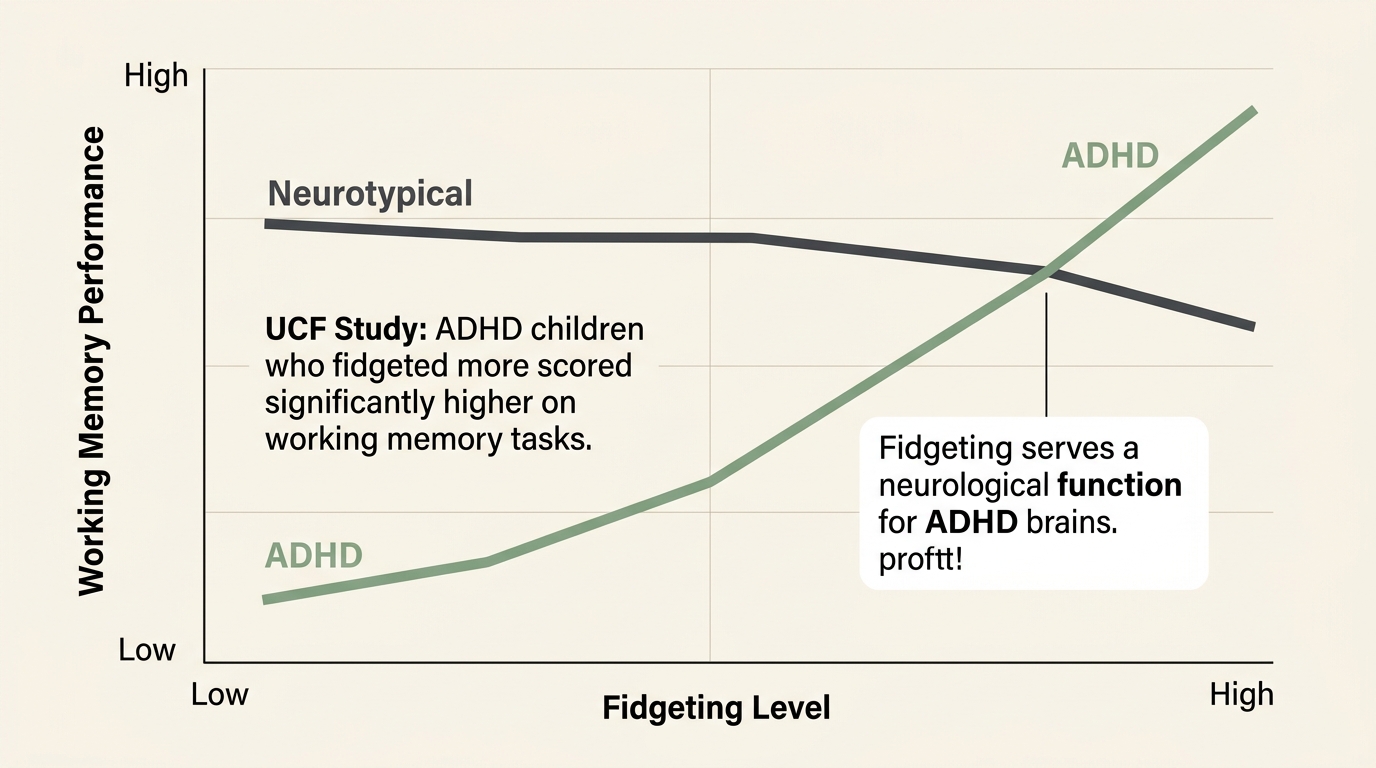
But when researchers at the University of Central Florida actually measured the relationship between fidgeting and performance, they found something that upended the assumption: ADHD children who fidgeted more during working memory tasks performed significantly better than those who sat still.
This was not a one-off finding. Multiple studies across different research groups, populations, and task types have replicated it. Fidgeting, it turns out, is not noise. It is signal.
What the research actually shows
Section 2 of 11
Here are the key studies, their methods, and their findings. These are not pop-science summaries. These are peer-reviewed publications in respected journals.
Sarver et al. (2015) – UC Florida
Finding: Gross motor activity in ADHD children directly predicted better working memory performance. The more they moved, the better they scored. For neurotypical children, the relationship was neutral or slightly negative.
Hartanto et al. (2016) – Children’s Hospital of Philadelphia
Finding: On a trial-by-trial basis, increased physical activity predicted improved cognitive control performance specifically in ADHD participants. Movement was compensatory, not disruptive.
Rapport et al. (2009) – Central Florida
Finding: Hyperactivity in ADHD is a manifestation of the cognitive system’s need for increased arousal, not a random behavioral excess. Movement is the brain’s self-medication strategy.
The numbers
ADHD participants who moved more scored up to 29% better on working memory tasks compared to their own still-seated performance. For neurotypical participants, forced movement provided no benefit and sometimes impaired scores slightly.
The neuroscience: why movement wakes up the brain
Section 3 of 11
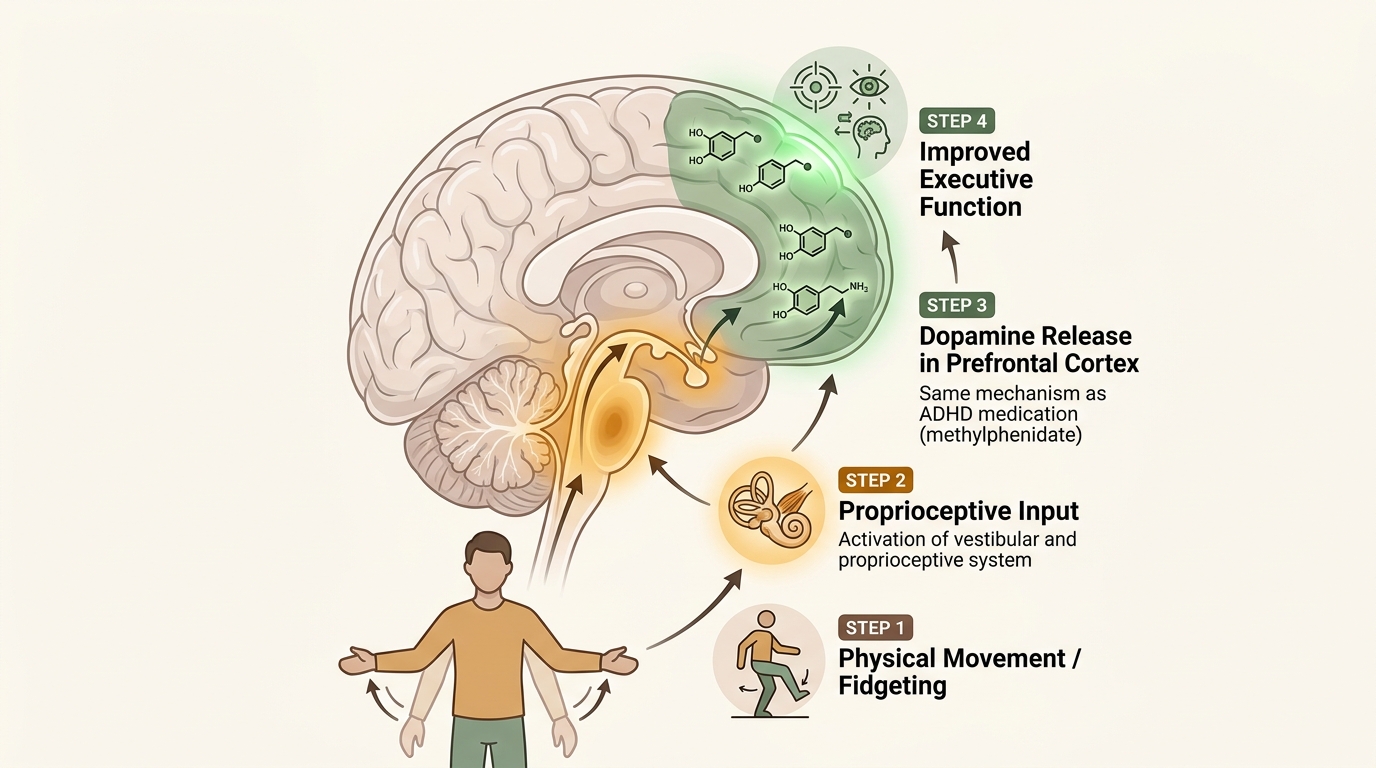
Fidgeting works because it raises dopamine and norepinephrine – the exact neurotransmitters that ADHD brains are short on.
Here is the chain of events:
- ADHD brains have lower baseline dopamine activity in the prefrontal cortex. This is the brain region responsible for attention, working memory, and impulse control.
- The prefrontal cortex needs a certain stimulation threshold to function. Below that threshold, focus degrades.
- Physical movement produces dopamine and norepinephrine. Even small movements – leg bouncing, position shifting, rocking – trigger the release of both neurotransmitters.
- The released neurotransmitters raise prefrontal activity to the functional threshold, temporarily improving attention.
This is the same mechanism that makes ADHD medication work. Stimulants like methylphenidate (Ritalin) and amphetamine (Adderall) increase dopamine availability in the prefrontal cortex. Fidgeting does the same thing, just through a different pathway.
The sitting still paradox
Section 4 of 11
Forcing an ADHD brain to sit still does not improve focus. It destroys it. When you suppress fidgeting, the cognitive resources that were going toward your task now go toward the effort of staying still. You are spending mental energy on body control instead of work.
This creates a paradox:
- Sitting still looks like focus to outside observers
- But sitting still feels like drowning in mental fog to the ADHD person
- Movement looks like distraction but actually enables attention
The sitting still paradox has a hardware solution: chairs that make stillness optional. The NYPOT Criss-Cross Chair is built for exactly this – a wide seat that lets your body fidget, shift, and reposition without falling off the edge or fighting armrests.
Is fidgeting a sign of ADHD?
Section 5 of 11
Fidgeting alone is not diagnostic, but persistent, involuntary fidgeting that intensifies during cognitive demand is a strong ADHD indicator.
Everyone fidgets sometimes. Boredom, anxiety, and fatigue all trigger movement. The difference with ADHD fidgeting:
- It increases during hard tasks, not just boring ones. ADHD fidgeting ramps up when the brain needs more dopamine, which happens during cognitive challenge.
- It is involuntary. You do not decide to bounce your leg. You notice you are doing it.
- Suppressing it impairs your performance. Neurotypical fidgeting can be stopped without cognitive cost. ADHD fidgeting cannot.
- It has been present since childhood. Not a new habit – a lifelong pattern.
If these describe your experience, the ADHD and cross-legged sitting guide explores the proprioceptive dimension of ADHD movement patterns.
ADHD stimming vs. fidgeting
Section 6 of 11
Stimming and fidgeting overlap but are not identical. Understanding the difference helps you channel each one effectively.
| Characteristic | Fidgeting | Stimming |
|---|---|---|
| Purpose | Raise arousal for focus | Self-soothe or regulate emotion |
| When it happens | During cognitive tasks | During stress, excitement, or sensory overload |
| Movements | Varied (shifting, bouncing, rocking) | Repetitive (hand flapping, rocking, humming) |
| Awareness | Often unconscious | Can be conscious or unconscious |
| Associated with | ADHD primarily | Autism, ADHD, and other neurotypes |
Both are valid self-regulation strategies. Neither should be suppressed. The workspace implications are the same: your environment should accommodate both, not fight either.
Not all fidgeting is equal
Section 7 of 11
Gross motor fidgeting (legs, core, full-body shifting) helps focus. Fine motor fidgeting (fingers, hands) can actually compete with task performance.

The research is specific about this distinction:
- Leg bouncing, position cycling, rocking – Productive. These engage large muscle groups and the vestibular system without using the hands or eyes that tasks require.
- Pen clicking, rubber band snapping, phone picking up – Often counterproductive. These use the same fine motor and visual systems that typing, writing, and reading require.
- Under-desk pedaling, foot rocking – Highly productive. Invisible to others, engages the legs, and provides rhythmic proprioceptive input.
The fidget spinner problem
Fidget spinners became popular as ADHD tools but the research does not support them. A 2018 study in the Journal of Attention Disorders found that fidget spinners provided no attention benefit and actually impaired memory performance in some participants. The problem: they require visual attention and fine motor control that compete with the task.
Channel your fidgeting into productive movement
Not all fidgeting helps focus – the research shows gross motor movement (leg repositioning, rocking, shifting) is productive. Active sitting chairs channel the productive kind.
Criss-Cross Chair: for leg repositioners and cross-legged shifters.
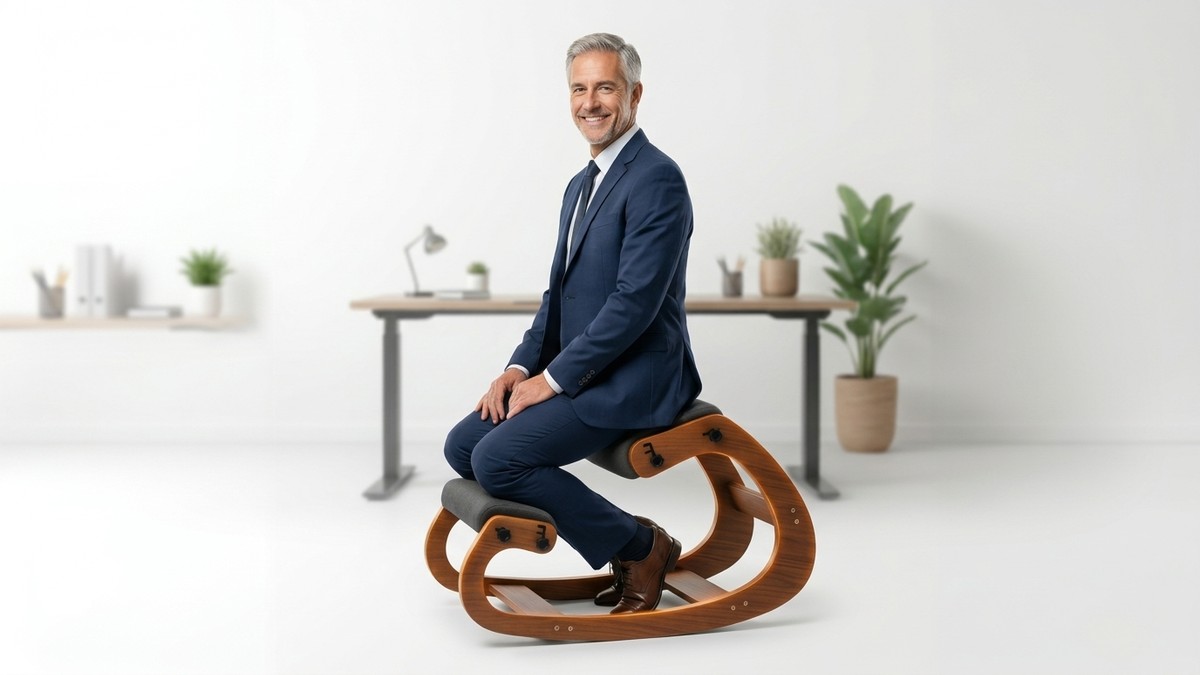
Kneeling Chair: for rockers and forward leaners.
Important caveats
Section 8 of 11
The research supports fidgeting for focus, but with important boundaries.
- These findings are strongest for ADHD. Neurotypical individuals show neutral or slightly negative effects from forced movement during tasks. The benefits are specific to the ADHD dopamine system.
- Social context matters. Fidgeting in a meeting may help your focus but distract others. Choose invisible fidgeting strategies (under-desk tools, position shifts in a quiet chair) for shared spaces.
- Fidgeting is not a replacement for treatment. If you have ADHD, movement strategies complement medication, therapy, and environmental design. They are one tool in a toolkit, not the whole toolkit.
- Excessive fidgeting may signal something else. Anxiety, restless leg syndrome, and thyroid conditions also cause movement. If your fidgeting is new, worsening, or accompanied by distress, consult a healthcare provider.
A note on self-diagnosis
This article explains how fidgeting relates to ADHD neuroscience. It is not a diagnostic tool. If you recognize yourself in these patterns and have never been evaluated, consider talking to a healthcare provider who specializes in adult ADHD. Late diagnosis is extremely common, especially in women.
Practical ways to channel fidgeting at work
Section 9 of 11
Here are specific, workplace-appropriate strategies for channeling productive fidgeting.

At your desk
- Wide-seat chair for position cycling. Cross your legs, tuck one foot, shift sideways, return to standard. A 20+ inch seat makes this seamless.
- Under-desk pedal exerciser. Silent, invisible, and provides continuous leg movement without disrupting typing or mouse work.
- Resistance band on chair legs. Push your feet against it for silent proprioceptive input.
- Wobble footrest. Tilts and rocks under your feet while your upper body stays stable.
In meetings
- Choose a chair at the back or side where your movement is less visible.
- Textured putty in one hand during passive listening. Put it away when you need both hands.
- Isometric exercises. Press your palms together under the table, squeeze your thighs, curl your toes. Invisible but arousal-raising.
During focused work
- Set a position-change timer for every 20 minutes. Deliberate position cycling prevents the unconscious fidgeting that can become distracting.
- Standing desk intervals. Alternate 20 minutes sitting, 20 minutes standing. Standing naturally enables more weight shifting and movement.
The full ADHD workspace setup guide covers how to integrate these tools into a complete focus-optimized environment.
Your action steps checklist
Section 10 of 11
Start with one change. Add more as each becomes automatic.
- Identify your primary fidget pattern. Leg bouncing? Rocking? Position cycling? Leaning? (See the four ADHD sitting styles.)
- Add one under-desk fidget tool. A foot rest, pedal exerciser, or resistance band. Use it for one week.
- Evaluate your chair. Is the seat wide enough for your movement pattern? Are the armrests blocking you? If yes, consider a wide-seat alternative.
- Set a 20-minute position rotation timer. Cross-legged, flat-footed, standing. Deliberate rotation prevents unconscious distraction.
- Stop apologizing for fidgeting. You have the research. Your movement is functional, not rude.
Reframing the narrative
Section 11 of 11
Fidgeting is not the enemy of focus. It is the prerequisite.
For decades, the narrative around fidgeting has been about suppression. Sit still. Stop moving. Pay attention. The research now tells a different story: for ADHD brains, movement is how attention gets paid.
Your body already knows how it needs to move. It has been telling you since childhood. The job now is not to fight that knowledge but to build an environment that supports it – starting with a chair that does not punish your body for doing what your brain requires.
For more on how neurodivergent-friendly furniture design supports this shift, explore our complete guide to building a workspace that works with your brain, not against it.
Your fidgeting is data. Let it guide you to the right chair.
Your body already knows how it needs to move. Our quiz reads those patterns – leg crossing, rocking, shifting, bouncing – and matches them to the chair that turns fidgeting from a “problem” into a focus tool.
References
- Sarver, D. E., et al. (2015). Hyperactivity in ADHD: Impairing deficit or compensatory behavior? Journal of Abnormal Child Psychology, 43(7), 1219-1232.
- Hartanto, T. A., et al. (2016). Trial-by-trial analysis of physical activity and cognitive control in ADHD. Child Neuropsychology, 22(5), 618-626.
- Rapport, M. D., et al. (2009). Hyperactivity in ADHD: A pervasive core symptom or working memory manifestation? Journal of Abnormal Child Psychology, 37(4), 521-534.
- Graziano, P. A., et al. (2018). Attention-deficit hyperactivity disorder and fidget spinners: A controlled classroom study. Journal of Attention Disorders, 24(13), 1925-1934.
- Koenig, K. P., & Buckley-Reen, A. (2009). Sensory processing and self-regulation in ADHD. Occupational Therapy in Mental Health, 25(2), 164-185.
- Barkley, R. A. (2020). Taking Charge of Adult ADHD (2nd ed.). Guilford Press.
Affiliate disclosure: This page contains affiliate links. ErgoLife Foundation may earn a commission at no additional cost to you. All recommendations are based on our independent research and mission to improve workplace wellness.