
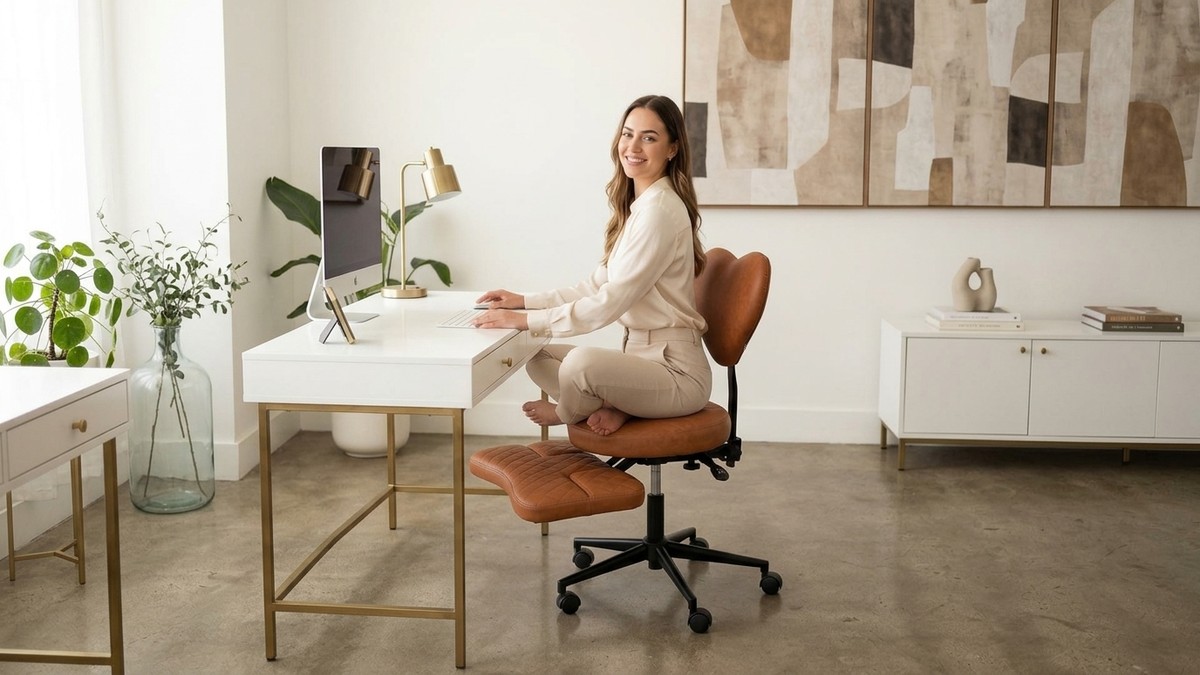
The short version
- Cross-legged sitting is not a bad habit. It is your ADHD brain seeking the sensory input it needs to focus.
- Proprioception drives it. Folding your legs gives your brain spatial feedback that improves attention and self-regulation.
- Dopamine plays a role. Low baseline dopamine in ADHD makes your body seek movement and pressure to compensate.
- Standard office chairs fight this instinct with narrow seats, armrests, and rigid posture expectations.
- Wide-seat chairs solve it by giving your legs room to fold, tuck, and shift freely throughout the day.
The Short Version
- Cross-legged sitting is not a bad habit – it is your nervous system seeking sensory input to stay focused.
- Proprioceptive input through sitting positions helps ADHD brains self-regulate without conscious effort.
- Standard office chairs fight this instinct by restricting the positions your body needs.
- A chair designed for cross-legged sitting works with your neurology instead of against it.
In this article
- You are not sitting wrong
- The neuroscience behind the urge to move
- Proprioception: your hidden sense
- Is sitting cross-legged a sign of ADHD?
- Why traditional office chairs fight your instincts
- What a movement-friendly chair actually looks like
- Standard chair vs. movement-friendly chair
- Practical tips for cross-legged sitters
- A note about “normal” sitting
If you have ADHD, you have probably heard it hundreds of times. Sit still. Put your feet on the floor. Stop fidgeting.
But here is the thing your teachers and managers never told you: your body is not misbehaving. Your brain is solving a problem they cannot see.
This article explains the neuroscience behind why ADHD brains crave cross-legged sitting, what proprioception and dopamine have to do with it, and how to work with your body instead of against it.
You are not sitting wrong
Section 1 of 9
Image Coming Soon
Editorial photo related to this section
Cross-legged sitting in ADHD is a self-regulation strategy, not a posture problem. Research from the University of Central Florida shows that physical movement helps ADHD brains maintain the level of arousal they need to concentrate.
When you fold your legs, tuck one foot under you, or sit in some unconventional position, your nervous system is doing something very specific. It is seeking proprioceptive input – the deep-pressure feedback your brain uses to understand where your body is in space.
For neurotypical brains, this input happens quietly in the background. For ADHD brains, it often needs amplification. Cross-legged sitting is one of the simplest, most accessible ways your body finds that amplification on its own.
The neuroscience behind the urge to move
Section 2 of 9
Image Coming Soon
Editorial photo for this section
ADHD brains have lower baseline dopamine activity, and movement helps compensate. Dopamine is the neurotransmitter responsible for attention, motivation, and the ability to filter distractions. In ADHD, the dopamine signaling system is underactive.
This creates a problem. Your prefrontal cortex – the part of your brain that manages focus and impulse control – needs a certain level of stimulation to function well. When dopamine is low, your brain goes looking for stimulation wherever it can find it.
Movement is one of the fastest, most reliable sources of that stimulation. A 2015 study published in the Journal of Abnormal Child Psychology found that ADHD participants who moved more during cognitive tasks performed significantly better than those forced to sit still.
This is not a discipline problem. This is brain chemistry. When you shift positions, bounce your knee, or fold your legs underneath you, your body is delivering the stimulation your prefrontal cortex needs to do its job.
Key research finding
Movement improves ADHD performance. The UC Florida study (Sarver et al., 2015) demonstrated that hyperactive movement in ADHD children directly correlated with better working memory performance. The same neurological mechanism applies to adults.
Proprioception: your hidden sense
Section 3 of 9
Proprioception is the sense that tells your brain where your body is in space, and ADHD brains often need more of it. Most people know about the five senses. Fewer know about the sixth: proprioception, the internal sense that detects joint position, muscle tension, and body movement.
When you cross your legs, your hip joints compress, your knee joints flex deeply, and your muscles engage in ways that sitting flat-footed never produces. Every one of those signals travels up to your brain and says: you are here, you are grounded, you are stable.
Occupational therapists call this proprioceptive self-regulation. It is the same reason weighted blankets help people sleep, compression shirts help athletes focus, and deep-pressure touch calms anxiety. Cross-legged sitting is the free, always-available version of that same input.
For ADHD brains with an underactive dopamine system, proprioceptive input acts as a natural stimulant. It raises alertness without the jittery quality of caffeine or the side effects of medication. Your body discovered this strategy on its own, probably in childhood, long before you had a word for it.
Image Coming Soon
Editorial photo for this section
The NYPOT Criss-Cross Chair was designed specifically for this – a 22-inch seat that lets you sit cross-legged, tucked, or sideways without balancing on the edge.
Is sitting cross-legged a sign of ADHD?
Section 4 of 9
Not on its own, but it is a common pattern in ADHD adults that occupational therapists recognize. Sitting cross-legged is not diagnostic. Plenty of neurotypical people sit this way. But when combined with other sensory-seeking behaviors – fidgeting, rocking, needing to move during long meetings – it forms a pattern that is very common in ADHD.
Here are signs that your sitting style may be ADHD-related:
- You cannot focus with both feet on the floor. Flat-footed sitting feels “too quiet” for your nervous system.
- You cycle through positions constantly – crossed, tucked, one foot up, legs stretched, back to crossed.
- You concentrate better in unusual positions like sitting on the floor, perching on the edge of a chair, or sitting backwards.
- You have done this since childhood and have been told repeatedly to “sit properly.”
- You feel restless within minutes of being forced into a standard seated position.
If three or more of those describe you, your sitting patterns are likely sensory-seeking behaviors. This does not mean you have ADHD. But if you already know you have ADHD, it helps explain why no office chair has ever felt right.
Did you know?
ADHD affects approximately 4.4% of adults in the United States, according to the National Institute of Mental Health. Many are undiagnosed, particularly women, who are more likely to present with inattentive rather than hyperactive symptoms.
Why traditional office chairs fight your instincts
Section 5 of 9
Standard office chairs were designed for one sitting position that no ADHD brain can maintain. The typical office chair has a 17-inch wide seat, armrests that block your legs from crossing, and a rigid back designed for a single “ergonomically correct” posture.
For someone whose brain needs position variety to maintain focus, this design is actively hostile. It is like giving someone with ADHD a fidget spinner and then gluing it shut.
Here is what standard chairs get wrong for ADHD users:
- Narrow seats (15-17 inches) make cross-legged sitting impossible without perching dangerously on the edge.
- Fixed armrests trap your legs in one forward-facing position.
- High backrests discourage leaning forward, perching, or sitting at angles.
- Rigid seat pans create pressure points within minutes, forcing position changes that the chair was not built to accommodate.
The result is a cycle. You try to sit “properly.” Within five minutes, your body rebels. You shift, cross your legs, tuck a foot. The chair fights back – the seat is too narrow, the armrest digs in. You feel uncomfortable and guilty for not sitting right.
Image Coming Soon
Editorial photo for this section
A chair that works with your ADHD, not against it
Standard office chairs have 17-inch seats, armrests that block your legs, and rigid posture expectations. The NYPOT Criss-Cross Chair has a 22-inch wide seat, no armrest barriers, and was designed for the exact sitting patterns described in this article.
What a movement-friendly chair actually looks like
Section 6 of 9
A movement-friendly chair gives your body options instead of rules. The goal is not to find another “correct” posture. It is to find a chair that supports multiple postures so your brain can regulate itself naturally.
Here is what to look for:
- Wide seat pan (20+ inches). This is the single most important dimension. A wide seat lets you cross legs, tuck one foot, sit sideways, or sit forward without falling off the edge.
- No fixed armrests or removable armrests. Armrests that cannot move are the biggest barrier to position variety.
- Breathable material. ADHD brains are often sensory-sensitive. Mesh or breathable fabric prevents the heat buildup that triggers restlessness.
- Height adjustable. Your desk height does not change, but your sitting positions do. You need a chair that can adjust for cross-legged sitting (which raises your hip height) and flat-footed sitting.
- Stable base. Five-point bases with casters let you shift and swivel without tipping, even in asymmetric positions.
Standard chair vs. movement-friendly chair
Section 7 of 9
The differences are functional, not cosmetic. Here is a direct comparison focused on what matters for ADHD sitting patterns.
Image Coming Soon
Editorial photo for this section
| Feature | Standard office chair | Movement-friendly chair |
|---|---|---|
| Seat width | 15-17 inches | 20-22+ inches |
| Cross-legged sitting | Not possible | Fully supported |
| Armrests | Fixed, block leg movement | None or removable |
| Position variety | 1-2 positions | 5-7+ positions |
| Sensory comfort | Often leather or vinyl (hot) | Breathable mesh (neutral) |
| ADHD fidgeting support | None | Built-in through design |
| Height adjustment range | Standard range | Extended range for varied positions |
Find the right movement-friendly chair for your brain
NYPOT Criss-Cross Chair
Wide seat, cross-legged freedom, position cycling. Best for ADHD sitters who shift constantly.
NYPOT Kneeling Chair
Forward tilt, core engagement, focused posture. Best for ADHD sitters who need body anchoring.
Practical tips for cross-legged sitters
Section 8 of 9
You do not need to stop sitting cross-legged. You need to do it safely and effectively. Here is what occupational therapists and ergonomic researchers recommend for adults who prefer unconventional sitting positions.
- Alternate positions every 20-30 minutes. Cross-legged sitting is healthy in rotation. Holding any single position for hours is not. Set a gentle timer or use the natural break of finishing a task.
- Raise your chair height when cross-legged. Crossing your legs raises your hip position by 2-4 inches. Your chair needs to be higher to keep your eyes at monitor level.
- Use a desk with height adjustment. Even better than adjusting your chair is a desk that moves with you. A sit-stand desk accommodates every position change without manual readjustment.
- Keep your spine neutral, not rigid. Cross-legged sitting is fine for your back as long as you are not rounding your lower spine. Think “tall and relaxed” rather than “stiff and straight.”
- Stretch your hips daily. Regular cross-legged sitting can tighten hip flexors over time. A 2-minute desk stretching routine prevents this.
The 20-minute rotation
No single position is healthy for more than 30 minutes. The best approach is a rotation: cross-legged for 20 minutes, flat-footed for 20 minutes, standing for 20 minutes. This gives your brain the variety it craves while protecting your joints.
You can also explore how other fidgeting strategies support focus alongside position cycling.
A note about “normal” sitting
Section 9 of 9
There is no “normal” way to sit. There is only the way your body needs to sit to do its best work.
For decades, the standard office setup assumed every body works the same way. Feet flat. Back straight. Eyes forward. That model was built for neurotypical bodies in a neurotypical world.
If you have ADHD, that model was never built for you. And that is not your failure – it is a design failure.
The good news is that you now understand why your body does what it does. You know about dopamine, proprioception, and the neuroscience behind your sitting instincts. You know that movement is not the enemy of focus – it is the prerequisite.
If you found this article useful, you may also want to read about the best chairs specifically designed for ADHD adults, how to set up a full ADHD-friendly workspace, or explore the broader guide to neurodivergent-friendly office furniture.
Your sitting style is not wrong. Your chair is.
You do not need to learn to sit “normally.” You need a chair that supports how your brain already wants you to sit. Our quiz matches your natural movement patterns to the right chair in 60 seconds.
References
- Sarver, D. E., et al. (2015). Hyperactivity in attention-deficit/hyperactivity disorder (ADHD): Impairing deficit or compensatory behavior? Journal of Abnormal Child Psychology, 43(7), 1219-1232.
- Hartanto, T. A., et al. (2016). A trial-by-trial analysis reveals more intense physical activity is associated with better cognitive control performance in attention-deficit/hyperactivity disorder. Child Neuropsychology, 22(5), 618-626.
- Koenig, K. P., & Buckley-Reen, A. (2009). Sensory processing, self-regulation, and participation in daily life activities among children with ADHD. Occupational Therapy in Mental Health, 25(2), 164-185.
- National Institute of Mental Health. (2023). Attention-deficit/hyperactivity disorder (ADHD). U.S. Department of Health and Human Services.
- Roley, S. S., et al. (2015). Understanding Ayres’ Sensory Integration. OT Practice, 20(17), CE-1-CE-8.
- Blanche, E. I., & Schaaf, R. C. (2001). Proprioception: A cornerstone of sensory integrative intervention. In S. S. Roley, E. I. Blanche, & R. C. Schaaf (Eds.), Understanding the Nature of Sensory Integration with Diverse Populations. Pro-Ed.
Affiliate disclosure: This page contains affiliate links. ErgoLife Foundation may earn a commission at no additional cost to you. All recommendations are based on our independent research and mission to improve workplace wellness.
