The short version
- The standard office was designed for one type of brain. Neurodivergent workers (ADHD, autism, dyspraxia) have different sensory and movement needs that most furniture ignores.
- Five dimensions define neuroinclusive furniture: movement freedom, sensory neutrality, adjustability, position variety, and simplicity of use.
- ADHD and autism have different furniture priorities. ADHD needs movement freedom. Autism needs sensory predictability. Both need user control.
- You have the right to request accommodations. Under the ADA, neuroinclusive furniture is a reasonable workplace accommodation.
- Start with the chair. It is the piece that interacts with your sensory system for the longest time every day.
In this guide
- The office was designed for one type of brain
- What “neurodivergent-friendly” actually means
- The five dimensions of neuroinclusive furniture
- Neuroinclusive furniture checklist
- ADHD vs. autism furniture needs: key differences
- “Look for” vs. “avoid” comparison
- Beyond furniture: the neuroinclusive workspace
- Advocating for neuroinclusive furniture at work
- Sample workplace accommodation request email
- Building a neurodivergent-friendly home office
- The bigger picture
Walk into any standard office supply store and look at the chairs. They are all built for the same person: someone who sits upright, feet flat, back against the backrest, for eight hours straight.
That person does not exist. And for the estimated 15-20% of the population that is neurodivergent, that assumption is not just wrong – it is a daily obstacle to focus, comfort, and productivity.
This guide explains what neuroinclusive furniture actually means, how different neurotypes need different solutions, and how to build or request a workspace that works with your brain instead of against it.

The office was designed for one type of brain
Section 1 of 11
Modern office furniture descends from a single design assumption: everyone works best sitting still in the same position. This assumption was never tested. It was inherited from mid-20th-century industrial workspace design, where standardization was about cost, not ergonomics.
The result is a furniture industry that optimizes for one neurotype – the person who can maintain sustained attention without physical movement, who processes sensory input without overwhelm, and who does not need variety to stay regulated.
That describes roughly 80% of the population. The other 20% – people with ADHD, autism, dyspraxia, sensory processing differences, and other neurological variations – have been forced to adapt to furniture that was never designed for them.
The cost is real. A 2023 survey by the Chartered Institute of Personnel and Development found that neurodivergent employees who lacked workplace accommodations were 2.5 times more likely to report burnout and significantly lower productivity.
What “neurodivergent-friendly” actually means
Section 2 of 11
“Neurodivergent-friendly” means furniture that adapts to the user, not furniture that forces the user to adapt.
This is a meaningful distinction. Standard “ergonomic” furniture adjusts to your body dimensions – seat height, armrest width, lumbar depth. Neuroinclusive furniture goes further: it adjusts to your neurological needs – movement patterns, sensory preferences, attention regulation strategies, and position variety requirements.
The difference looks like this:
- Standard ergonomic: “Here is the correct posture. We will help you hold it.”
- Neuroinclusive: “Here are multiple ways to sit. You choose what your brain needs right now.”
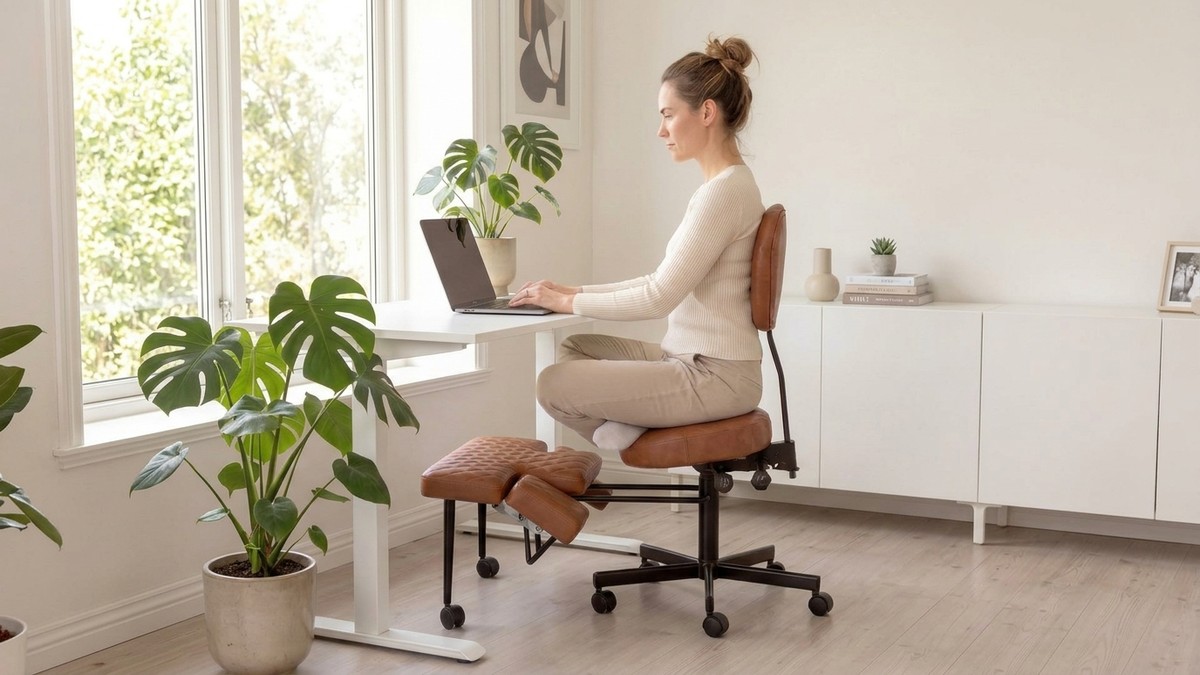
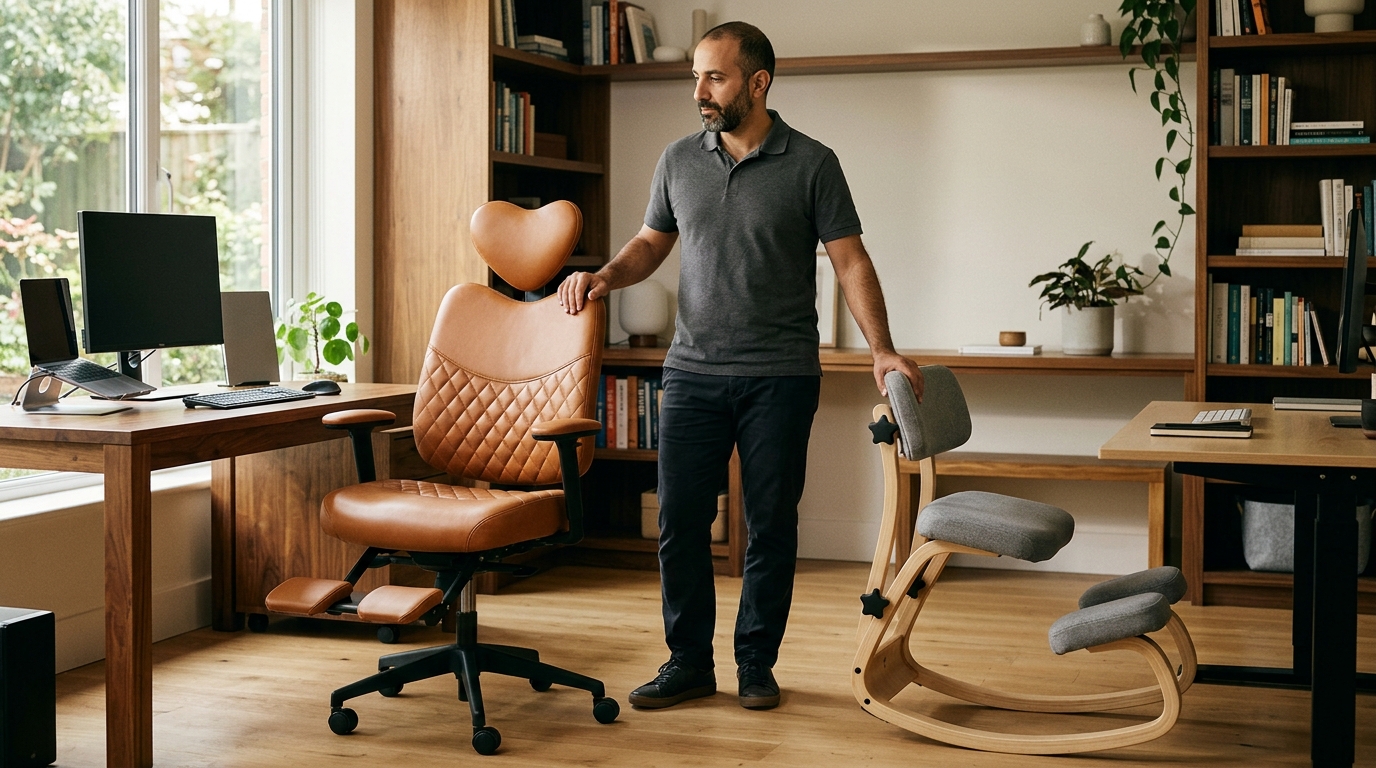
Movement freedom – one of the five dimensions covered next – is where most office furniture fails neurodivergent users. The NYPOT Criss-Cross Chair scores high on all five: movement freedom, sensory neutrality, adjustability, position variety, and simplicity of use.
The five dimensions of neuroinclusive furniture
Section 3 of 11
Every piece of neurodivergent-friendly furniture can be evaluated on five dimensions. No single product scores perfectly on all five, but understanding these dimensions helps you prioritize what matters most for your neurotype.
1. Movement freedom
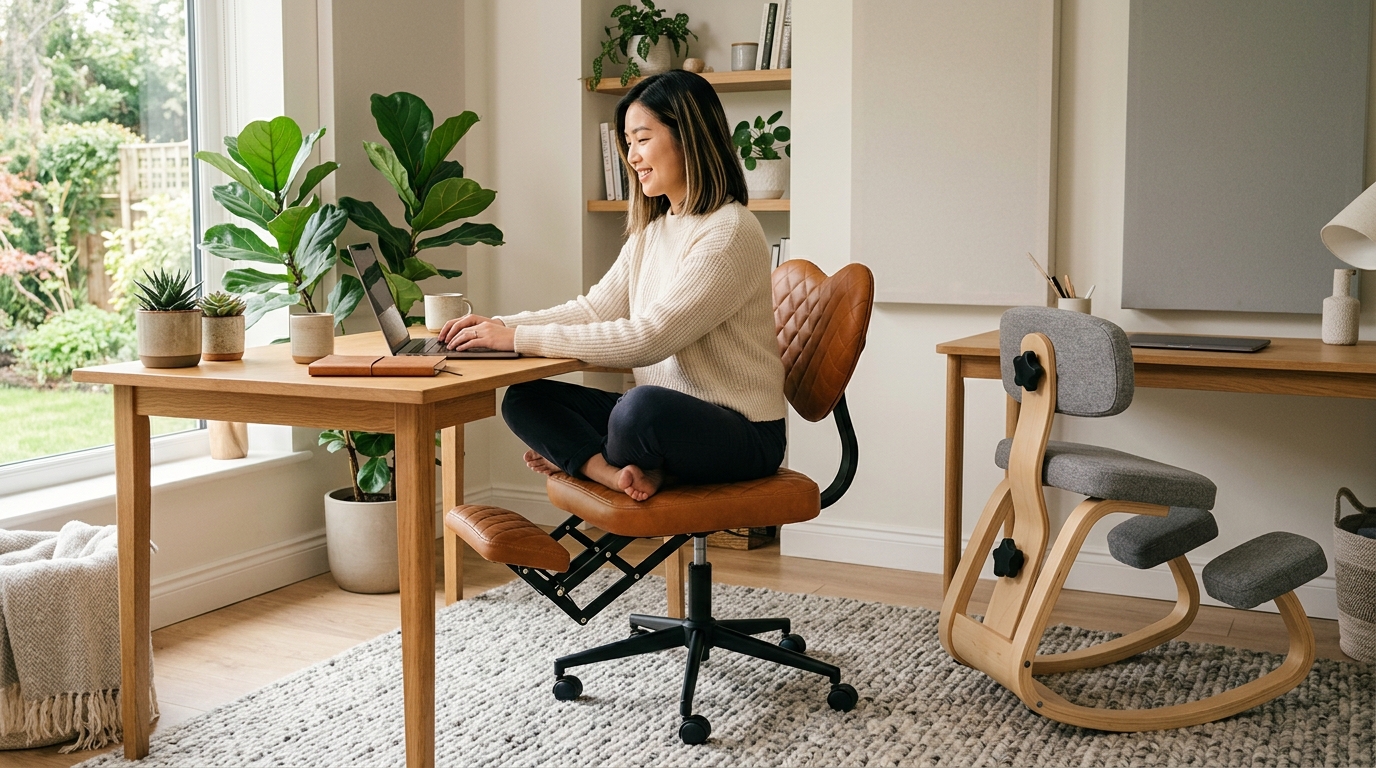
How much does this furniture allow or encourage physical movement? For ADHD brains, movement is a focus tool. For autistic individuals, repetitive movement (rocking, swaying) is a regulation strategy. Furniture that restricts movement restricts neurological self-regulation.
2. Sensory neutrality
Does this furniture introduce unwanted sensory input? Leather that sticks to skin. Fabric that scratches. Squeaky mechanisms. Sticky foam. For sensory-sensitive users, these are not minor annoyances – they are constant distractions that drain cognitive resources.
3. Adjustability
How many dimensions of this furniture can the user control? Height, tilt, depth, firmness, armrest position. The more control the user has, the more likely they can find a configuration that works for their specific neurological needs.
4. Position variety
How many distinct sitting positions does this furniture support? A standard chair supports 1-2 positions. A wide-seat chair supports 5-7+. For ADHD adults who cycle positions every 10-20 minutes, position variety is not a luxury – it is a functional requirement.
5. Simplicity of use
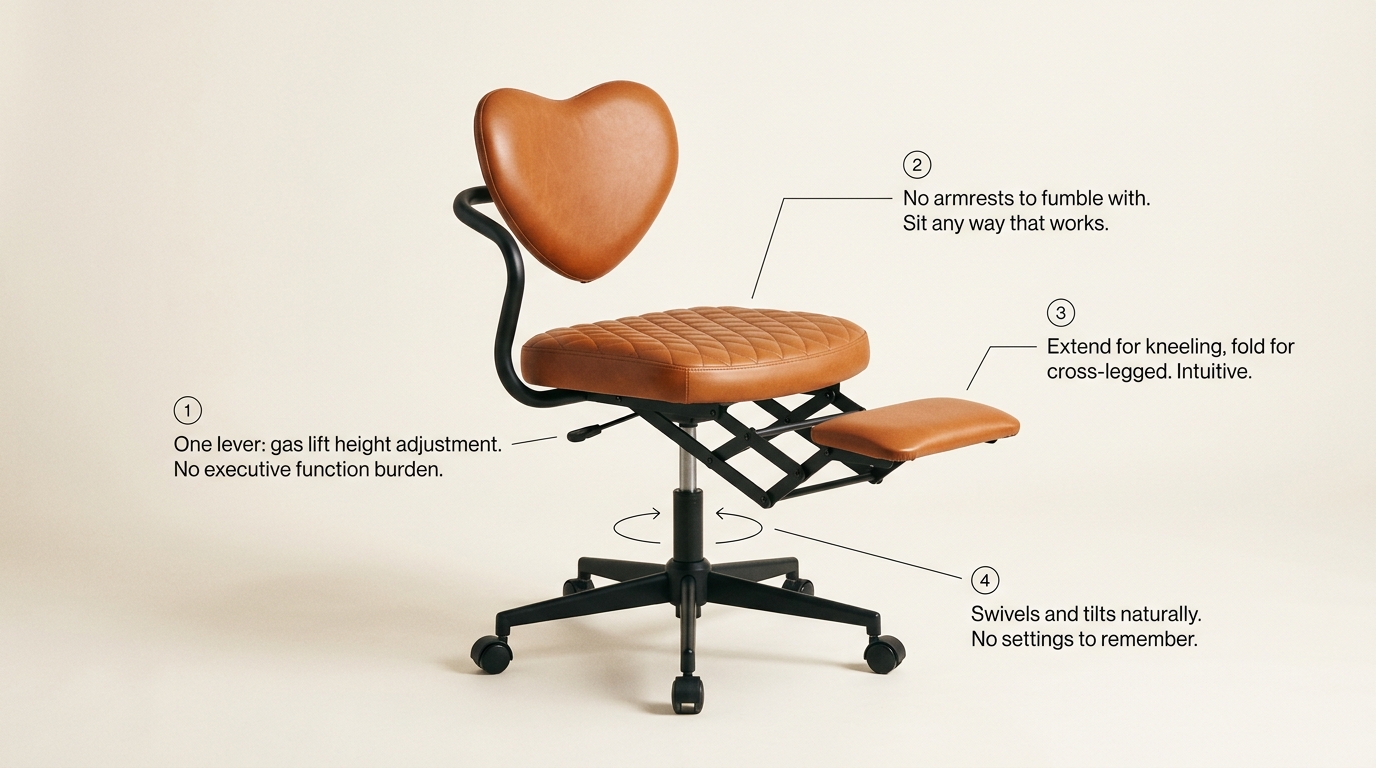
Can the user adjust this furniture without instructions, tools, or frustration? Complex adjustment mechanisms with hidden levers and unclear labels create executive function demands. For ADHD and dyspraxic users, this means the chair may never get adjusted at all.
The 5-dimension quick test
Before buying any piece of furniture, rate it 1-5 on each dimension. A total score of 20+ indicates neuroinclusive design. Below 15 suggests the furniture was designed for neurotypical users and may create friction for neurodivergent ones.
Neuroinclusive furniture checklist
Section 4 of 11
Use this checklist when evaluating any office chair, desk, or accessory for neuroinclusive design.
Chairs
- Seat width 20+ inches (supports cross-legged and tucked positions)
- No fixed armrests (or fully removable)
- Breathable mesh or fabric (temperature-neutral)
- Quiet mechanisms (no squeaks, clicks, or grinding)
- Single-lever height adjustment (simple controls)
- Stable in asymmetric positions (5-point base with quality casters)
Desks
- Height-adjustable (sit-stand) for position variety
- Matte surface (reduces glare and visual noise)
- Clean edges (no sharp corners that catch clothing or skin)
- Cable management (eliminates visual clutter)
- Adequate depth for monitor distance (24-30 inches)
Accessories
- Under-desk footrest with rocking or tilting surface
- Monitor arm for easy height/angle adjustment
- Task lighting (warm, adjustable brightness)
- Acoustic panels or noise-canceling headphones
ADHD vs. autism furniture needs: key differences
Section 5 of 11
ADHD and autism are both neurodivergent conditions, but they create different furniture needs. Many people have both (co-occurring ADHD and autism is common), so understanding the differences helps you prioritize features.
| Dimension | ADHD priority | Autism priority |
|---|---|---|
| Movement | High variety, frequent changes | Repetitive, predictable (rocking) |
| Sensory | Temperature and pressure | Texture, sound, and smell |
| Position | Many positions, low commitment | One reliable position, deep support |
| Adjustability | Quick, one-handed changes | Set once, stay consistent |
| Simplicity | Critical (executive function) | Important (change resistance) |
What this means for chair selection
ADHD-dominant needs: Wide-seat chairs with position variety. The ability to cross legs, tuck, shift, and cycle is more important than deep lumbar support or armrests.
Autism-dominant needs: Consistent proprioceptive input. A kneeling chair provides predictable joint compression and a structured position. Mesh chairs with breathable, non-textured surfaces avoid tactile triggers.
Co-occurring ADHD and autism: Start with a wide-seat chair (addresses ADHD movement needs) and add a kneeling chair as a rotation option (addresses autism’s need for structured input).
Match your neurotype to the right chair
ADHD: Criss-Cross Chair
Position variety, movement freedom, wide seat for fidgeting and leg repositioning.
Autism: Kneeling Chair
Consistent proprioceptive input, predictable positioning, structured support.
Unsure or co-occurring?
“Look for” vs. “avoid” comparison
Section 6 of 11
A quick reference for neuroinclusive furniture shopping.
| Category | Look for | Avoid |
|---|---|---|
| Seat | Wide (20+ inches), flat or gently curved | Narrow, bucket-shaped, deep bolsters |
| Material | Breathable mesh, smooth fabric | Sticky leather, vinyl, rough textiles |
| Armrests | Removable or none | Fixed, non-adjustable |
| Sound | Silent mechanisms | Squeaky tilt, creaking frame |
| Controls | Single lever, intuitive | Multiple hidden levers, complex adjustments |
| Stability | 5-point base, quality casters | 4-point base, plastic casters |
| Desk surface | Matte, solid color | Glossy, patterned, reflective |
| Desk adjustment | Electric sit-stand with memory presets | Manual crank (requires sustained effort) |
Beyond furniture: the neuroinclusive workspace
Section 7 of 11
Furniture is the foundation, but a truly neuroinclusive workspace addresses the full sensory environment.
- Lighting: Warm task lighting (2700-3500K). No flickering fluorescents. Individual control over brightness.
- Sound: Acoustic panels or white noise machines. Noise-canceling headphone policy. No open-plan ambush conversations.
- Visual environment: Minimal wall clutter. Calming colors (greens, blues, neutrals). No flashing screens or moving advertisements in sight lines.
- Temperature: Personal control matters. A small desk fan or space heater can make the difference between productive and miserable for a sensory-sensitive worker.
- Scent: Fragrance-free policy. No air fresheners, scented candles in common areas, or strong cleaning products used during work hours.
The full ADHD workspace setup guide covers each of these elements in detail.
Advocating for neuroinclusive furniture at work
Section 8 of 11
Under the ADA, neuroinclusive furniture is a reasonable workplace accommodation. You have the right to request it. Here is how to make a strong case.
- Frame it as productivity, not disability. “I work better with a wide-seat chair because it lets me maintain focus for longer periods” is more effective than “I need this because of my ADHD.”
- Provide specific product recommendations and costs. A $200-400 chair is a negligible expense compared to the cost of lost productivity or employee turnover.
- Reference the ADA Interactive Process. Employers are legally required to engage in a good-faith dialogue about accommodations. They cannot simply say no.
- Document the impact. Keep brief notes on how your current furniture affects your work. Concrete examples are more persuasive than general discomfort.
You do not need a formal diagnosis
While a diagnosis strengthens a formal ADA accommodation request, many employers will approve ergonomic furniture requests without one. Frame your request around work performance and comfort, and many HR departments will approve it as a standard ergonomic upgrade.
Sample workplace accommodation request email
Section 9 of 11
Here is a template you can adapt for your own situation.
Sample email
Subject: Ergonomic chair request – [Your Name]
Hi [Manager/HR Name],
I am writing to request an ergonomic chair upgrade that would improve my comfort and productivity. My current chair has a narrow seat and fixed armrests that restrict the movement I need to maintain focus during long work sessions.
I have researched chairs designed for diverse sitting styles and recommend the [specific chair name] at approximately $[price]. This chair has a wider seat, removable armrests, and breathable mesh that would better support my working style.
I am happy to discuss this further and can provide additional information if helpful. Thank you for considering this request.
Best,
[Your Name]
Building a neurodivergent-friendly home office
Section 10 of 11
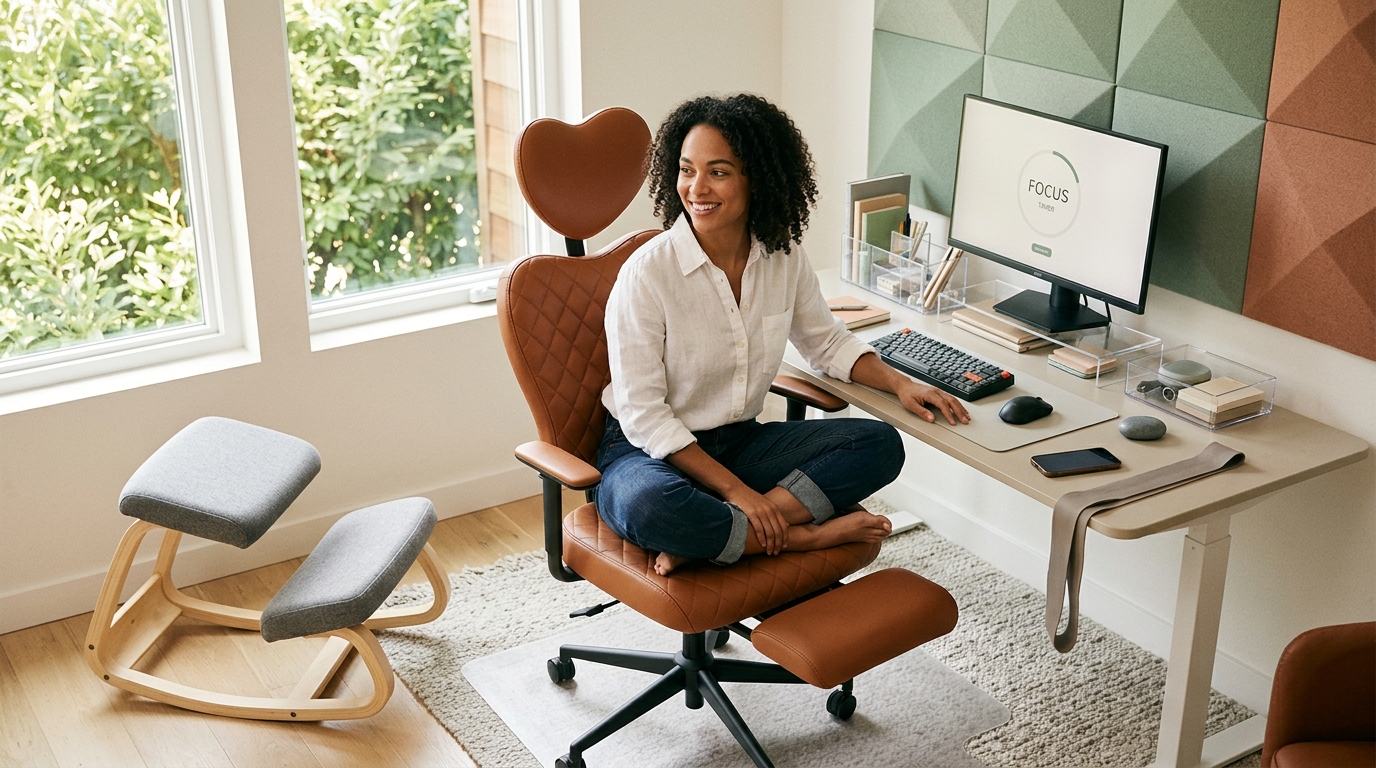
At home, you have full control. Use it. Unlike a corporate office where you may need approval, your home office is your laboratory for finding what works.
Here is the priority order based on impact:
- Chair (highest impact). A wide-seat chair that supports your movement patterns. This is the piece you touch for 8+ hours. It shapes your posture, sensory experience, and ability to self-regulate all day.
- Lighting. Warm task lamp, bias lighting behind monitor, natural light access.
- Sound control. Noise-canceling headphones, brown noise source, door that closes.
- Desk. Sit-stand if budget allows. At minimum, a desk deep enough for proper monitor distance and wide enough for organized zones.
- Accessories. Under-desk fidget tools, visual timer, clear containers for organization.
Total budget for a neuroinclusive home office: $400-800 covers everything on this list at a quality level. The chair is the largest single expense and the highest-impact purchase.
Start your neuroinclusive home office with the right chair
Your chair is the foundation of your workspace – and the piece that interacts with your sensory system for 8+ hours. Our quiz factors in neurodivergent-specific needs like movement patterns, sensory preferences, and focus requirements.
Get My Neuroinclusive Chair Match →
The bigger picture
Section 11 of 11
Neuroinclusive furniture is not a niche category. It is the future of workplace design.
As awareness of neurodivergence grows – and as remote work gives people the freedom to discover what actually works for their brains – the demand for furniture that adapts to diverse neurological needs is accelerating.
The principles in this guide are not just for neurodivergent workers. Movement freedom, sensory neutrality, adjustability, position variety, and simplicity of use make furniture better for everyone. The neuroinclusive approach does not limit design – it expands it.
If you found this guide useful, explore the related resources:
- Why ADHD brains crave cross-legged sitting
- Best chairs for ADHD adults
- The science of fidgeting and focus
- What is active sitting?
Neuroinclusive design starts with one decision
You do not need to overhaul your entire office today. Start with the one piece of furniture that shapes your posture, movement, and sensory experience all day. Our 60-second quiz finds the right one for your brain.
References
- CIPD. (2023). Neurodiversity at work: A biopsychosocial model and the impact on working adults. Chartered Institute of Personnel and Development.
- Doyle, N. (2020). Neurodiversity at work: A framework for inclusion. Harvard Business Review.
- Sarver, D. E., et al. (2015). Hyperactivity in ADHD: Compensatory behavior? Journal of Abnormal Child Psychology, 43(7), 1219-1232.
- Job Accommodation Network. (2024). Accommodation and compliance: ADHD. U.S. Department of Labor.
- Grandin, T. (2006). Thinking in Pictures: My Life with Autism (2nd ed.). Vintage Books.
- Vermeulen Design. (2025). Designing for neurodiversity: Inclusive visual content strategies.
- INTERACT 2025. Towards inclusive guidelines for web design for adults with ADHD. Springer LNCS.
Affiliate disclosure: This page contains affiliate links. ErgoLife Foundation may earn a commission at no additional cost to you. All recommendations are based on our independent research and mission to improve workplace wellness.