Key Takeaways
- Sitting increases spinal disc pressure by up to 90% compared to standing, and the damage accumulates throughout your workday.
- Viscoelastic creep causes your spinal ligaments and discs to physically deform under sustained load – your spine literally changes shape by afternoon.
- Gluteal amnesia, shortened hip flexors, and fatigued erector spinae create a muscle imbalance cycle that no amount of “sitting up straight” can fix.
- Micro-breaks every 30 minutes, posterior chain strengthening, and alternative seating can reduce back pain significantly.
- A forward-tilting seat opens the hip angle and redistributes spinal load, addressing the root biomechanical cause of sitting pain.
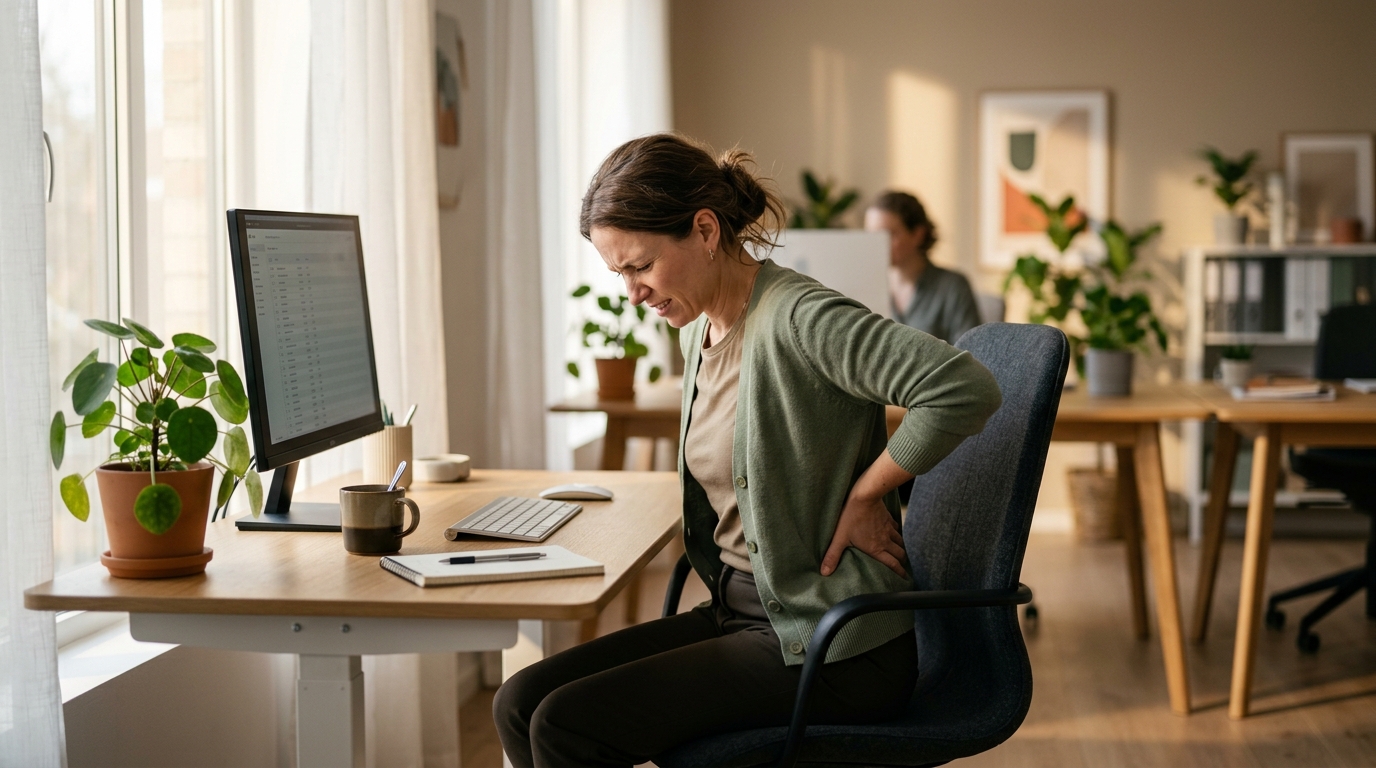
It starts as a dull ache around 2 p.m. By the time you leave the office, your lower back feels tight, stiff, and impossibly sore. You stretch. You shift in your seat. You walk to the break room. But by the next afternoon, the pain is back – same spot, same pattern, same frustration.
Image Placeholder
Anatomical side-view showing spinal compression zones during sitting, with disc pressure highlighted at L3-L5
If this sounds familiar, you are far from alone. Back pain at work is the leading cause of disability worldwide, according to the World Health Organization. An estimated 80% of adults experience lower back pain at some point, and for office workers, prolonged sitting is one of the primary triggers (Hoy et al., 2012).
But why? You are not lifting heavy objects or doing physical labor. You are just sitting. The answer lies in biomechanics – and once you understand what is happening inside your body, the solutions become much clearer.
In This Article
What Happens to Your Spine When You Sit
Your spine is not a rigid column. It is a dynamic, curved structure made up of 33 vertebrae, 23 intervertebral discs, and a complex network of muscles, ligaments, and tendons. When you stand with good posture, the spine maintains three natural curves: cervical (neck), thoracic (mid-back), and lumbar (lower back).
When you sit – especially slumped or unsupported – the lumbar curve flattens. This is called lumbar flexion, and it dramatically changes how forces distribute across your spine.
Think about that. Simply sitting at your desk can nearly double the compression on your lower spinal discs compared to standing upright. And you do this for 8 hours a day, 5 days a week.
Image Placeholder
Disc pressure comparison diagram – standing vs. sitting vs. sitting with forward lean
The Muscles That Stop Working
Disc pressure is only part of the story. When you sit for extended periods, certain muscles effectively shut down while others become overloaded. This creates a chain reaction that makes pain worse over time.
Gluteal amnesia – your largest muscle goes silent
Your gluteus maximus is the largest muscle in your body and a primary stabilizer of the pelvis and lower spine. When you sit, it is completely unloaded. Over time, prolonged sitting leads to what physiotherapists call “gluteal amnesia” – the muscles become inhibited and stop firing efficiently even when you stand up (McGill, 2015).
When your glutes stop doing their job, smaller muscles that were never designed for the role take over. This overloading contributes directly to back pain at work.
Shortened hip flexors – the silent posture saboteur
While your glutes shut down, your hip flexors – the iliopsoas muscles at the front of your hips – are locked in a shortened position. Over weeks and months, they adaptively shorten, pulling your pelvis into an anterior tilt.
The result is a vicious cycle: tight hip flexors pull the pelvis forward, weak glutes cannot counterbalance, and the lower back bears the strain. No amount of “sitting up straight” fixes this imbalance.
Image Placeholder
Side-by-side: active vs. inactive muscle groups when standing vs. sitting, with glutes and hip flexors highlighted
Erector spinae fatigue – your last line of defense
These muscles run along either side of your spine and keep you upright. During prolonged sitting, they fatigue. A 2012 study found that erector spinae endurance decreased by 26% after just two hours of continuous sitting (Gregory et al., 2012).
As these muscles fatigue, you unconsciously shift into passive postures – slumping, leaning, rounding your shoulders. This further increases spinal loading. It is a downward spiral that accelerates through the afternoon.
The Role of Your Chair (and Why It Matters Less Than You Think)
An ergonomic chair can help maintain your lumbar curve, but it is not a magic solution. Research consistently shows that even in well-designed chairs, people shift out of “correct” posture within 15 to 20 minutes (Vergara and Page, 2002).
The problem is not just the chair. It is the sitting itself. Humans evolved for movement. Static loading – holding one position for hours – is the opposite of what our musculoskeletal system is built for.
While no chair alone solves back pain, the right chair stops making it worse. The NYPOT Kneeling Chair eliminates posterior pelvic tilt – the primary driver of the spinal compression described above.
Image Placeholder
Split-screen: standard chair with 90-degree hip angle vs. kneeling chair with 110-120 degree open hip angle
The Creep Phenomenon – Why Pain Builds All Day
“Viscoelastic creep” explains why back pain builds throughout the day. Your spinal ligaments and discs are viscoelastic, meaning they deform slowly under sustained load.
When you sit for hours, the ligaments in your lower back gradually stretch, and the discs lose height as fluid is squeezed out. This creep reduces the passive stiffness of the spine, leaving more work for the active muscles. By late afternoon, your muscles are working harder to stabilize a spine that has become mechanically looser (McGill and Brown, 1992).
Image Placeholder
Timeline infographic: spinal creep progression from 9 AM (healthy) through 5 PM (maximum deformation)
Five Evidence-Based Solutions
The science points to a combination of strategies – not a single fix. Here are the five interventions with the strongest research backing.
1. Take micro-breaks every 30 minutes
A 2019 systematic review found that breaking up sitting time every 30 minutes with just 1 to 2 minutes of standing or walking significantly reduced lower back pain intensity (Parry et al., 2019). The interruption of static loading matters more than the duration of the break.
- Every 30 minutes: Stand up, walk 10-20 steps, do a gentle stretch
- Every 60 minutes: Walk to a different room for 2-3 minutes
- Every 2 hours: Do 5 minutes of targeted movement (see our desk exercises guide)
2. Optimize your workstation setup
Monitor at eye level, keyboard at elbow height, chair supporting your lumbar curve. These are not luxury improvements – they are baseline requirements for reducing spinal stress. For the complete guide, see our desk ergonomics setup guide.
3. Strengthen your posterior chain
Targeted exercises for the glutes, erector spinae, and core can counteract muscular imbalances from sitting. Dr. Stuart McGill’s “Big Three” exercises – the curl-up, side plank, and bird-dog – are supported by extensive research as safe and effective (McGill, 2015). Even 10 minutes daily makes a meaningful difference.
4. Consider alternative seating
Kneeling chairs open the hip angle to approximately 110 degrees, encouraging a more neutral lumbar curve. A study in Ergonomics found that kneeling chairs reduced lumbar flexion by 20% compared to conventional chairs (Bridger, 1988). Alternating between chair types provides the postural variety your spine needs.
5. Move outside of work
If you sit for 8 hours at work and then 4 hours at home, no chair fixes that. The WHO recommends at least 150 minutes of moderate-intensity physical activity per week. Regular activity is one of the strongest protective factors against chronic lower back pain (WHO, 2020).
Solution #6: Match Your Chair to Your Pain Pattern
The five solutions above address movement, posture, and strengthening. But if your chair recreates the compression cycle every time you sit down, you are fighting against 8 hours of bad biomechanics. Our quiz matches your specific pain pattern to ergonomic seating that supports recovery.
When to See a Professional
Not all back pain at work is purely ergonomic. Some symptoms indicate conditions beyond postural strain that require medical evaluation.
- Radiating pain down one or both legs (possible nerve involvement)
- Numbness, tingling, or weakness in your legs or feet
- Pain persisting beyond 6 weeks despite ergonomic changes and movement
- Pain with unexplained weight loss, fever, or bowel/bladder changes
- Pain that wakes you from sleep or is severe at rest
Image Placeholder
Five red-flag symptoms infographic – icons with brief labels for when to see a doctor about back pain
The Bottom Line
Your back hurts at work because prolonged sitting fundamentally changes spinal biomechanics. It increases disc pressure, deactivates stabilizing muscles, shortens hip flexors, and causes viscoelastic creep in spinal ligaments. Over time, these factors accumulate into chronic discomfort.
The solution is not a single product or behavior change. It is a combination: a supportive chair, a well-configured workstation, regular movement breaks, targeted strengthening, and physical activity outside of work.
- This week: Set a 30-minute timer for micro-breaks during your workday
- This week: Check your workstation against the ergonomics checklist
- Next week: Start McGill’s Big Three – 10 minutes daily
- This month: Try alternating between your current chair and an active seating alternative
- Ongoing: Build toward 150 minutes of weekly physical activity
Address all five factors, and your back pain can improve dramatically. You now understand why your back hurts more at 5 PM than at 9 AM. The science says the fix is within reach.
Your Back Pain Has a Biomechanical Cause. Find the Biomechanical Fix.
You now understand the creep phenomenon, muscle deactivation, and spinal loading. The next step is identifying which ergonomic intervention addresses your specific sitting pain.
Related Reading
- Exercises for lower back pain relief
- How to fix your posture
- Neck pain from desk work
- Standing desk as an alternative
- How kneeling chairs reduce disc pressure
References
- Bridger, R. S. (1988). “Postural adaptations to a sloping chair and desk surface.” Ergonomics, 31(2), 281-296.
- Gregory, D. E., et al. (2012). “Stability ball versus office chair: comparison of muscle activation and lumbar spine posture.” Applied Ergonomics, 43(6), 1078-1085.
- Hoy, D., et al. (2012). “The epidemiology of low back pain.” Best Practice & Research Clinical Rheumatology, 26(6), 769-781.
- McGill, S. M. (2015). Back Mechanic: The Secrets to a Pain-Free Spine. Backfitpro Inc.
- McGill, S. M., & Brown, S. (1992). “Creep response of the lumbar spine to prolonged full flexion.” Clinical Biomechanics, 7(1), 43-46.
- Nachemson, A. (1966). “The load on lumbar discs in different positions of the body.” Clinical Orthopaedics and Related Research, 45, 107-122.
- Parry, S., et al. (2019). “Interventions to reduce prolonged sitting in the workplace.” Scandinavian Journal of Work, Environment & Health, 45(1), 7-16.
- Vergara, M., & Page, A. (2002). “Relationship between comfort and back posture and mobility in sitting-posture.” Applied Ergonomics, 33(1), 1-8.
- WHO. (2020). WHO Guidelines on Physical Activity and Sedentary Behaviour. World Health Organization.
This article contains affiliate links. ErgoLife Foundation may earn a commission at no additional cost to you. All recommendations are based on our independent research and mission to improve workplace wellness.