In this guide
- Why sitting causes lower back pain
- How these exercises help
- 1. Seated knee-to-chest stretch
- 2. Pelvic tilts
- 3. Seated cat-cow
- 4. Standing child’s pose
- 5. Glute bridges
- 6. Seated spinal twist
- 7. Bird-dog
- 8. Standing hip flexor stretch
- 9. Dead bug
- 10. Standing lumbar extension
- Building your daily routine
- What results to expect and when
- References
Key Takeaways
- Prolonged sitting increases lower back pain risk by up to 54% – these 10 exercises directly counter the damage.
- Each exercise can be done at or near your desk with no equipment required.
- A consistent 10-minute daily routine can produce measurable pain reduction within 2 to 4 weeks.
- Exercises address symptoms, but fixing your seating setup addresses the root cause.
- Difficulty levels included so you can start where your body is today.
Lower back pain is the single most common reason people miss work. For desk workers specifically, sitting for more than 6 hours per day increases your risk of developing chronic lower back pain by 54% according to research in the Annals of Internal Medicine.
The good news is that targeted exercises can both relieve existing pain and prevent it from getting worse. These 10 exercises are specifically selected for people who work at desks. Every movement can be done at or near your workstation, requires no equipment, and takes less than 90 seconds each.
Understanding why your back hurts at work makes these exercises more effective because you will know exactly which muscles need attention and why.
In This Article
- Why sitting causes lower back pain
- How these exercises help
- 1. Seated knee-to-chest stretch
- 2. Pelvic tilts
- 3. Seated cat-cow
- 4. Standing child’s pose
- 5. Glute bridges
- 6. Seated spinal twist
- 7. Bird-dog
- 8. Standing hip flexor stretch
- 9. Dead bug
- 10. Standing lumbar extension
- Building your daily routine
- What results to expect and when
Why sitting causes lower back pain
Sitting compresses your lumbar discs, shortens your hip flexors, and deactivates the muscles that stabilize your lower back. This triple hit explains why back pain is so common among desk workers.
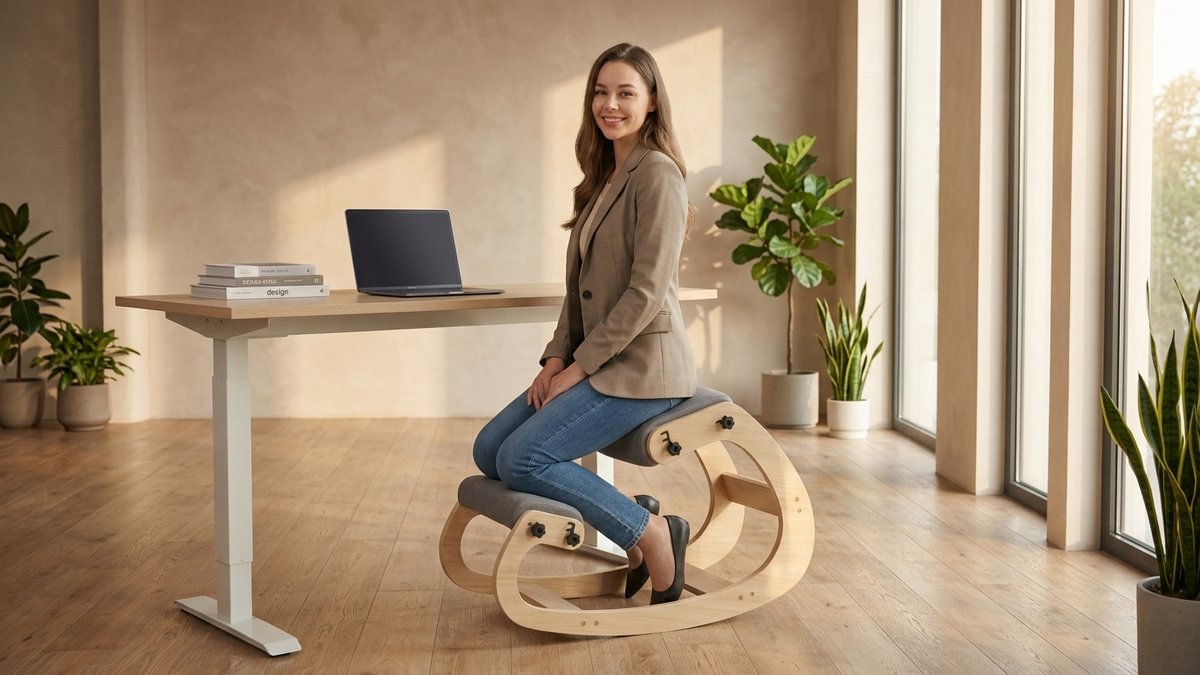
When you sit in a standard chair, your pelvis tilts backward. This flattens your lumbar curve and shifts disc pressure to the posterior side of each vertebra. Research by Nachemson showed that unsupported sitting creates 40% more disc pressure than standing.
Simultaneously, your hip flexors shorten and your glute muscles stop firing. Your lower back muscles must compensate for this lost stability, leading to fatigue, spasm, and eventually chronic pain. The exercises below target each component of this problem.
These exercises address the symptoms, but if your chair is the root cause of your lumbar compression, no amount of stretching will fix what 8 hours of bad posture creates. Our Chair Finder Quiz can identify whether your seating setup is part of the problem.
How these exercises help
These exercises work by reversing the three mechanisms of sitting-related back pain. Stretches restore length to shortened muscles. Strengthening exercises reactivate dormant stabilizers. Mobility drills restore healthy movement patterns to stiff joints.
For best results, perform these exercises twice daily – once mid-morning and once mid-afternoon. Consistency matters more than intensity. A gentle 10-minute routine done daily outperforms an aggressive 30-minute session done twice a week.
1. Seated knee-to-chest stretch
Difficulty: Beginner | Time: 60 seconds | Targets: Lower back, hip flexors, glutes
- Sit upright in your chair with both feet flat on the floor.
- Place both hands under your right knee and gently pull it toward your chest.
- Hold for 15 to 20 seconds. You should feel a gentle stretch in your lower back and hip.
- Lower your leg slowly and repeat on the left side.
- Complete 2 repetitions per side.
Why it works: This stretch gently decompresses the lumbar spine and lengthens the hip flexor on the stretching side. It is one of the safest lower back stretches because you control the intensity entirely with your hands.
2. Pelvic tilts
Difficulty: Beginner | Time: 60 seconds | Targets: Lower back, deep core, pelvic stabilizers
- Sit upright with your hands on your thighs.
- Tilt your pelvis forward (arching your lower back) and hold for 3 seconds.
- Tilt your pelvis backward (flattening your lower back) and hold for 3 seconds.
- Move slowly between these two positions for 10 repetitions.
Why it works: Pelvic tilts restore the mobility that static sitting removes. They teach your pelvis to move through its full range of motion and activate the deep stabilizer muscles that become dormant during prolonged sitting.
3. Seated cat-cow
Difficulty: Beginner | Time: 60 seconds | Targets: Full spine mobility, core activation
- Sit on the edge of your chair with feet flat on the floor.
- Inhale and arch your back, pushing your chest forward and lifting your chin slightly (cow position).
- Exhale and round your back, tucking your chin to your chest and pulling your navel toward your spine (cat position).
- Flow between these two positions for 8 to 10 repetitions, moving with your breath.
Why it works: Seated cat-cow mobilizes every segment of your spine. It counteracts the static flexed position that sitting creates and stimulates the intervertebral discs through gentle compression and decompression cycles.
4. Standing child’s pose
Difficulty: Beginner | Time: 45 seconds | Targets: Lower back, lats, shoulders
- Stand facing your desk and place both palms flat on the desk surface.
- Walk your feet back until your arms are fully extended and your torso is roughly parallel to the floor.
- Let your chest sink toward the floor while keeping your arms straight. You should feel a long stretch through your entire back.
- Hold for 20 to 30 seconds, breathing deeply.
Why it works: This standing variation of child’s pose decompresses the lumbar spine under gravity while also stretching the latissimus dorsi muscles. Tight lats contribute to both shoulder rounding and lower back compression.
5. Glute bridges
Difficulty: Intermediate | Time: 90 seconds | Targets: Glutes, hamstrings, lower back stabilizers
- Lie on your back with knees bent and feet flat on the floor (use a yoga mat or carpet).
- Squeeze your glutes and lift your hips until your body forms a straight line from knees to shoulders.
- Hold at the top for 3 seconds, focusing on glute contraction.
- Lower slowly and repeat for 10 to 12 repetitions.
Why it works: Glute bridges directly address “dead butt syndrome” by reactivating the gluteus maximus. Strong glutes take stabilization load off your lower back. This is arguably the single most important exercise for desk workers with lower back pain.
6. Seated spinal twist
Difficulty: Beginner | Time: 60 seconds | Targets: Thoracic spine rotation, obliques, lower back
- Sit upright in your chair with feet flat on the floor.
- Place your right hand on the outside of your left knee.
- Gently rotate your torso to the left, using your hand for light leverage.
- Hold for 15 to 20 seconds, breathing into the stretch.
- Return to center and repeat on the opposite side.
Why it works: Sitting restricts thoracic rotation. Restoring this rotation reduces compensatory movement in the lumbar spine, which is a common cause of lower back strain during everyday activities like reaching, turning, and even walking.
7. Bird-dog
Difficulty: Intermediate | Time: 90 seconds | Targets: Deep core, multifidus, glutes, balance
- Start on all fours with hands under shoulders and knees under hips.
- Extend your right arm forward and left leg backward simultaneously.
- Hold for 5 seconds, keeping your core tight and back flat – do not let your hips rotate.
- Return to starting position and repeat with the opposite arm and leg.
- Complete 8 repetitions per side.
Why it works: Dr. Stuart McGill, one of the world’s leading spine biomechanists, considers bird-dog part of the “Big Three” core stabilization exercises. It strengthens the multifidus muscles that directly stabilize each vertebral segment.
8. Standing hip flexor stretch
Difficulty: Beginner | Time: 60 seconds | Targets: Psoas, iliacus, rectus femoris
- Stand in a split stance with your right foot forward and left foot back.
- Bend your front knee slightly and tuck your pelvis under (posterior pelvic tilt).
- You should feel a deep stretch in the front of your left hip.
- Hold for 20 to 30 seconds per side. Do not arch your lower back.
Why it works: This stretch directly counteracts the hip flexor shortening that happens during sitting. Tight hip flexors pull your pelvis into anterior tilt when standing, which compresses the lumbar discs. Combining this stretch with desk stretches you can do in 5 minutes creates a solid mid-day reset.
9. Dead bug
Difficulty: Intermediate | Time: 90 seconds | Targets: Deep core, transverse abdominis, pelvic floor
- Lie on your back with arms extended toward the ceiling and knees bent at 90 degrees (tabletop position).
- Press your lower back firmly into the floor – this is the key position to maintain.
- Slowly extend your right arm overhead and your left leg straight, hovering just above the floor.
- Return to starting position and repeat with the opposite arm and leg.
- Complete 8 repetitions per side. If your lower back lifts off the floor, reduce your range of motion.
Why it works: Dead bug teaches your deep core to stabilize your pelvis independently of your limbs. This directly translates to better lumbar stability during sitting, standing, and transitioning between positions.
10. Standing lumbar extension
Difficulty: Beginner | Time: 30 seconds | Targets: Lumbar extensors, disc rehydration
- Stand with feet shoulder-width apart and hands on your lower back.
- Gently lean backward, supporting your lower back with your hands.
- Hold the extended position for 3 to 5 seconds.
- Return to upright and repeat 5 times.
Why it works: Standing lumbar extension is the direct antidote to seated flexion. It shifts disc pressure from the posterior side (where sitting concentrates it) to the anterior side, promoting more even disc hydration. Robin McKenzie, a pioneer in back pain treatment, considered this movement essential for anyone who sits for extended periods.
Building your daily routine
The most effective approach is two short sessions per day rather than one long one. Here is a practical routine that takes 10 minutes total.
Morning session (5 minutes) – at your desk:
- Seated knee-to-chest stretch – 2 reps per side (60 seconds)
- Pelvic tilts – 10 reps (60 seconds)
- Seated cat-cow – 8 reps (60 seconds)
- Seated spinal twist – 20 seconds per side (40 seconds)
- Standing lumbar extension – 5 reps (30 seconds)
Afternoon session (5 minutes) – away from desk:
- Standing child’s pose – 30 seconds
- Standing hip flexor stretch – 25 seconds per side (50 seconds)
- Bird-dog – 8 reps per side (90 seconds)
- Standing lumbar extension – 5 reps (30 seconds)
On days when you have more time, add glute bridges and dead bugs. These strengthening exercises provide the most long-term benefit but require lying on the floor. A yoga mat under your desk makes this practical. For more on building habits that stick, see fixing your posture to prevent pain.
What results to expect and when
Consistency is what determines results, not intensity. Here is a realistic timeline based on exercise physiology research and clinical outcomes data.
- Week 1-2: Reduced stiffness at end of workday. Less “morning startup” pain. Movements feel easier.
- Week 3-4: Measurable pain reduction during sitting. Improved ability to maintain upright posture without effort.
- Week 5-8: Significant strength gains in core and glutes. Pain episodes become less frequent and less intense.
- Month 3+: Postural habits begin to feel automatic. Many people report that their back pain has shifted from “daily problem” to “occasional reminder.”
These exercises work best when your seating supports the improvements you are building. If your chair re-creates lumbar compression every time you sit back down, your exercises are fighting an uphill battle. Optimizing your desk setup to reduce back strain amplifies every minute of exercise you do.
Stretches help. Fixing the root cause helps more.
These exercises relieve lower back pain – but they work best when your chair is not re-creating the compression every time you sit down. Our 60-second quiz matches your pain patterns to ergonomic seating that prevents the problem at the source.
Find My Back-Friendly Chair →
References
- Nachemson, A. (1976). The lumbar spine: An orthopedic challenge. Spine, 1(1), 59-71.
- Biswas, A., et al. (2015). Sedentary time and its association with risk for disease incidence, mortality, and hospitalization in adults. Annals of Internal Medicine, 162(2), 123-132.
- McGill, S. (2016). Low Back Disorders: Evidence-Based Prevention and Rehabilitation (3rd ed.). Human Kinetics.
- McKenzie, R. (2011). Treat Your Own Back (9th ed.). Spinal Publications.
- Shiri, R., et al. (2019). The role of physical activity in the prevention of low back pain. PLOS ONE, 14(1), e0210507.
- Steffens, D., et al. (2016). Prevention of low back pain: A systematic review and meta-analysis. JAMA Internal Medicine, 176(2), 199-208.