Key Takeaways
- Upright posture reliably improves mood and feelings of confidence, even after the “power pose” hormone claims were debunked (Cuddy et al., 2018 meta-analysis of 55 studies)
- Slouching amplifies negative emotions – participants in slumped postures recalled more negative memories and developed helplessness faster
- Posture affects breathing, and breathing affects mood – a slouched position can reduce lung capacity by up to 30%, triggering stress responses
- The slouch-mood cycle is real – poor posture lowers mood, low mood worsens posture, and the loop deepens without intervention
- Small posture resets throughout the day accumulate into meaningful mood improvements – you do not need perfection, you need awareness
You probably think of posture as a back problem. Something your doctor mentions, your mother nagged about, and your desk chair slowly ruins.
But a growing body of research shows that posture is also a mood problem. The way you hold your body does not just affect your spine – it sends signals to your brain that influence how you feel, how you think, and how you respond to stress.
This is not pop psychology. It is grounded in decades of peer-reviewed research in embodied cognition, psychophysiology, and clinical psychology. And the practical implications are surprisingly accessible – because unlike many factors that shape your mood, your posture is something you can change right now.
Image Coming Soon
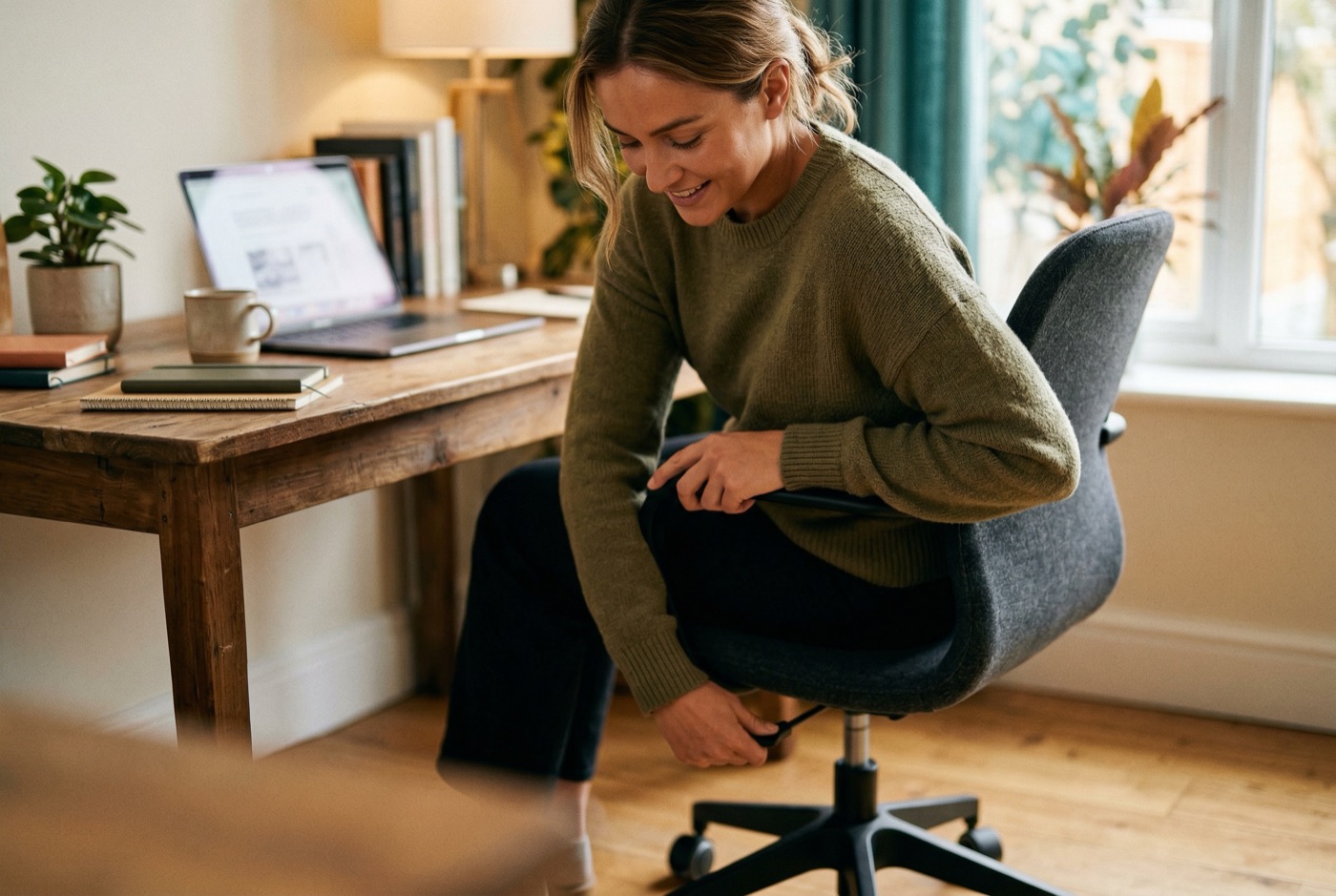
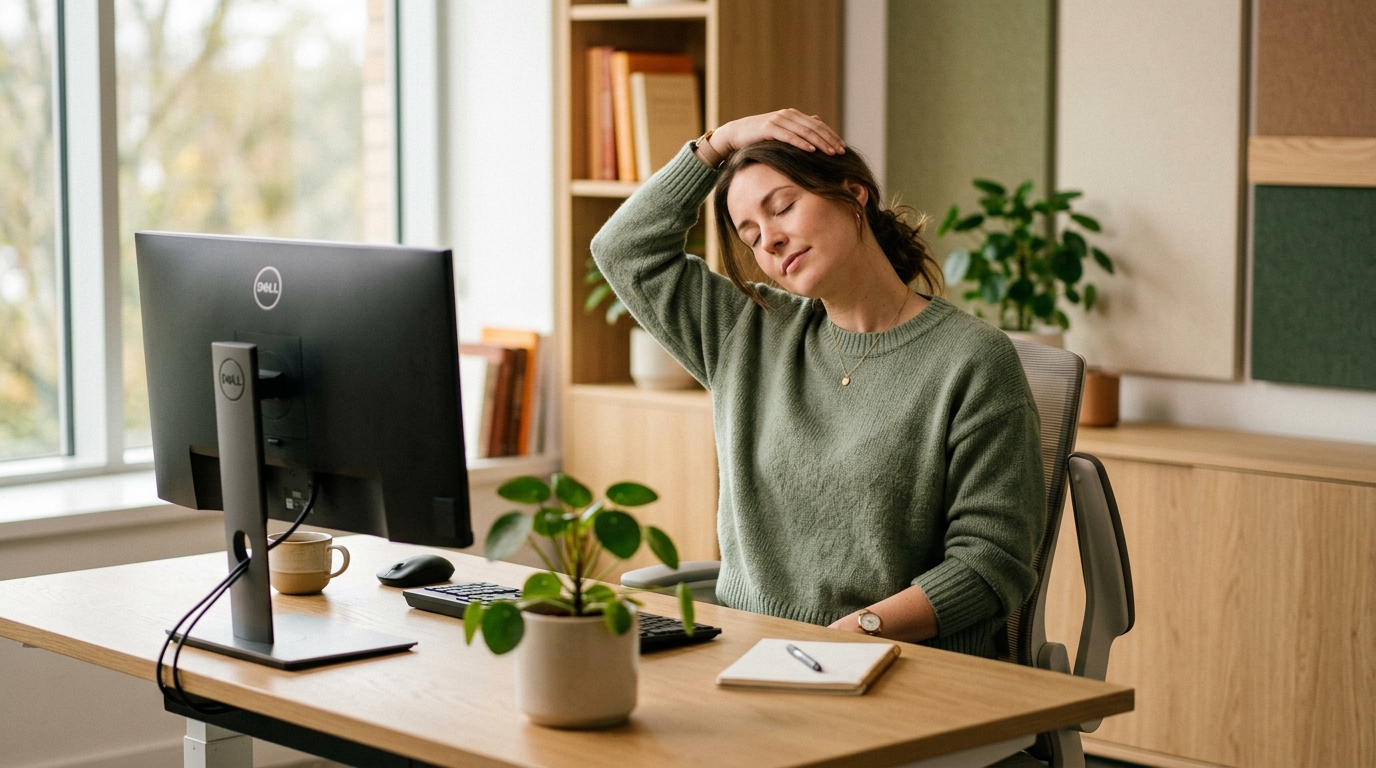
Person sitting upright at a desk with calm, confident expression – warm natural light, open workspace – woman in her 30s, soft green and neutral tones
In This Article
- The research – how posture talks to your brain
- What the confidence studies actually found
- The slouch effect – when collapsed posture worsens mood
- The slouch-mood cycle and how it deepens
- The breathing connection – posture, oxygen, and stress
- What to do about it
- Your daily posture-mood reset
- What posture cannot do
The Research: How Posture Talks to Your Brain
For most of modern psychology’s history, the brain was treated as the boss. It sends commands downward – to your muscles, organs, and limbs – and the body obeys.
But over the past three decades, a field called embodied cognition has fundamentally challenged that view. The core insight is simple and powerful: your brain does not just send signals to your body. It reads your body for information about how you are doing.
When you slouch, your brain interprets the physical signals – compressed chest, lowered gaze, folded-in shoulders – as consistent with withdrawal, fatigue, or defeat. This interpretation subtly shifts your emotional state in that direction, especially when you are already under stress.
This is not metaphor. It is measurable. And the research base is substantial, spanning studies from psychology, neuroscience, and clinical rehabilitation.
Image Coming Soon
Split brain-body illustration showing bidirectional arrows between posture and mood – left side shows slouched posture with negative mood indicators, right side shows upright posture with positive indicators – clean infographic
What the Confidence Studies Actually Found
You have probably heard of the “power pose” phenomenon – Amy Cuddy’s 2012 TED Talk claimed that standing in an expansive posture for two minutes could increase testosterone, decrease cortisol, and make you more willing to take risks.
The science community pushed back hard. A 2015 replication by Ranehill and colleagues failed to reproduce the hormonal changes. One of the original co-authors publicly disavowed the testosterone and cortisol findings.
But here is what gets lost in the backlash: the hormonal claims collapsed, but the psychological effects held up.
The Nair studies – posture under stress
Some of the most compelling evidence comes from Shwetha Nair and colleagues at the University of Auckland. In a 2015 study published in Health Psychology, participants who sat upright during a stress task reported higher self-esteem, better mood, and lower fear compared to those who sat slumped.
The upright sitters also used more positive words and fewer negative words in a subsequent speech task. Their posture did not just change how they felt – it changed how they communicated.
Depression and upright posture
A 2017 study by Wilkes, Kydd, Sagar, and Broadbent examined participants with mild to moderate depression. Those instructed to sit upright showed reduced fatigue and increased positive affect compared to those who maintained their habitual posture.
The nuanced takeaway: upright posture does not magically create confidence. But it does appear to support and reinforce positive emotional states. It is one input among many, and it works best as part of a broader pattern of self-care.
Image Coming Soon
Person in an upright, confident posture during a meeting or presentation – body language showing openness and energy – man in his 40s, modern conference room
The Slouch Effect: When Collapsed Posture Worsens Mood
If upright posture supports positive emotions, the reverse also appears true. Research consistently finds that slouched, collapsed postures are associated with increased negative emotional states.
Slouching changes what you remember
A 2014 study by Michalak, Mischnat, and Teismann found that participants who walked with a slouched, downward-gazing posture recalled significantly more negative words from a previously memorized list compared to those who walked upright.
The posture did not just reflect mood – it actively shifted what people remembered and paid attention to.
Slouching accelerates helplessness
In a foundational 1982 study, Riskind and Gotay demonstrated that participants placed in slumped postures developed feelings of helplessness more quickly than those in upright positions – even when the task difficulty was identical. The body’s position primed the mind to give up sooner.
The Slouch-Mood Cycle: How It Deepens
The relationship between posture and mood is not a one-time event. It is a self-reinforcing cycle that builds through your workday. Each hour of slouching deepens the loop.
It starts with fatigue. You sit for hours and gradually slouch. Slouching sends “withdrawal” signals to your brain. Your mood drops – less energy, more negative thinking. Lower mood reduces your motivation to sit well or move. You slouch deeper, the signals intensify, and the cycle continues.
This feedback loop accelerates through the workday. By mid-afternoon, you are not just tired from your work. You are tired from hours of your body telling your brain things are worse than they are.
- Notice it: Set a reminder every 45 minutes to check your posture
- Interrupt it: Stand up, roll your shoulders, take three breaths
- Reset it: Sit back down with intention – feet planted, chest open
- Sustain it: Use environmental triggers (water breaks, meetings) as reset cues
- Prevent it: Choose a chair that makes slouching harder by default
Breaking the slouch-mood cycle requires a physical interruption. Active sitting chairs like the NYPOT Kneeling Chair make slouching biomechanically difficult – your pelvis tilts forward, your spine stacks, and the collapsed posture that feeds negative thought patterns becomes the harder position to hold.
Image Coming Soon
Illustration of the slouch-mood cycle as a circular diagram with 5 steps – showing how poor posture and low mood reinforce each other – clean infographic with green and terracotta accents
The Breathing Connection: Posture, Oxygen, and Stress
One of the most concrete pathways from posture to mood runs through your respiratory system. How you sit directly affects how you breathe, and how you breathe directly affects your emotional state.
Slouching reduces your oxygen supply
When you sit slumped, your ribcage compresses and your diaphragm cannot descend fully. Research by Lee, Chang, and Tsauo (2015) measured lung function in different sitting postures and found that a slumped position reduced forced vital capacity by up to 30% compared to upright sitting.
That is 30% less air per breath. Over a full workday, that translates to chronic mild oxygen reduction. It is not dangerous, but it is enough to affect energy levels, cognitive clarity, and mood.
Shallow breathing activates your stress response
Posture-related breathing restrictions push people toward shallow, chest-dominant breathing rather than deep, diaphragmatic breathing.
Deep diaphragmatic breathing activates the parasympathetic nervous system, reducing cortisol and promoting calm. Shallow chest breathing does the opposite – it activates the sympathetic nervous system, increasing heart rate and amplifying anxiety.
A 2021 study in Frontiers in Psychology found that diaphragmatic breathing exercises significantly reduced cortisol levels. Critically, the researchers noted that postural correction was a prerequisite for effective diaphragmatic breathing (Magnon, Dutheil, and Vallet, 2021). You cannot breathe deeply from your diaphragm when your chest is compressed.
The chain reaction: Poor posture restricts breathing. Restricted breathing activates stress responses. Stress responses worsen mood. Posture is the first domino.
Image Coming Soon
Side-by-side comparison of lung capacity in upright versus slouched posture – anatomical overlay showing compressed versus expanded ribcage – clean medical illustration with labeled differences
What to Do About It: Evidence-Based Strategies
Understanding the research is useful, but applying it is what actually changes your day. Here are strategies backed by the studies above.
1. The posture check-in (3 to 4 times daily)
Set reminders throughout your workday. When one goes off, ask yourself: Am I slumped? Are my shoulders elevated? Is my chest compressed? Then make a simple adjustment: roll your shoulders back, lift your sternum slightly, and take three deep breaths.
This works because the mood-boosting effects of posture changes are immediate. The Nair studies showed improved mood within minutes of adopting an upright posture.
2. The pre-meeting power-up
Before an important meeting, presentation, or difficult conversation, spend 60 seconds sitting or standing in an expanded, upright posture. Take slow, deep breaths. This is not about faking confidence. It is about putting your body in a state that supports the emotional resources you need.
3. The mid-afternoon reset
The mid-afternoon energy dip (typically between 2:00 and 3:30 PM) is partly postural. A deliberate reset – standing up, stretching, sitting back down with intention – combined with deep breathing can counteract both the physical fatigue and the mood dip.
Image Coming Soon
Woman in her 50s taking a deep breath at her standing desk during a mid-afternoon break – warm afternoon light through window – open, airy corporate office
4. Address the environment, not just the habit
Behavioral science consistently shows that environment design outperforms willpower. If your chair lets you collapse, you will collapse. A chair with a forward-tilting seat naturally opens your chest and maintains the upright posture the mood research associates with positive emotional states.
Add an Eighth Strategy: Change What You Sit On
The seven strategies above require conscious effort. Your chair shapes your posture unconsciously for 8+ hours. An active sitting chair that prevents slouching is the highest-leverage intervention on this list – and the one that requires zero willpower.
Your Daily Posture-Mood Reset: Micro-Habits That Add Up
You do not need a new routine. You need small posture resets woven into what you already do.
Before you open your laptop
Sit down. Plant your feet. Roll your shoulders back once. Take one deep breath with your chest open. This takes 10 seconds and sets a postural baseline for your first work block.
Every time you sip water
Use your water break as a posture check. Reach for your glass, then ask: am I slouching? Adjust. If you drink 6 to 8 times a day, that is 6 to 8 posture resets with zero extra effort.
When a meeting ends
Before you click into the next task, stand for 30 seconds. Stretch your arms overhead. Take two deep breaths. Sit back down with intention. This prevents the “meeting to meeting slouch spiral” that builds through the day.
Your evening wind-down
Three minutes of gentle stretching before bed counteracts the day’s accumulated tension. Focus on opening your chest and rolling your shoulders – the areas most compressed by desk work. Learn more about exercises to improve your posture.
“Your best posture is your next posture.” No single position should be held all day. The goal is awareness and variety, not rigidity. Explore how active sitting supports better posture and mood.
Image Coming Soon
Person doing a simple posture reset at their desk – rolling shoulders back, deep breath, calm expression – afternoon light, home office – woman in her 40s
An Important Caveat: What Posture Cannot Do
The research on posture and mood is genuine and growing. But it is important to keep it in perspective. Posture is one factor among many that influence emotional well-being. It is not a replacement for professional mental health care, medication when needed, social support, exercise, or sleep.
What the research does tell us is that the physical and emotional are more connected than most people realize. How you hold your body matters – not as a magic fix, but as a real, measurable influence on how you think, feel, and experience your day. Understanding how pain from poor posture compounds the problem can help you break the cycle.
Sit taller. Breathe deeper. Notice how it feels. That is where it starts.
Image Coming Soon
Calm, confident person at an organized workspace with good posture – natural light, plants, minimal desk setup – man in his 30s, warm and inviting home office
Your Mood Starts With Your Posture. Your Posture Starts With Your Chair.
The research is clear: upright posture improves energy, confidence, and stress resilience. Our 60-second quiz finds the chair that makes upright your default – not something you have to remember.
Related reading
- How to Fix Your Posture: Exercises and Daily Habits
- 5 Stretches You Can Do at Your Desk in Under 5 Minutes
- What Is Active Sitting? The Science of Moving While You Work
References
- Cuddy, A. J. C., Schultz, S. J., and Fosse, N. E. (2018). “P-curving a more comprehensive body of research on postural feedback reveals clear evidential value for power-posing effects.” Psychological Science, 29(4), 656-666.
- Lee, L. J., Chang, A. T., and Tsauo, J. Y. (2015). “The effect of sitting posture on lung function.” Journal of Physical Therapy Science, 27(4), 1049-1051.
- Magnon, V., Dutheil, F., and Vallet, G. T. (2021). “Benefits from one session of deep and slow breathing on vagal tone and anxiety.” Frontiers in Psychology, 12, 624254.
- Michalak, J., Mischnat, J., and Teismann, T. (2014). “Sitting posture makes a difference – embodiment effects on depressive memory bias.” Clinical Psychology and Psychotherapy, 21(6), 519-524.
- Nair, S., et al. (2015). “Do slumped and upright postures affect stress responses?” Health Psychology, 34(6), 632-641.
- Ranehill, E., et al. (2015). “Assessing the robustness of power posing: No effect on hormones and risk tolerance in a large sample of men and women.” Psychological Science, 26(5), 653-656.
- Riskind, J. H., and Gotay, C. C. (1982). “Physical posture: Could it have regulatory or feedback effects on motivation and emotion?” Motivation and Emotion, 6(3), 273-298.
- Wilkes, C., et al. (2017). “Upright posture improves affect and fatigue in people with depressive symptoms.” Journal of Behavior Therapy and Experimental Psychiatry, 54, 143-149.
This article contains affiliate links. ErgoLife Foundation may earn a commission at no additional cost to you. All recommendations are based on our independent research and mission to improve workplace wellness.