Key takeaways
- A kneeling chair is an ergonomic seat that positions your hips at 60 to 70 degrees
- encourages your pelvis to tilt forward
- Quick comparison:
- preserves the natural lumbar curve while reducing disc pressure
- naturally adopted more upright, relaxed posture
What Is a Kneeling Chair?
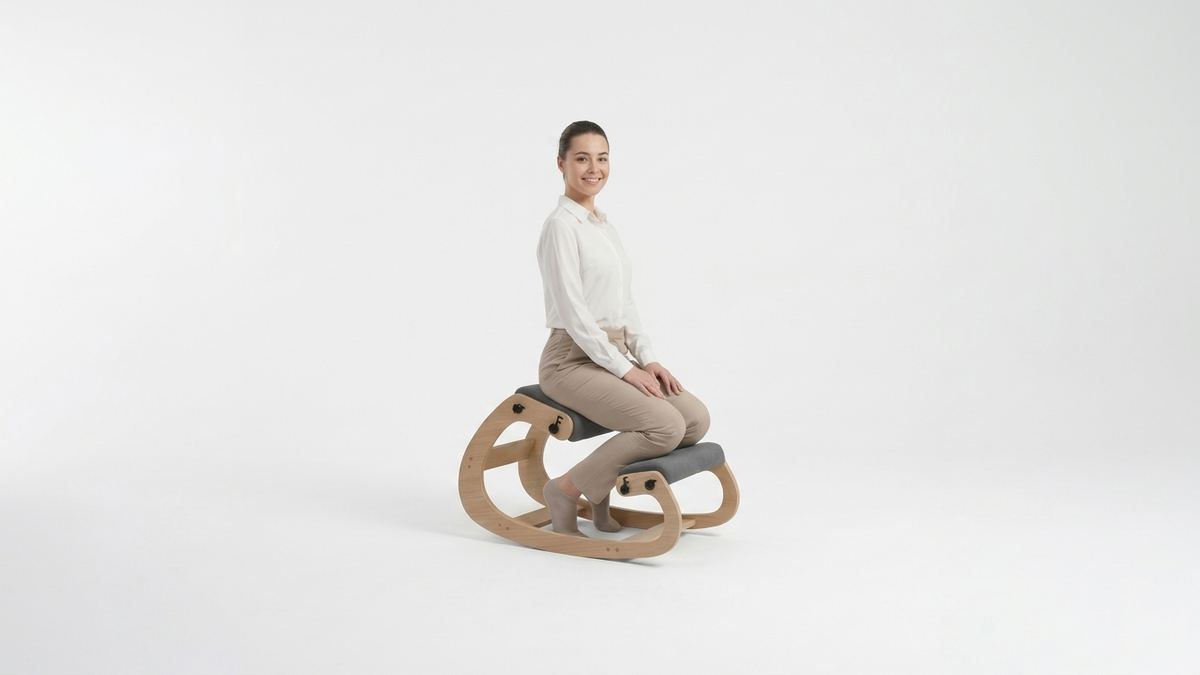
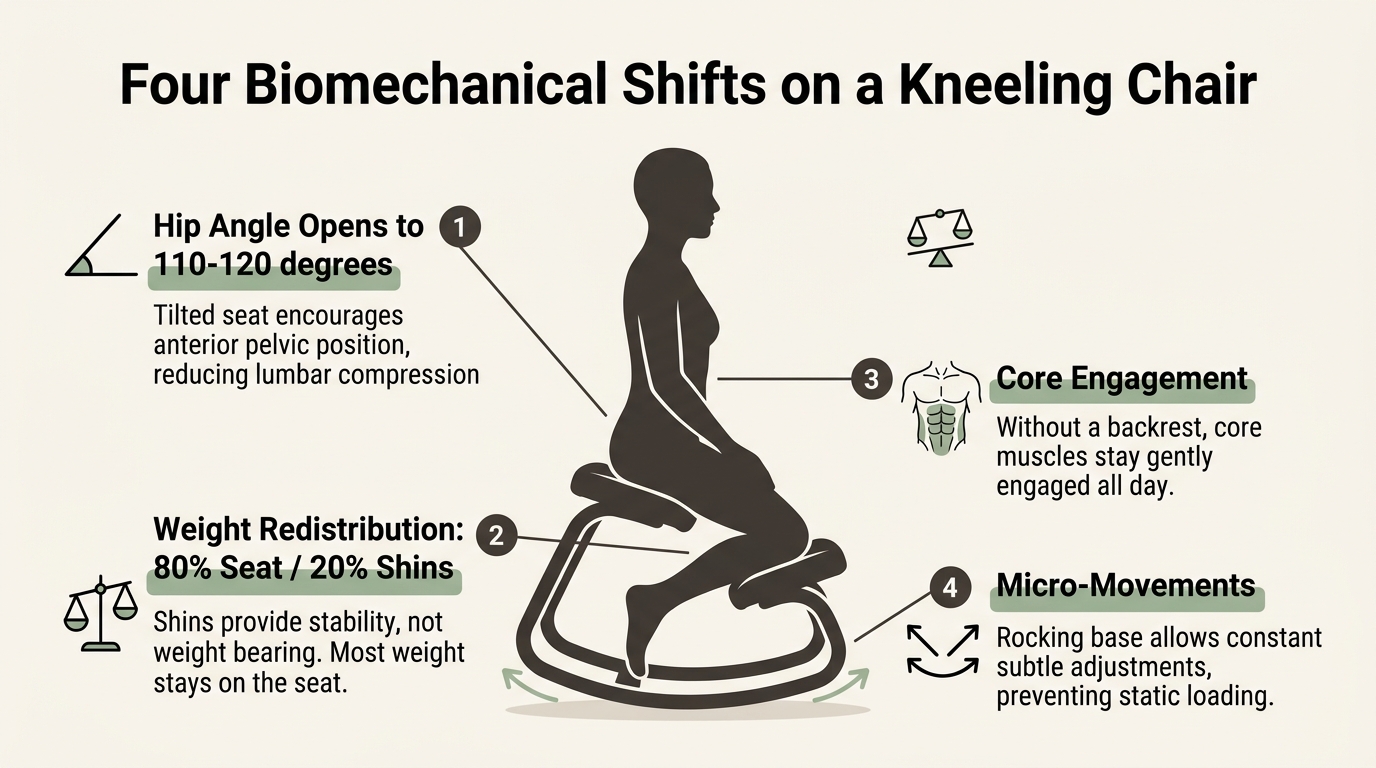
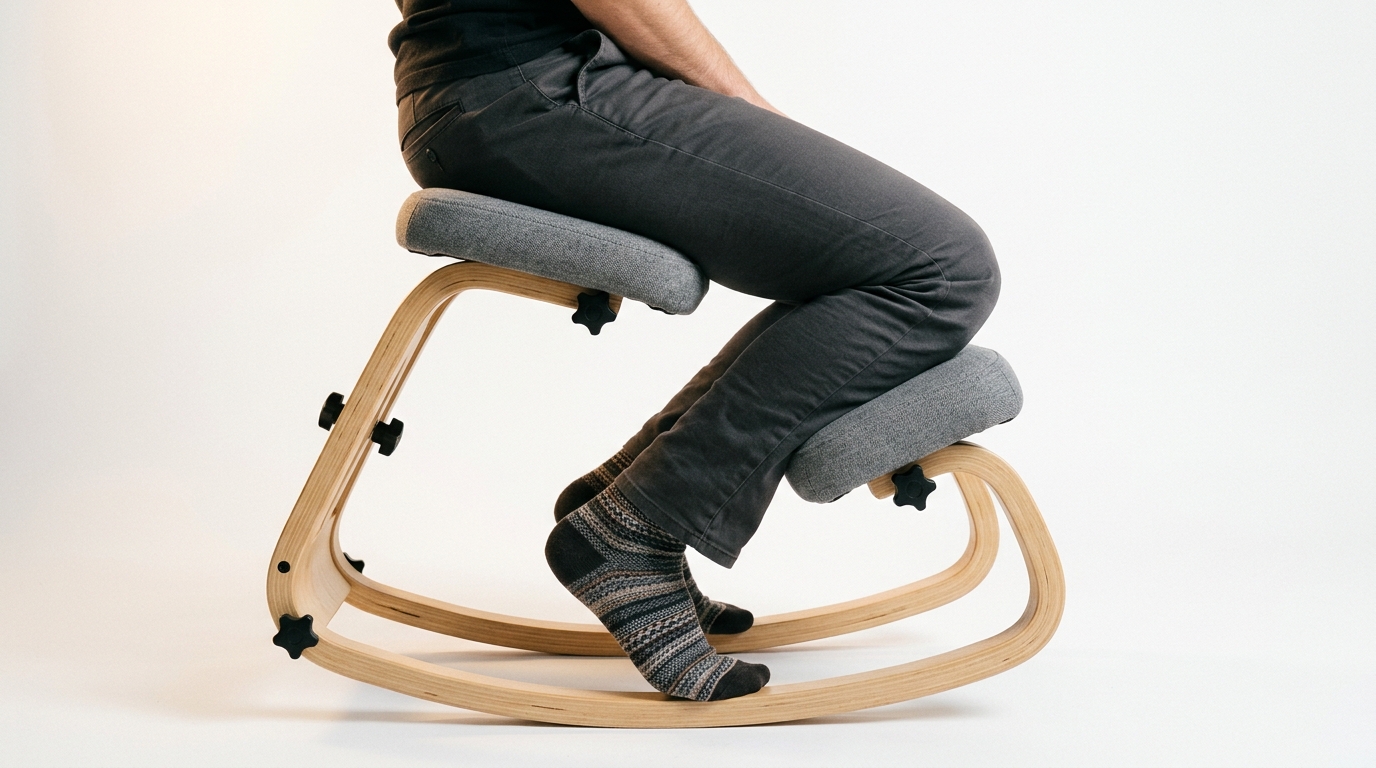
A kneeling chair is an ergonomic seat that positions your hips at 60 to 70 degrees instead of the standard 90 degrees. Your shins rest on a padded support below and behind the seat. Despite the name, you are not actually kneeling. Your weight distributes between the seat (roughly 80%) and the shin pads (roughly 20%).
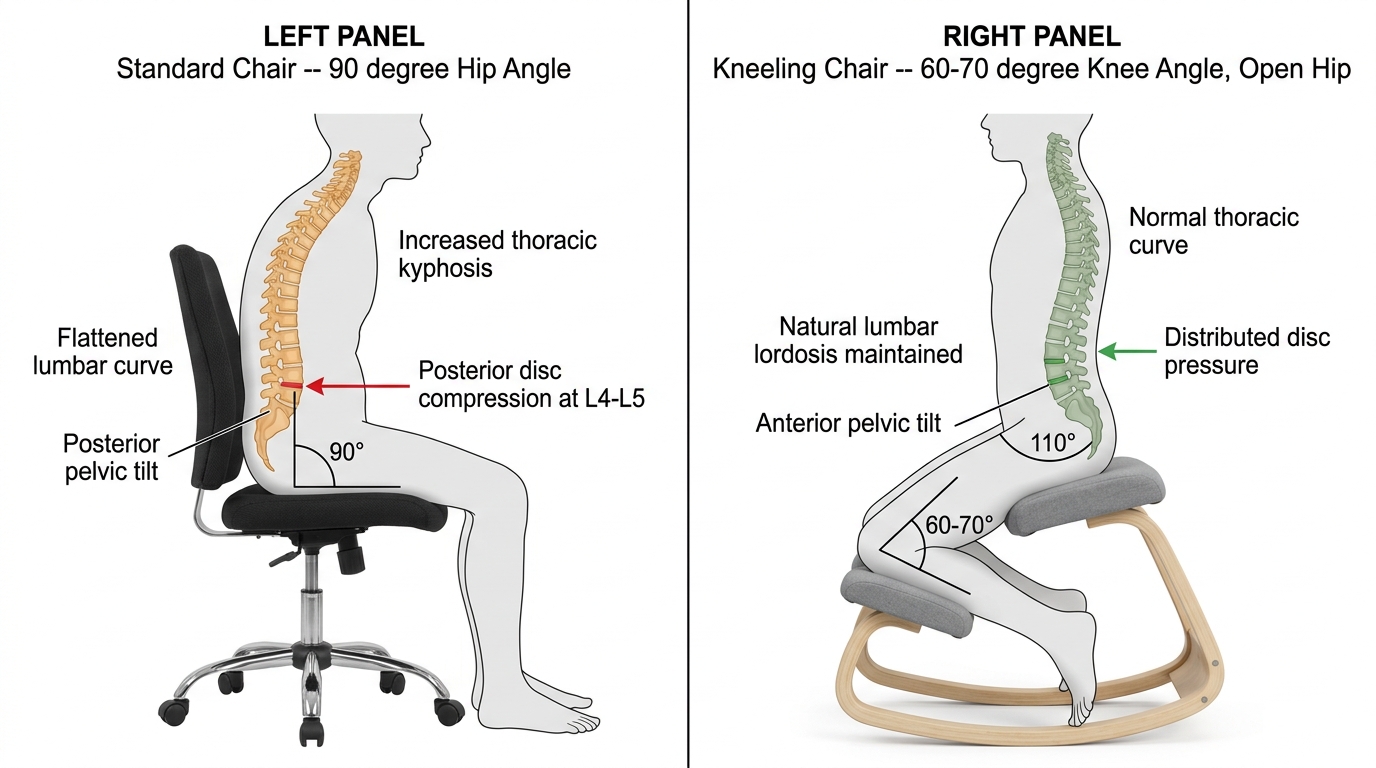
The fundamental principle is straightforward. By opening the hip angle beyond 90 degrees, a kneeling chair encourages your pelvis to tilt forward. This supports the natural lordotic curve of your lumbar spine. In a conventional flat-seat chair, the pelvis tilts backward, flattening that curve and increasing disc pressure.
The design concept dates back to 1979. Scandinavian designers observed that people seated on forward-sloping surfaces naturally adopted more upright, relaxed posture without being told to “sit up straight.” The geometry of the chair did the work that willpower could not.
A Brief History of Kneeling Chairs
The kneeling chair was born from observation, not invention. In 1979, Norwegian designer Hans Christian Mengshoel created the first commercial kneeling chair called the “Balans” after studying how people naturally sit when given a choice.
Peter Opsvik, another Norwegian designer, further developed the concept into several variations. He noticed that children sitting on forward-sloping surfaces maintained upright posture without reminders. The question became: could furniture guide adults toward the same result?
The answer, confirmed by decades of research since, is yes. The original Balans chair went into production in Scandinavia and reached international markets by the mid-1980s. Today, kneeling chairs range from simple fixed-frame designs to sophisticated adjustable models with rocking bases. For a deeper look at the science, see our complete guide to kneeling chair ergonomics.
How It Works – the Biomechanics
Understanding why a kneeling chair helps requires looking at four biomechanical shifts that happen when you sit in one.
1. Opens the hip angle
The forward-tilted seat opens your hips to 60-70 degrees. This triggers a cascade: the pelvis tilts anteriorly, the lumbar spine restores its natural inward curve, and your upper body stacks naturally over the pelvis rather than rounding forward.
Bridger (1988) found that kneeling chairs reduced lumbar flexion by approximately 20% compared to standard office chairs. Betsch et al. (2011) confirmed more lordotic lumbar posture across different body types using surface topography measurements.
2. Redistributes your weight
Instead of your entire weight pressing on your sit bones and lower spine, it divides across two surfaces. Roughly 80% stays on the seat and 20% transfers to the shin pads. Less concentrated pressure means better circulation and less localized discomfort over long work sessions.
3. Engages your core
Without a backrest, your core and back muscles gently engage to maintain the upright position. This is mild – about 5-10% of maximum contraction – but enough to build postural endurance over time and keep muscles active rather than dormant.
4. Encourages micro-movements
Kneeling chairs – especially those with a rocking base – promote continuous subtle position shifts. This matters because static posture, even “perfect” posture, causes problems over time. Your spine thrives on movement variability.
Nachemson’s landmark research (1966) established that lumbar disc pressure is lowest when the spine maintains lordosis. Van Deursen et al. (2008) confirmed reduced erector spinae activity, suggesting lower compressive loads.
Who Benefits Most
People with lower back pain from sitting
If your back pain worsens as the workday progresses and improves when you stand or walk, a kneeling chair addresses the root cause – posterior disc pressure from the flat-seat hip angle. The forward pelvic tilt reverses that loading pattern.
Chronic slouchers
Some people cannot maintain upright posture in a conventional chair no matter how well it is adjusted. A kneeling chair makes slouching mechanically difficult. The forward-tilting seat guides the pelvis into the correct position automatically.
- Desk workers with sitting-related lower back pain
- People who slouch despite good chair adjustments
- Anyone seeking more postural variety in their workday
- Creative and focus workers who report better concentration upright
People seeking postural variety
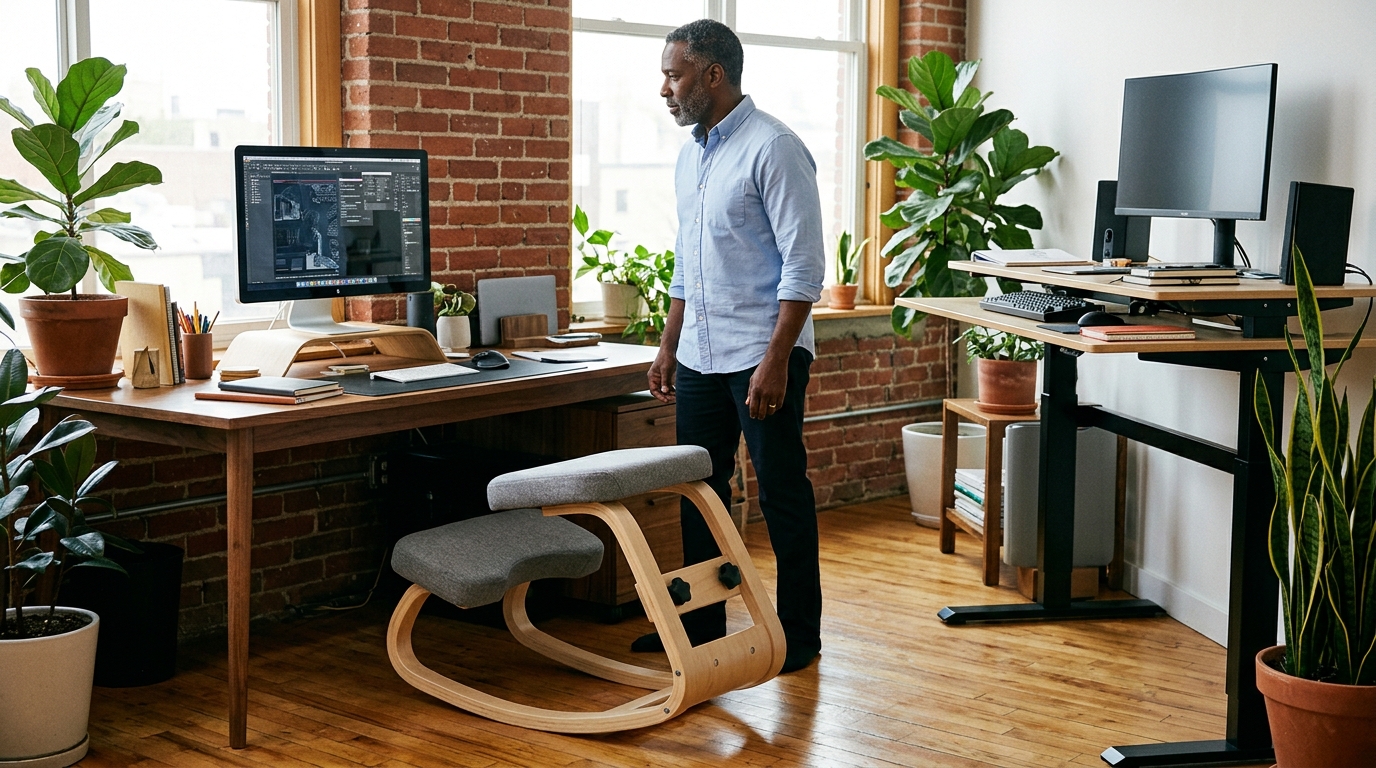
The healthiest sitting strategy alternates between different postures throughout the day. A kneeling chair provides a genuinely different biomechanical profile from standard seating. Consider pairing it with a standing desk for maximum variety.
Creative and focus work
Many users report enhanced alertness and concentration on a kneeling chair. The slightly active position and upright torso may contribute to mental engagement. Research in embodied cognition supports the link between upright posture and cognitive performance (Riskind and Gotay, 1982). Learn more about how active sitting supports focus and energy.
See What a Kneeling Chair Designed for Real Work Looks Like
The NYPOT Kneeling Chair is built for 8-hour workdays – not 30-minute novelty use. Adjustable height, memory foam knee pads, and a forward tilt engineered around the biomechanics described in this guide.
Who Should Be Cautious
Knee and shin conditions. Arthritis, ligament injuries, meniscus tears, or patellofemoral syndrome may be aggravated by sustained knee flexion. The shin pads distribute weight well, but prolonged use can cause discomfort in the anterior tibial region (Lander et al., 1987).
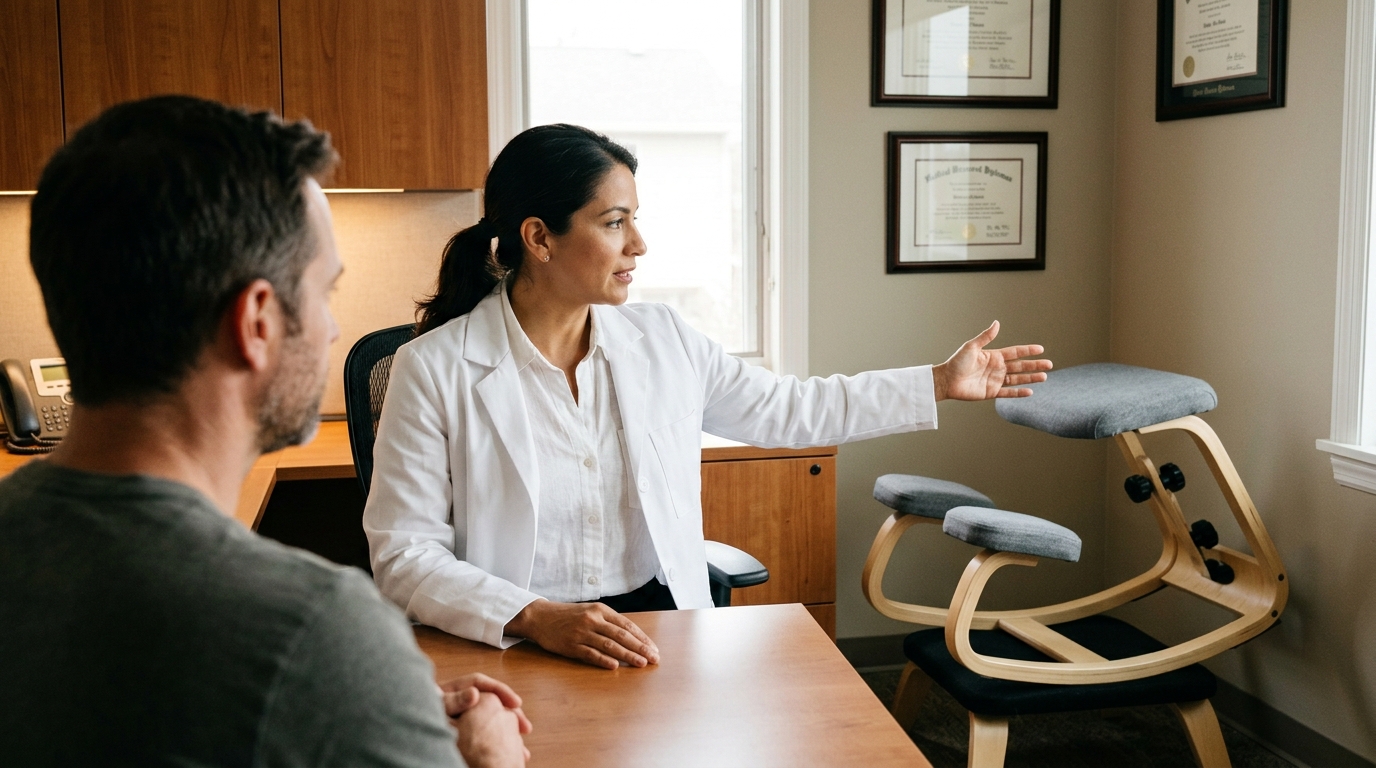
Circulation issues. History of deep vein thrombosis, peripheral vascular disease, or significant varicose veins are concerns because the knee-flexed position can restrict lower limb blood flow.
Pregnancy (later stages). Getting on and off becomes difficult, and the pelvic angle may be uncomfortable. Most pregnant individuals prefer chairs with full back support during the third trimester.
Frequent mobility needs. If your work requires constant desk-to-desk movement, kneeling chairs are slower to enter and exit than standard rolling chairs. For a complete analysis of tradeoffs, read our detailed kneeling chair pros and cons guide.
How to Sit in a Kneeling Chair Correctly
Sit on the seat first, then lower your shins onto the pads. Your weight should rest primarily on your sitting bones, not on your knees. The shin pads provide stability and prevent forward sliding – they should not bear the majority of your weight.
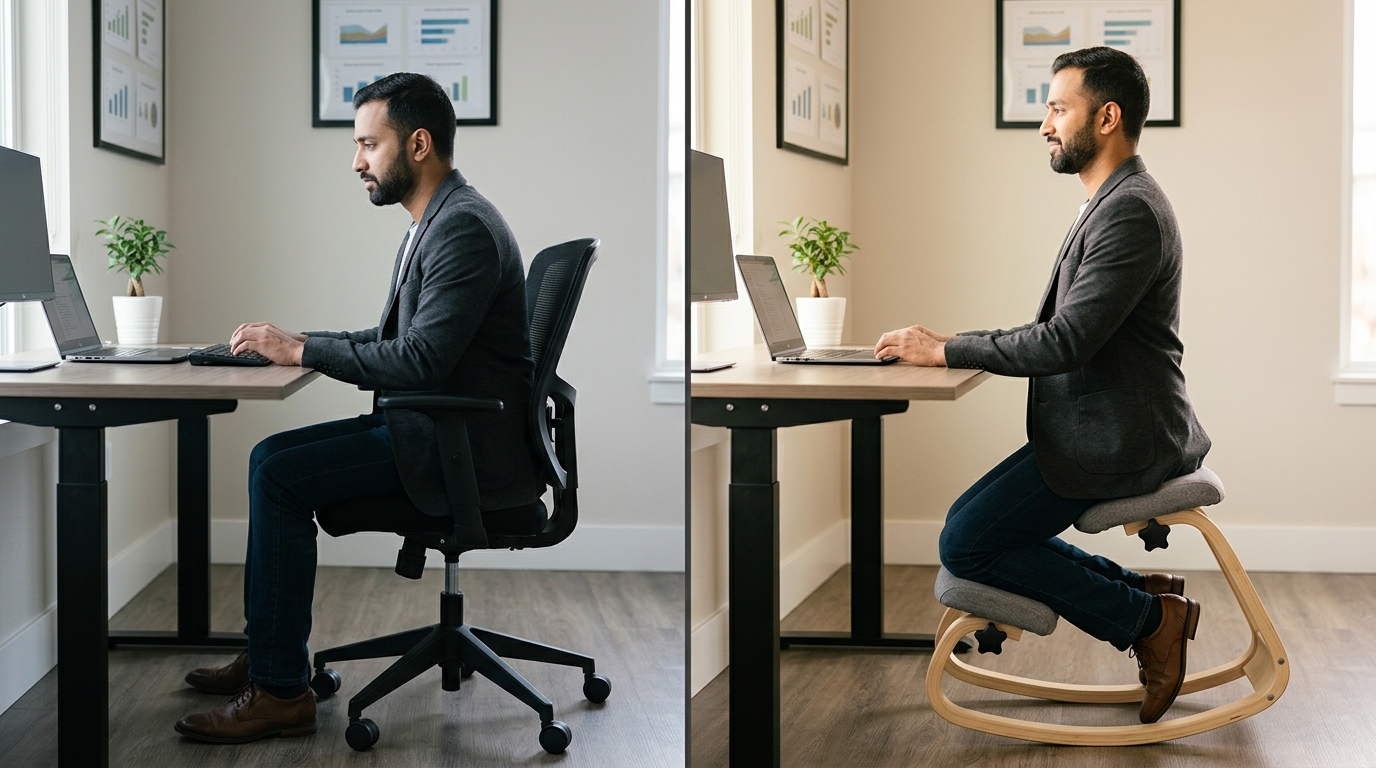
A practical daily rotation works best for most people. Try 30-60 minutes on the kneeling chair in the morning, switch to conventional seating or standing mid-morning, return for another kneeling session after lunch, and alternate based on comfort through the afternoon.
Your best posture is always your next posture. No single position – no matter how ergonomically sound – should be maintained all day. Alternate between kneeling, conventional sitting, and standing throughout the workday. Learn more in our guide on why regular chairs cause back pain.
Kneeling Chair vs Office Chair: Quick Comparison
The most common question is whether a kneeling chair can replace a standard office chair. The honest answer: it depends on your body, your work, and how you use it.
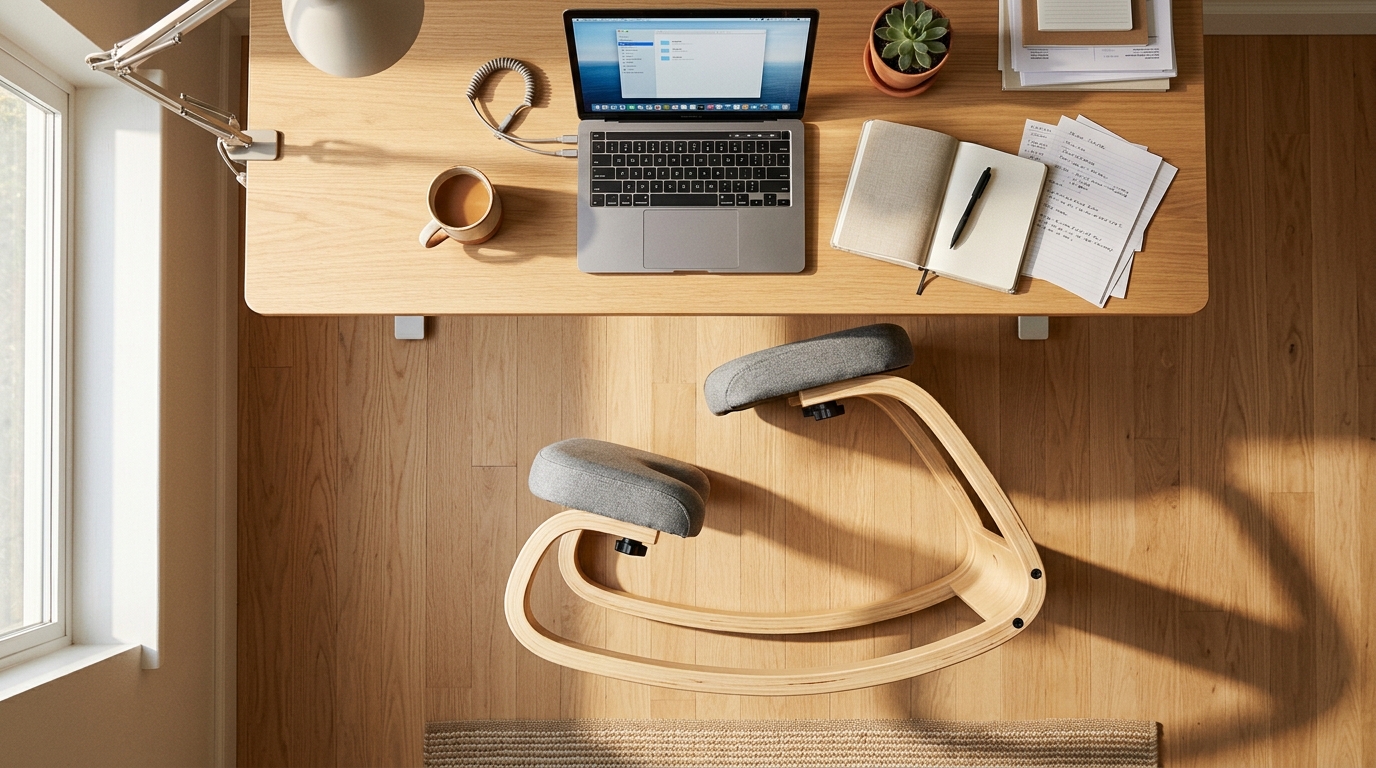
Standard chairs excel at versatility and familiar comfort. They accommodate many positions, allow easy entry and exit, and work well for meetings and tasks requiring frequent movement. Kneeling chairs excel at focused desk work and posture correction. They reduce lumbar disc pressure, engage core muscles, and prevent the slouching that accumulates over hours.
The ideal setup for most people is both. Use a kneeling chair for focused work blocks of 1-2 hours, and a conventional chair or standing desk for the rest. Learn more about choosing the right ergonomic chair for your needs.
The Bottom Line
A kneeling chair is a biomechanically sound seating option that promotes natural lumbar alignment, engages your core, and encourages the postural variety your spine needs. It is not a miracle cure, and it is not meant to replace your office chair entirely.
It is a tool – one that works best as part of a daily rotation of sitting, kneeling, and standing positions. If you sit for long hours, experience lower back pain from conventional chairs, or want more variety in your workday postures, a kneeling chair is worth trying. Start gradually, alternate with other seating, and let your body guide the adjustment.
Curious About Kneeling Chairs But Not Sure If They Are Right for You?
A kneeling chair is not for everyone. Our Chair Finder Quiz evaluates your body, work habits, and any existing conditions to tell you whether a kneeling chair, a criss-cross chair, or something else is the better fit.
Ready to find the right setup for you?
Explore our ergonomic products designed for how you actually sit.
Related reading
- Understanding Kneeling Chair Ergonomics – Complete Guide
- Kneeling Chair Pros and Cons – What to Know Before You Buy
- Standing Desk vs Kneeling Chair – Which Wins?
- How to Choose an Ergonomic Chair
- What Is Active Sitting?
References
- Betsch, M., et al. (2011). “The influence of different seating positions on spinal curvature.” European Spine Journal, 20(Suppl 5), S634.
- Bridger, R. S. (1988). “Postural adaptations to a sloping chair and desk surface.” Ergonomics, 31(2), 281-296.
- Lander, C., et al. (1987). “The Balans chair and its semi-kneeling position: An ergonomic comparison.” Spine, 12(3), 269-272.
- Nachemson, A. (1966). “The load on lumbar discs in different positions of the body.” Clinical Orthopaedics and Related Research, 45, 107-122.
- Riskind, J. H., and Gotay, C. C. (1982). “Physical posture: Could it have regulatory or feedback effects on motivation and emotion?” Motivation and Emotion, 6(3), 273-298.
- van Deursen, D. L., et al. (2008). “Sitting on an office chair or a kneeling chair: Trunk muscle activity and lumbar lordosis.” Clinical Biomechanics, 23(6), 772-779.
This article contains affiliate links. ErgoLife Foundation may earn a commission at no additional cost to you. All recommendations are based on our independent research and mission to improve workplace wellness.