Buying Guide
Key takeaways
- Kneeling chairs open your hip angle to 110-120 degrees, which helps your spine stay in a more natural position than a standard office chair.
- They reduce lumbar disc pressure by about 20% – but they are not a fix for serious back conditions.
- 30-40% of new users experience shin discomfort during the first 1-3 weeks. This is normal and fades with adaptation.
- The best approach is the 50/25/25 rule – split your day between kneeling, traditional sitting, and standing or moving.
- Quality matters more than brand – cheap kneeling chairs cause the problems people complain about online.
In this guide
- How kneeling chairs actually work
- 5 proven benefits (with research)
- 6 honest limitations you should know
- Side-by-side: kneeling chair vs. traditional chair
- Kneeling chair vs. other active seating
- How to spot a quality kneeling chair
- Who benefits most from a kneeling chair
- Who should avoid kneeling chairs
- Common mistakes new users make
- The verdict: is a kneeling chair worth it?
- Frequently asked questions
You have probably seen the claims. Kneeling chairs fix your posture, eliminate back pain, and transform your workday. But when you search for real opinions, you find people who love them sitting next to people who returned theirs within a week.
So which is it? The answer depends on your body, your work habits, and how realistic your expectations are. Kneeling chairs deliver genuine benefits for the right person – but they are not a universal solution.
This guide walks through every advantage and limitation based on actual research. No hype, no spin. By the end, you will know exactly whether a kneeling chair makes sense for you.
How kneeling chairs actually work
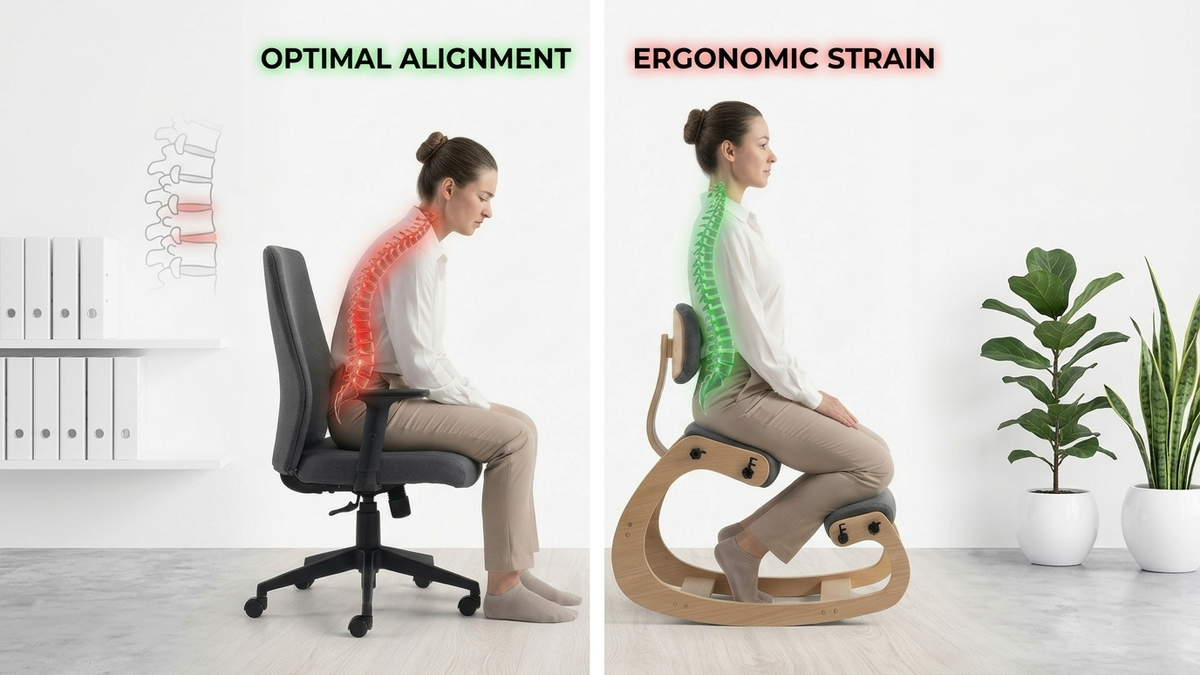
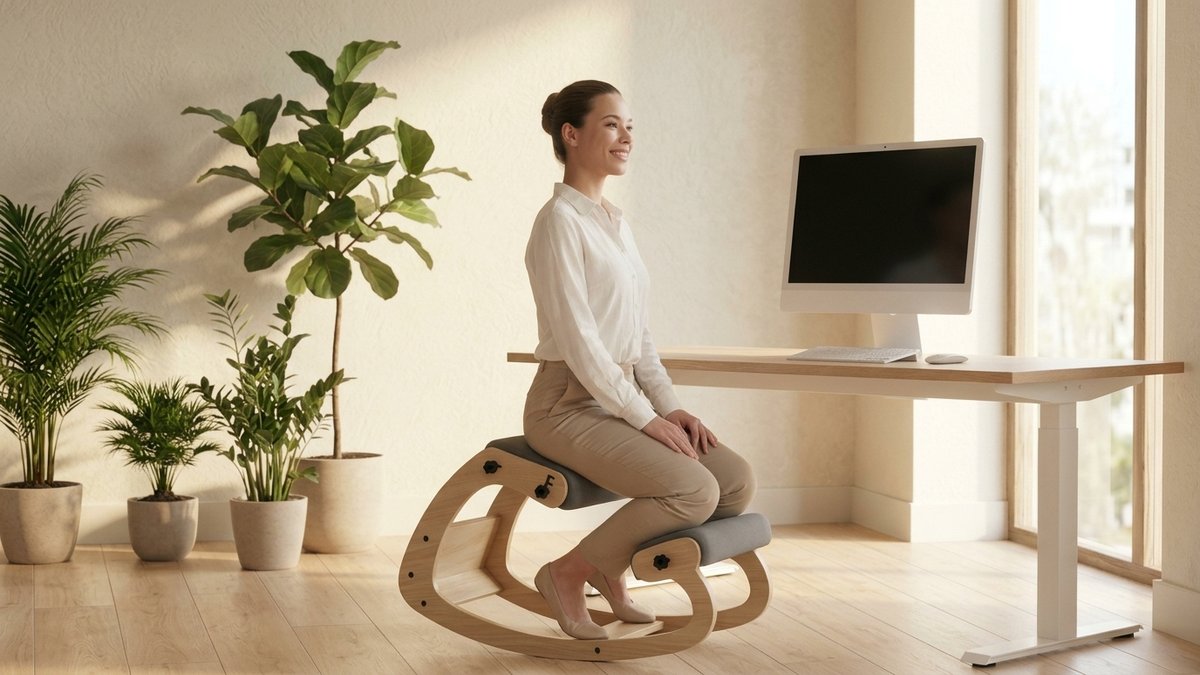
A kneeling chair tilts your seat forward by 20-30 degrees. This pushes your hips open and shifts your pelvis into a more natural angle. Your spine follows the pelvis, so it curves less and stays closer to its neutral alignment.
Traditional office chairs hold your hips at roughly 90 degrees. That angle tucks your pelvis backward, which flattens the natural curve in your lower back. Over time, this position puts extra pressure on your spinal discs.
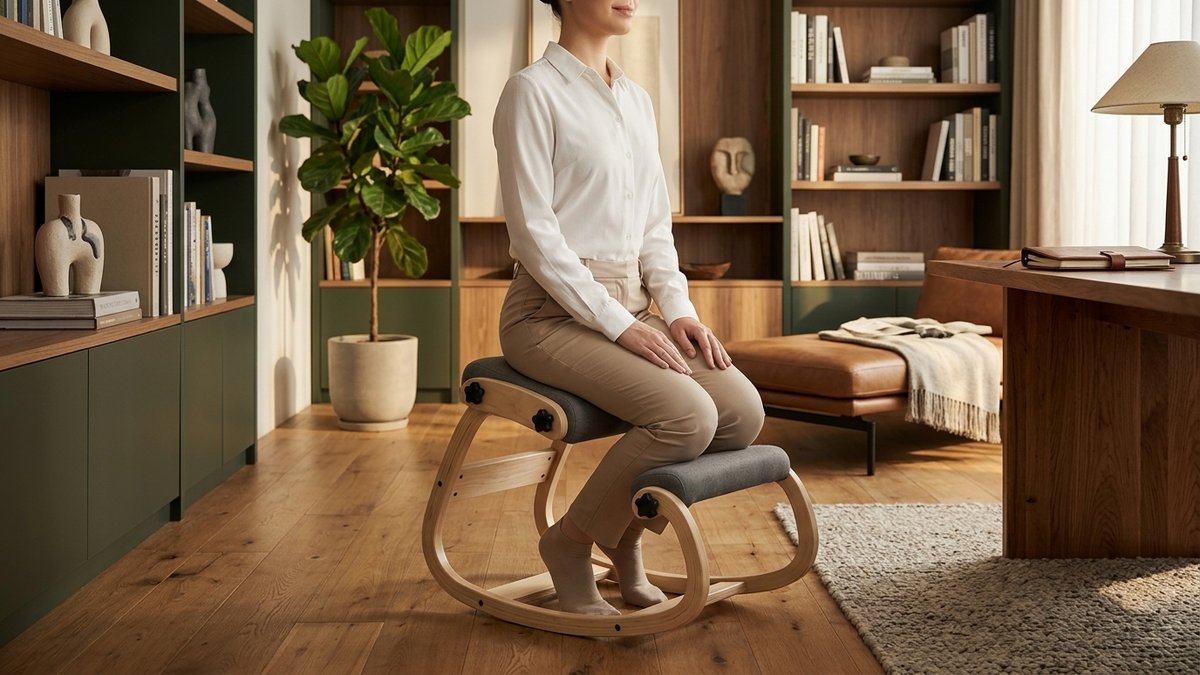
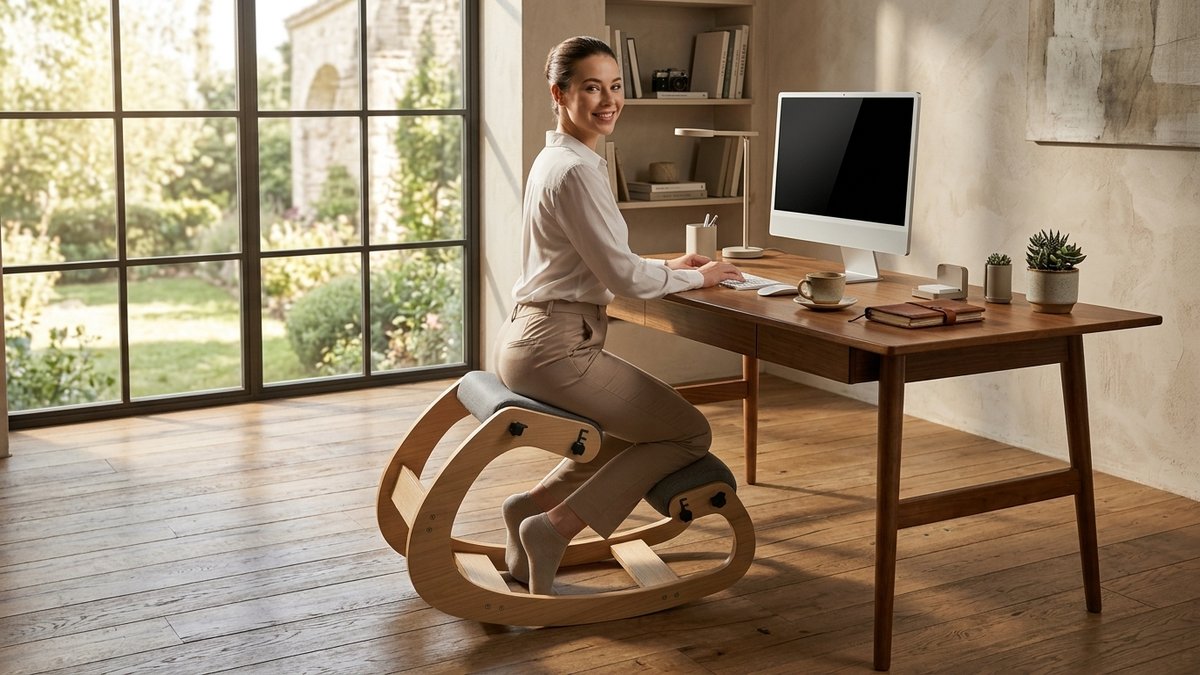
The shin pad on a kneeling chair is not there to hold your weight. It stops you from sliding forward off the tilted seat. Most of your body weight – about 80% – still rests on your sit bones, not your knees.
This design also removes the backrest. Without something to lean against, your core muscles stay lightly engaged throughout the day. Think of it as passive exercise – you are building stability without thinking about it.
5 proven benefits of kneeling chairs
The research on kneeling chairs is not as large as for traditional ergonomic chairs. But the studies that do exist point to consistent, measurable advantages for certain users.
1. Better spinal alignment
The forward seat tilt opens your hip angle to 110-120 degrees. This allows your pelvis to rotate forward naturally, which preserves the lumbar curve your spine needs. A 2008 study in Ergonomics found that kneeling chairs improved the biomechanics behind kneeling chairs and thoracolumbar positioning compared to standard seating.
2. Reduced lower back pressure
When you sit upright without a backrest, your body distributes weight differently. The forward pelvic tilt shifts load away from your lumbar discs and spreads it more evenly across your skeleton. For people with mild lower back discomfort from desk work, this can provide noticeable relief.
3. Passive core engagement
No backrest means no crutch. Your abdominal and back muscles stay lightly active to keep you balanced. This is not an intense workout – it is more like a constant, low-level engagement that builds stability over weeks. Think of it as the difference between sitting on a couch and sitting on a park bench.
4. Improved posture awareness
This benefit sneaks up on you. After a few weeks on a kneeling chair, you start noticing when you slouch on other chairs. Your body learns what good alignment feels like, and it flags the difference. Many users report sitting taller even when they switch back to a traditional chair.
5. Budget-friendly alternative to premium chairs
Quality kneeling chairs cost $200-$400. A comparable ergonomic task chair with proper lumbar support runs $800-$1,500. If you are a remote worker who needs ergonomic seating for your home office without spending a month’s rent, a kneeling chair closes the gap.
6 honest limitations you should know
Every kneeling chair review that skips the downsides is selling you something. Here is what the research and real users consistently report.
1. Shin and knee discomfort during adaptation
About 30-40% of new users feel pressure on their shins during the first 1-3 weeks. This is the most common complaint in user reviews and forums. It usually fades as your body adapts and you learn to keep most of your weight on the seat, not the shin pad.
2. Not built for 8-hour marathons
Kneeling chairs work best in rotation. Most ergonomists recommend 2-4 hour stretches, mixed with traditional sitting and standing. Using a kneeling chair as your only seat for a full workday is like wearing running shoes to a formal dinner – right tool, wrong duration.
3. Limited position variety
You can sit forward. That is basically it. You cannot cross your legs, tuck one foot under, or shift into a reclined position. If you are someone who naturally fidgets or changes position every 20 minutes, a kneeling chair can feel restrictive.
If the knee pressure or limited position variety concerns you, consider a wide-seat design like the NYPOT Criss-Cross Chair – it offers the same active sitting benefits without any weight on your knees.
4. Quality varies wildly
This is the limitation nobody talks about enough. Most kneeling chairs sold online are cheap imports with thin padding, weak frames, and no adjustability. People buy a $70 chair, hate it after a week, and blame the concept instead of the product. A quality kneeling chair has thick memory foam, adjustable height, and a steel frame.
5. Not ideal for all desk types
Kneeling chairs sit lower than standard office chairs. If your desk is a fixed-height model at 29-30 inches, you may find yourself reaching up to your keyboard. Adjustable desks or keyboard trays solve this, but it is worth checking before you buy.
6. Adjustment period is real
Expect 1-3 weeks before a kneeling chair feels natural. Your muscles need time to build the endurance for unsupported sitting. Most people who give up do so in the first 5 days – right before their body would have started adapting.
Side-by-side: kneeling chair vs. traditional chair
This comparison helps you see the tradeoffs at a glance. Neither chair wins every category – the right choice depends on your priorities.
| Feature | Kneeling chair | Traditional ergonomic chair |
|---|---|---|
| Hip angle | 110-120 degrees (open) | 90 degrees (closed) |
| Lumbar support | None (spine self-supports) | Built-in lumbar pad |
| Core engagement | Constant light activation | Minimal |
| Position variety | Limited (forward-facing only) | Multiple recline angles |
| Recommended use time | 2-4 hours per stretch | Full workday with breaks |
| Adaptation period | 1-3 weeks | None |
| Price range (quality) | $200-$400 | $800-$1,500 |
| Best for | Focused forward-leaning work | Long sessions, varied tasks |
Kneeling chair vs. criss-cross chair: quick comparison
Kneeling chair – best for focused, forward-leaning work. Engages your core. Opens your hips with a 20-degree pelvic tilt.
Criss-cross chair – best for position variety. Sit cross-legged, tucked, or sideways on a 22-inch wide seat. No knee pressure.
Not sure which fits your style?
Kneeling chair vs. other active seating options
Kneeling chairs are not the only alternative to a standard desk chair. Here is how they compare to other popular active seating options.
| Feature | Kneeling chair | Yoga/stability ball | Wobble stool |
|---|---|---|---|
| Core activation | Moderate (constant) | High (but fatiguing) | Moderate (dynamic) |
| Spinal alignment | Excellent (pelvis-driven) | Poor without training | Good when adjusted right |
| Comfort for long use | Good (2-4 hours) | Low (60-90 minutes) | Moderate (1-2 hours) |
| Desk compatibility | Needs height check | Requires specific height | Adjustable height |
| Injury risk | Low (if quality) | Moderate (falls, slouching) | Low |
The key difference is predictability. A kneeling chair gives you consistent spinal positioning. Yoga balls and wobble stools introduce instability, which some people love and others find exhausting. If you want reliable posture support during focused work, the kneeling chair or standing desk approach typically wins.
How to spot a quality kneeling chair
Most kneeling chair complaints trace back to poor quality, not poor design. Here is what separates a chair that works from one that ends up in your closet.
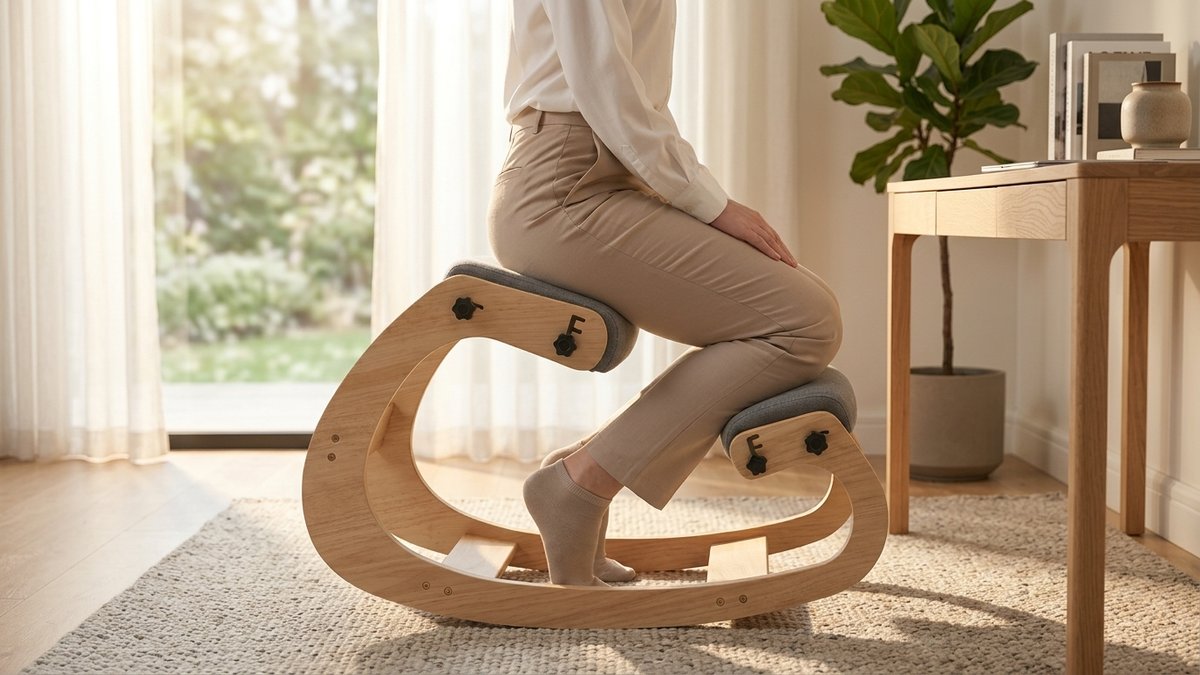
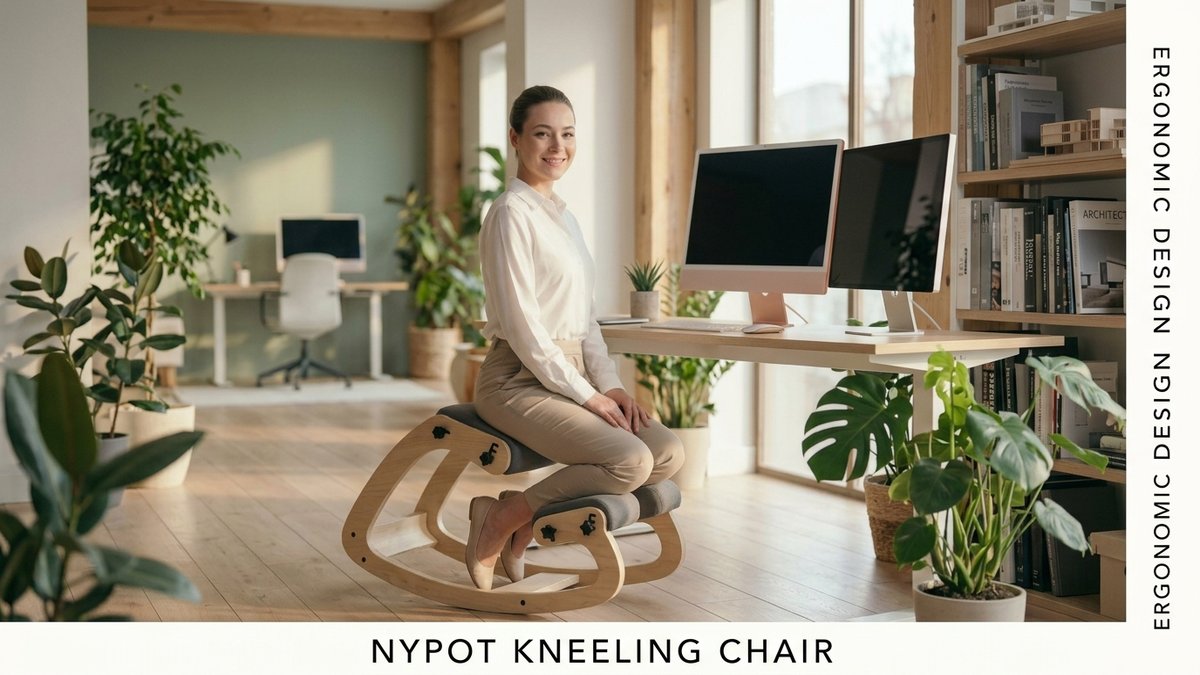
- Memory foam cushioning at least 3 inches thick on both seat and shin pad
- Steel or aluminum frame – wood frames creak and loosen over time
- Adjustable seat height with a gas lift cylinder (not fixed pegs)
- Adjustable knee pad distance to accommodate different leg lengths
- Weight capacity of 250+ pounds even if you weigh less – it signals build quality
- Locking casters so the chair does not roll away when you sit down
Price is a reliable signal. Under $100 almost always means thin padding, a flimsy plastic frame, and no adjustability. The $200-$400 range is where you find chairs built to last more than six months.
Read reviews that mention the 3-month mark. First-week reviews tell you about the unboxing experience. Three-month reviews tell you whether the padding held up and whether the frame stays stable. That is the data that matters.
Who benefits most from a kneeling chair
Kneeling chairs are not for everyone. But for these groups, the research and user feedback consistently point to real improvements.
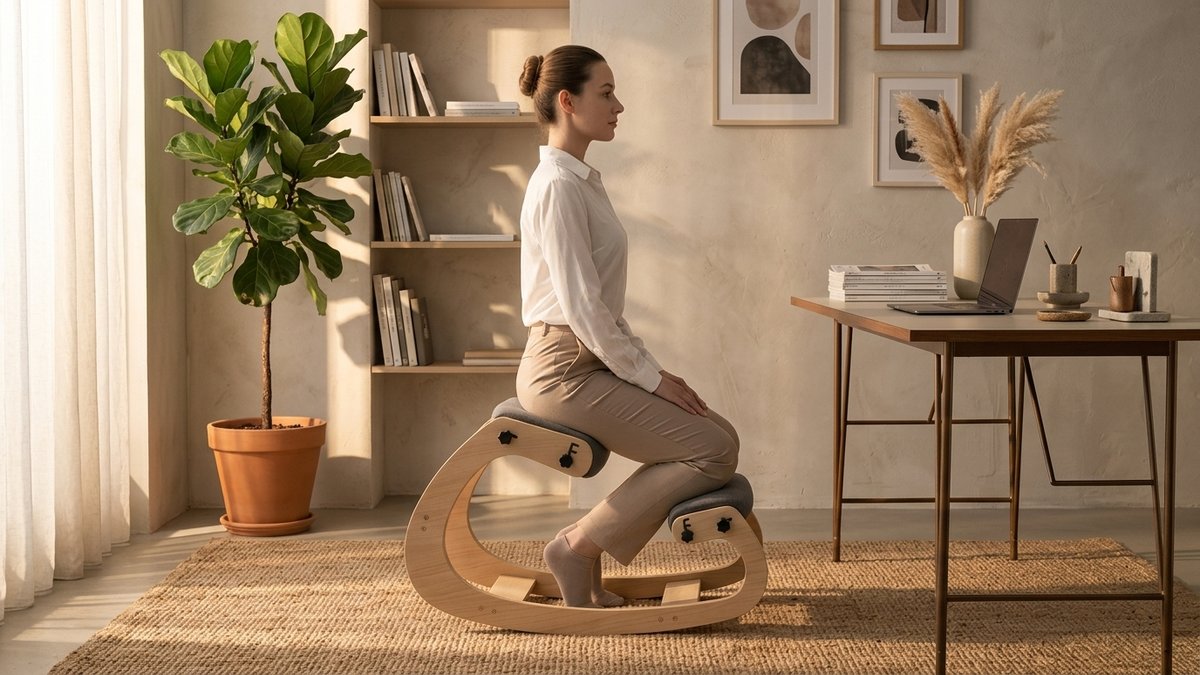
Remote workers who sit 6+ hours daily
If your commute is 10 steps from the bedroom to the desk, you probably sit more than you did at an office. A kneeling chair breaks up the monotony and keeps your core active during focused work blocks. Pair it with a proper desk setup and you cover the fundamentals.
People with mild lower back stiffness
Not sharp pain – stiffness. The kind that builds through the afternoon and eases when you stand up. The open hip angle of a kneeling chair addresses exactly the postural pattern that causes this type of discomfort. If your back hurts because of how you sit, changing how you sit can help.
Natural slouchers
If you catch yourself hunched over your keyboard multiple times a day, a kneeling chair makes slouching physically harder. The forward tilt of the seat works against the slouch reflex. You still can slouch on one – but it takes effort, which means you are more likely to sit tall.
Creative professionals and focused workers
Writers, designers, programmers, and anyone who does deep-focus work in 2-3 hour blocks. The slight forward lean of a kneeling chair matches the natural posture of concentration. Several users describe it as feeling more “engaged” with their work.
Who should avoid kneeling chairs
Kneeling chairs are wrong for some people. This is not a soft “be careful” – it is a clear “do not use.”
- Anyone with knee injuries or chronic knee pain – even though weight sits mostly on the seat, your shins still bear some load. Existing knee problems will get worse.
- People with circulation issues in the legs – the bent knee position can reduce blood flow. If you already deal with swelling, numbness, or varicose veins, this chair is not safe for you.
- Severe mobility limitations – getting on and off a kneeling chair requires more effort than a standard chair. If mobility is a concern, a well-adjusted traditional ergonomic chair is a better choice.
- Jobs requiring frequent standing and sitting – if you pop up from your desk 20+ times a day, the mount/dismount cycle of a kneeling chair becomes a real annoyance.
- Pregnancy (second and third trimester) – the forward tilt and restricted movement make kneeling chairs uncomfortable and potentially unsafe as your center of gravity shifts.
If any of these apply to you, choosing the right ergonomic chair means looking at traditional designs with proper lumbar support and adjustability.
Common mistakes new users make
Most people who give up on kneeling chairs make the same handful of errors. Avoid these and your adaptation period gets much smoother.
Going full-time too fast
Start with 30-60 minutes per day. Add 15-30 minutes each day until you reach 2-4 hours. Your muscles need time to build the endurance for unsupported sitting. Jumping straight to a full workday almost guarantees discomfort.
Putting too much weight on the shin pads
The shin pads are a kickstand, not a seat. About 80% of your weight should rest on your sit bones. If your shins feel crushed, you are leaning too far forward. Sit back slightly and let gravity hold you on the seat.
Ignoring desk height
Your desk might be too high for a kneeling chair. Your elbows should bend at 90 degrees when your hands rest on the keyboard. If you are reaching up, you need a lower desk or a keyboard tray. This single adjustment prevents shoulder and neck strain.
Buying the cheapest option available
A $50 kneeling chair with 1 inch of foam padding will hurt. That is not a kneeling chair problem – that is a product quality problem. Research the features that matter in a kneeling chair before buying based on price alone.
The verdict: is a kneeling chair worth it?
Yes – if you use it correctly and buy a quality one. That is the honest answer. Kneeling chairs solve a real biomechanical problem. They open your hips, reduce disc pressure, and build core strength passively. The research supports these benefits.
But they are not a magic fix. The best results come from the 50/25/25 approach – spend about half your day on a kneeling chair, a quarter on a traditional chair, and a quarter standing or moving. This rotation gives you the posture benefits without the fatigue.
If you deal with mild back pain from desk work, tend to slouch, or want an affordable way to sit better – a kneeling chair is one of the best investments under $400 you can make for your workspace.
Still weighing the pros and cons?
You have read the honest breakdown. Now let our Chair Finder Quiz factor in your specific body, work habits, and pain points to make the call. Takes 60 seconds.
Frequently asked questions
Are kneeling chairs actually good for your back?
Yes, for mild to moderate back stiffness caused by poor sitting posture. They reduce lumbar disc pressure by about 20% and encourage natural spinal alignment. But they are not a treatment for serious conditions like herniated discs or sciatica. If your back pain is severe, see a doctor before changing your chair.
How long does it take to get used to a kneeling chair?
Most people adapt within 1-3 weeks. Start with short sessions of 30-60 minutes and build up gradually. The shin discomfort and core fatigue that feel odd in week one typically disappear by week three.
Can I use a kneeling chair all day?
That is not recommended. Ergonomists suggest 2-4 hours at a time, rotated with other seating. The 50/25/25 rule – kneeling, traditional chair, standing or walking – gives you the benefits without the fatigue.
Do kneeling chairs hurt your knees?
Not if you use them correctly. About 80% of your weight stays on the seat, not the shin pads. If your knees hurt, you are probably leaning too far forward. Adjust your position so your weight sits on your sit bones. If pain persists, the chair may not be right for your body.
What is the best desk height for a kneeling chair?
Most people need a desk surface around 25-27 inches high when using a kneeling chair – several inches lower than the standard 29-30 inch desk. An adjustable desk or a keyboard tray is the easiest fix if your current desk is too high.
References
- Nachemson, A. (1976). The lumbar spine: An orthopedic challenge. Spine, 1(1), 59-71.
- Bridger, R.S. (1991). Some fundamental aspects of posture related to ergonomics. International Journal of Industrial Ergonomics, 8, 3-15.
- McGill, S.M. (2002). Low Back Disorders: Evidence-Based Prevention and Rehabilitation. Human Kinetics.
- Grooten, W.J.A., et al. (2013). Sitting posture and postural support in commercial vehicles. Applied Ergonomics, 44(4), 590-597.
- Betsch, M., et al. (2008). Influence of kneeling chairs on spinal curvature. Ergonomics, 51(6), 890-898.
- Drury, C.G., & Francher, M. (1985). Evaluation of a forward-sloping chair. Applied Ergonomics, 16(1), 41-47.