Key takeaways
- Five stretches you can do without leaving your desk, each taking under 60 seconds
- Regular micro-stretching prevents the stiffness that builds during long sitting sessions
- These stretches target the neck, shoulders, back, wrists, and hips – the areas most affected by desk work
- Consistency matters more than intensity – brief stretches every hour beat one long session
In this guide
- 1. Neck Rolls and Chin Tucks (60 Seconds)
- 2. Shoulder Shrugs and Rolls (60 Seconds)
- 3. Wrist Circles and Extensions (60 Seconds)
- 4. Seated Spinal Twist (60 Seconds)
- 5. Seated Hip Flexor Stretch (60 Seconds)
- Building the Habit: When and How Often
- Beyond Stretching: Why Stretching Alone Is Not Enough
- When Stretching Is Not Enough: See a Professional
In This Article
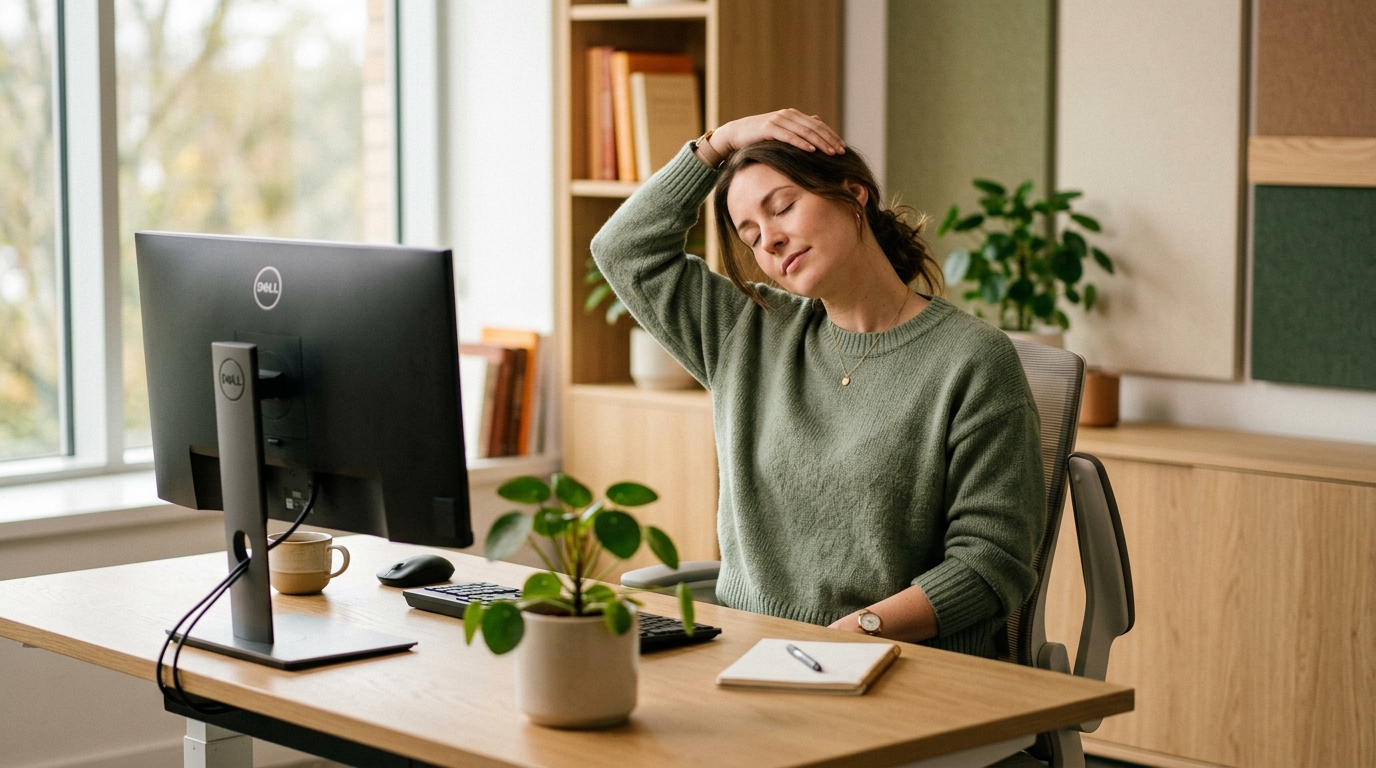
1. Neck Rolls and Chin Tucks (60 Seconds)
Your head weighs roughly 10 to 12 pounds. Even a slight 15-degree forward tilt increases the effective load on your cervical spine to about 27 pounds. At 30 degrees – a common laptop angle – it jumps to 40 pounds (Hansraj, 2014).
How to do it
- Sit tall with feet flat on the floor
- Drop your chin gently toward your chest
- Roll slowly to the right – ear toward shoulder – then continue the circle back and to the left
- Perform 3 slow circles in each direction (5-6 seconds per circle)
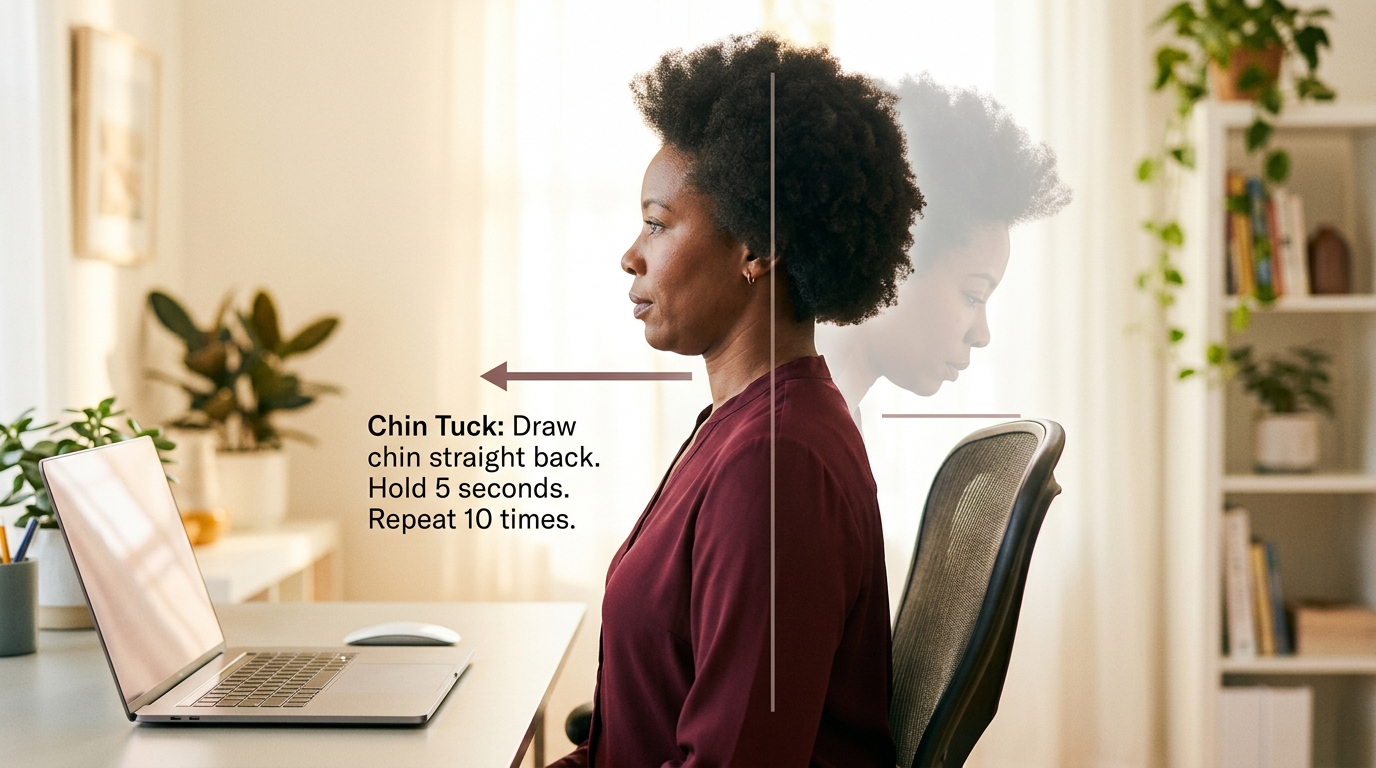
- Follow with 5 chin tucks – draw your chin straight back, hold 3 seconds, release
2. Shoulder Shrugs and Rolls (60 Seconds)
The upper trapezius is one of the most overworked muscles in desk workers. Research in Clinical Biomechanics found it maintains 2-8% of its maximum contraction during computer work. Seemingly small, but enough to cause fatigue and trigger points over hours (Szeto et al., 2005).
How to do it
- Shrugs: Inhale and raise both shoulders toward your ears. Hold 3 seconds. Exhale and drop them suddenly – let gravity do the work
- Repeat 5 times
- Rolls: Roll shoulders forward in large, slow circles for 5 reps, then reverse for 5 more
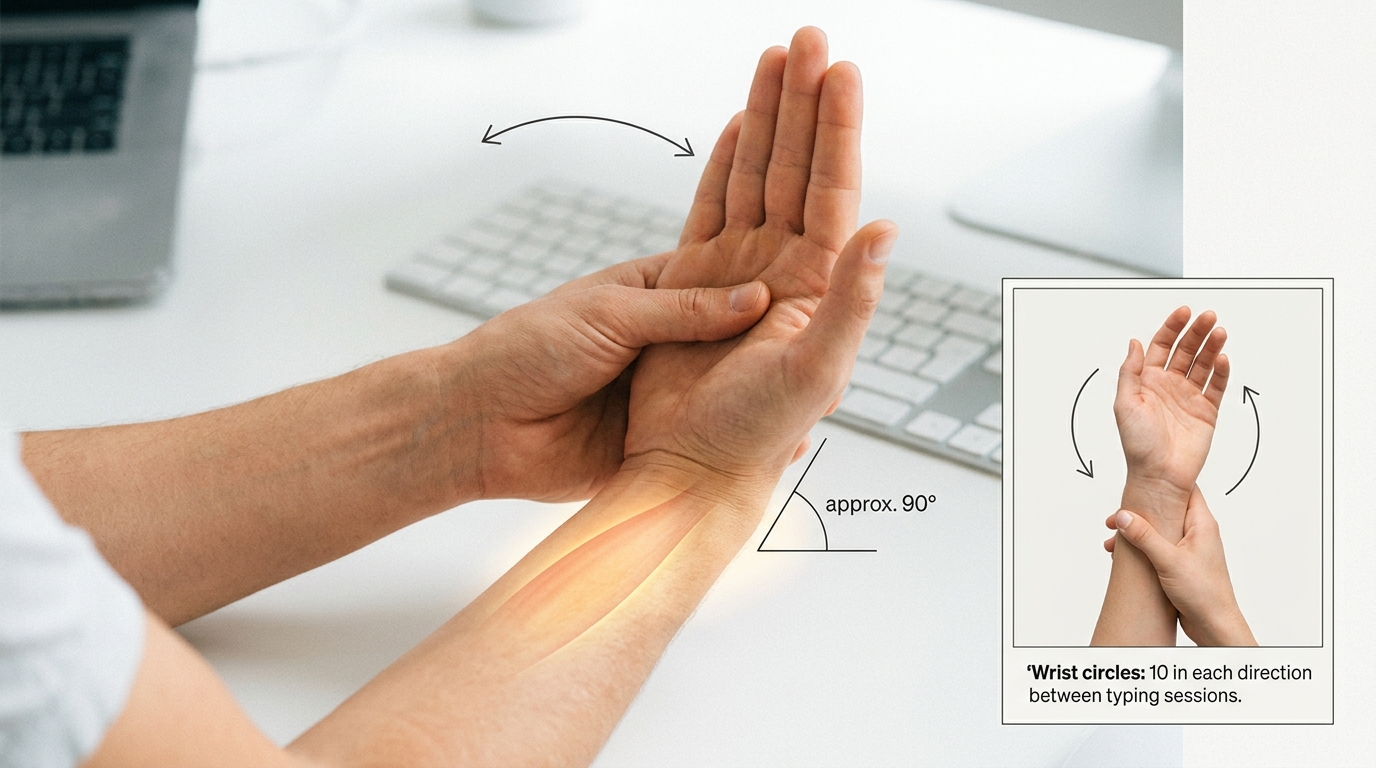
3. Wrist Circles and Extensions (60 Seconds)
Workers who type for more than four hours daily have a 2.5x higher risk of developing wrist and hand symptoms. Regular wrist mobility exercises are one of the most effective protective factors (Andersen et al., 2020).
How to do it
- Circles: Extend both arms, make fists, rotate wrists – 5 clockwise, 5 counterclockwise
- Extension: Hold your right arm out, palm facing away. Use your left hand to gently pull fingers back. Hold 10 seconds
- Flexion: Flip your hand so fingers point down. Gently press the back of your hand toward your body. Hold 10 seconds
- Repeat on the left side
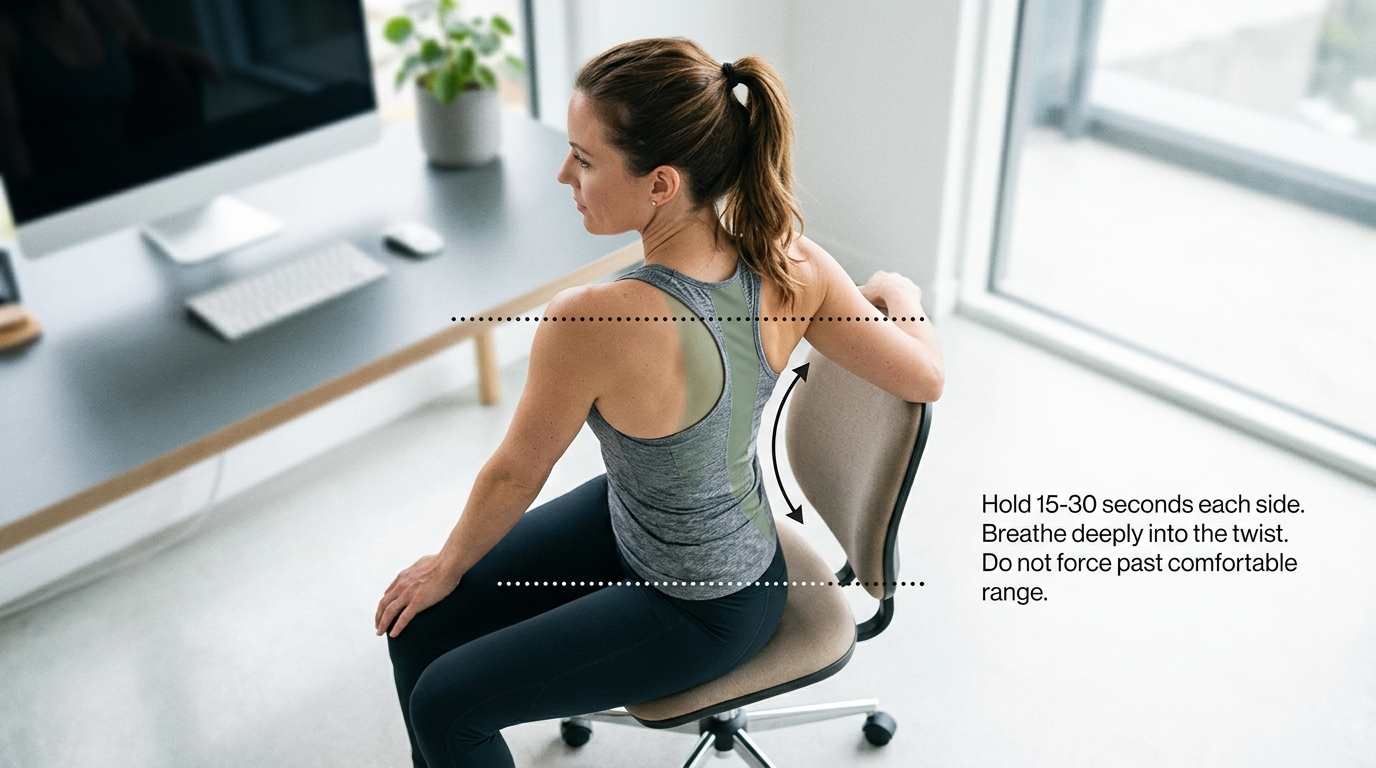
4. Seated Spinal Twist (60 Seconds)
Desk work locks your thoracic spine in a single forward-facing position for hours. When this area loses mobility, your lower back and neck compensate – one of the underappreciated pathways to both lower back and neck pain.
A 2018 study in the Journal of Sports Science and Medicine showed thoracic rotation exercises improved spinal mobility and reduced low back pain in sedentary workers over eight weeks (Kim and Kim, 2018).
How to do it
- Sit with feet flat, hip-width apart
- Place your right hand on the outside of your left knee
- Place your left hand on the back of your chair
- Inhale to sit taller, exhale as you gently rotate left
- Hold 15 seconds. With each exhale, rotate slightly further without forcing
- Return to center. Repeat on the right side
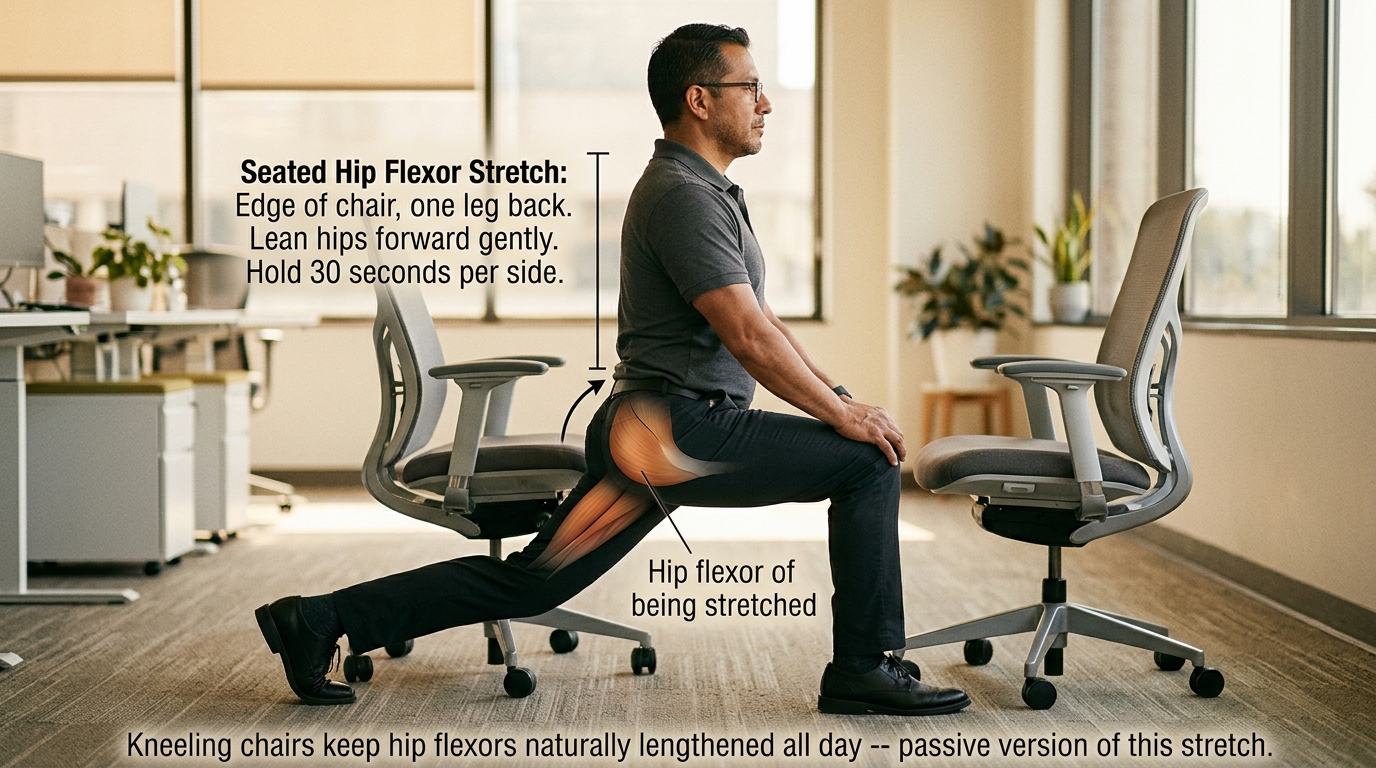
5. Seated Hip Flexor Stretch (60 Seconds)
Your hip flexors are in a shortened position every second you sit. Over hours, they adapt to that shortened length, tilting your pelvis forward and increasing your lower back curve. Research from the University of Queensland found hip flexor tightness was significantly correlated with lower back pain in office workers (Jull et al., 2008).
How to do it
- Slide forward to the edge of your chair
- Keep your left foot flat with the knee at 90 degrees
- Extend your right leg behind you, ball of foot on the floor
- Keep your torso upright – do not lean forward
- Press hips forward gently. Hold 15 seconds. Switch sides
A kneeling chair naturally keeps your hip flexors in a lengthened position all day. That is why kneeling chair users often report less lower back stiffness – the forward seat angle does the work for you.
Building the Habit: When and How Often
Frequency matters more than duration. Five minutes every two hours beats a single 30-minute session at the end of the day. Here is a practical schedule:
- Morning start: All five stretches before your first task (4-5 minutes)
- Mid-morning: Neck and hip flexors – your tightest areas
- After lunch: Full five-stretch sequence to reset your posture
- Mid-afternoon: Shoulders and wrists – they accumulate the most tension late in the day
- End of day: Full sequence as a cool-down
Set a timer, use a calendar reminder, or attach stretches to an existing habit like refilling your water glass. The method matters less than the consistency. For more movement ideas, explore our lower back pain exercises and our complete posture improvement guide.
Beyond Stretching: Why Stretching Alone Is Not Enough
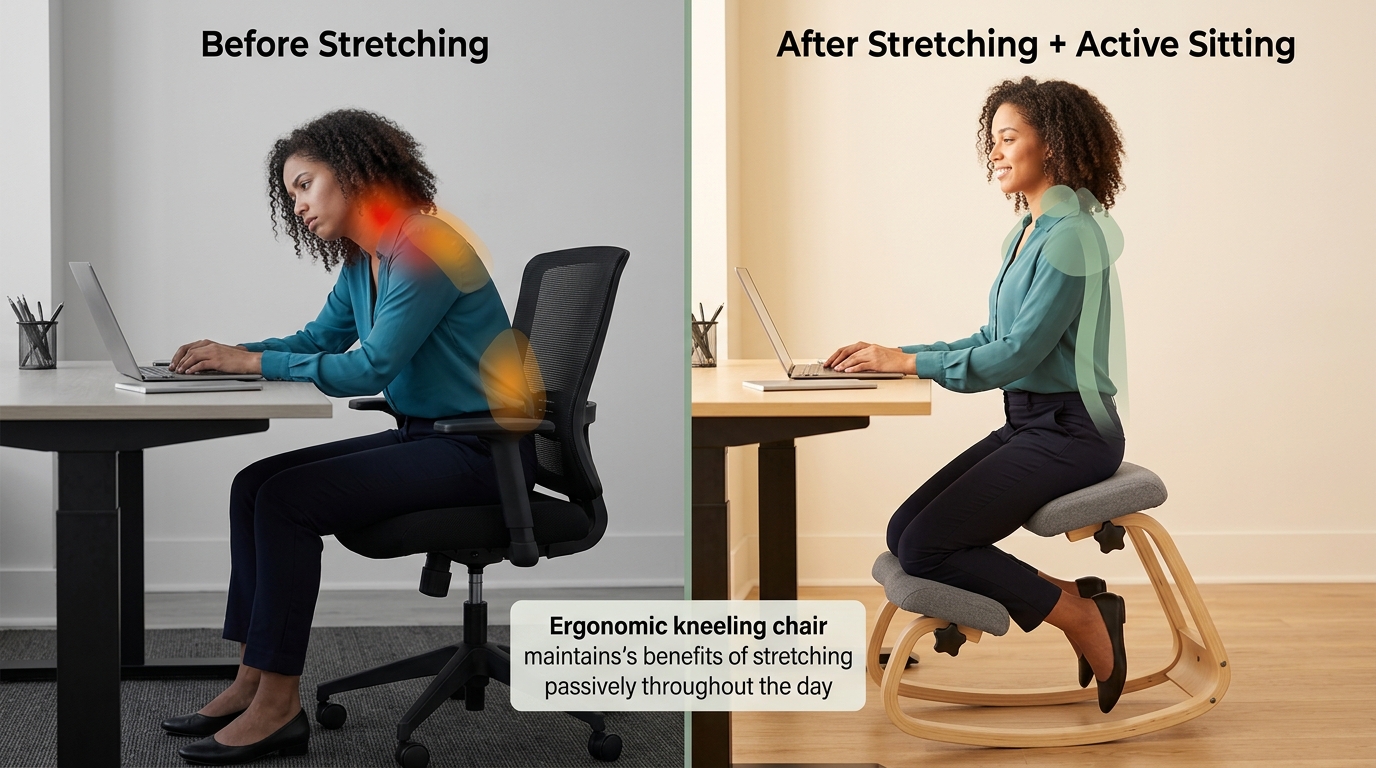
These stretches address the symptoms of prolonged sitting. But no amount of stretching can fully compensate for eight hours in a chair that forces your body into a poor position.
Here is the difference:
- Stretching: Resets muscle tension after it builds up (reactive)
- Active seating: Prevents muscle tension from building in the first place (proactive)
Active sitting chairs keep your hip flexors open, your core engaged, and your spine mobile throughout the workday – doing passively what these stretches do actively. Our Chair Finder Quiz matches your body to the right active sitting chair.
When Stretching Is Not Enough: See a Professional
Desk stretches work for general tightness. But they are not a substitute for professional care. See a healthcare provider if you experience:
- Numbness, tingling, or weakness in your hands, arms, or legs
- Pain that persists even when you are not sitting
- Sharp pain during any stretch (it should feel like mild tension, never sharp)
- Symptoms worsening over weeks despite stretching and ergonomic improvements
- Pain that radiates from your back into your legs or from your neck into your arms
For the vast majority of desk workers, these five stretches performed consistently will make a noticeable difference within the first week. Your body is designed to move. Give it permission to do so – even in small doses – and it will respond. For a complete approach, pair these stretches with proper desk ergonomics and learn about how stretching affects your mood.
Stretches Relieve Pain. The Right Chair Prevents It.
If you are stretching every day and the tension keeps coming back, your chair might be the variable you have not addressed. Our 60-second quiz identifies whether your seating is the root cause.
Related reading
- Exercises for Lower Back Pain Relief
- How to Fix Your Posture
- The Complete Desk Ergonomics Guide
- What Is Active Sitting?
- Fixing Neck Pain from Desk Work
References
- Andersen, J. H., et al. (2020). “Risk factors for wrist and hand symptoms among computer workers.” Occupational and Environmental Medicine, 77(4), 250-256.
- Hansraj, K. K. (2014). “Assessment of stresses in the cervical spine caused by posture and position of the head.” Surgical Technology International, 25, 277-279.
- Jull, G. A., et al. (2008). “Retraining cervical joint position sense.” Manual Therapy, 12(2), 167-175.
- Kim, D., and Kim, T. (2018). “Effects of thoracic mobility exercises on spinal pain in sedentary workers.” Journal of Sports Science and Medicine, 17(3), 456-463.
- Sihawong, R., et al. (2021). “Effects of desk-based stretching on musculoskeletal discomfort.” BMC Musculoskeletal Disorders, 22(1), 312.
- Szeto, G. P., et al. (2005). “A comparison of symptomatic and asymptomatic office workers performing monotonous keyboard work.” Clinical Biomechanics, 20(10), 1014-1021.
This article contains affiliate links. ErgoLife Foundation may earn a commission at no additional cost to you. All recommendations are based on our independent research and mission to improve workplace wellness.